
ZERO BREAK.
ZERO RISK.
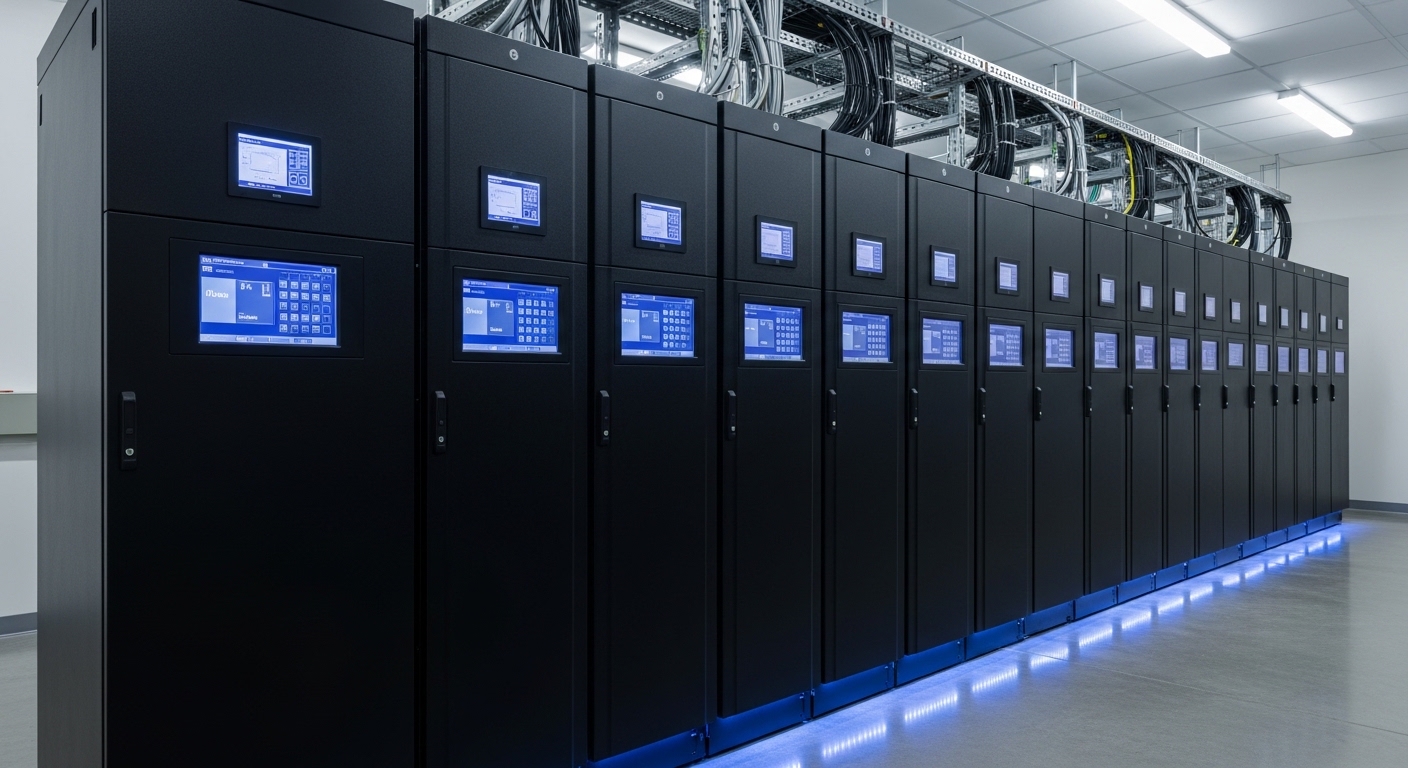
Industrial online UPS of double conversion for objects where shutdown is unacceptable — hospitals, production lines, data centers, telecommunications.
0 ms switching. Pure sine wave always. Compatibility of generator without synchronization.
Price per second without electricity
The Ukrainian power system has experienced unprecedented damage of 2022 years. Blackouts, voltage sags and unstable frequency have become the norm. For critical facilities, every millisecond without power is a threat to life and business.
Hospitals: a threat to life
Operating rooms, ventilators, resuscitation - even 20 ms without power resets the settings of critical equipment. A linear-interactive UPS has a switching time of 4-12 ms — this is unacceptable for medicine.
Production: destroyed batches
Extruders, pharmaceutical lines, chemical reactors — a stoppage for 0.5 seconds destroys tens of thousands of dollars worth of raw materials. Restarting the line takes an hour.
Data centers: data loss
Servers, DBMS, active network equipment - improper shutdown leads to damage to file systems, loss of transactions and breach of SLA to clients.
Online UPS: the real zero
Online UPS of double conversion is the only topology that provides TRUE ZERO transfer time. The load is always powered by the inverter and not directly by the grid.
0 ms switching
Double conversion: AC→DC→AC. The load is always on the inverter. Switchover Time is not required - the load simply does not notice the network failure.
Compatibility of generator
The generator emits a "dirty" frequency (47-53 Hz). Online UPS accepts it as an input and outputs a perfect sine wave of 50 Hz ± 0.1% at the output. No sync issues.
N+1 reservation
Modular architecture: up to 8 UPSs in parallel. Hot-swap modules 20/30/50 kVA — replacement without disconnecting the load. One module is always redundant.
Configuration of the Complex
Online UPS (modular)
60-600 kVA, double conversion
- • Modular architecture
- • Hot-swap modules 20/30/50 kVA
- • Efficiency up to 96% (ECO mode)
- • Incoming PF > 0.99
Lead batteries
VRLA AGM or GEL, 12V units
- • Resource 5-12 years (depending on the type)
- • Rack version 19" or rack
- • Autonomy from 10 minutes to 8 hours
- • Temperature charge compensation
Bypass and distribution
Static + manual bypass
- • Automatic static bypass
- • Manual service bypass (MBS)
- • Parallel operation of up to 8 UPS
- • Automatic ATS (option)
Monitoring
SNMP / Modbus / Cloud
- • SNMP v2/v3 card
- • Modbus RTU/TCP
- • Dry contacts (relay card)
- • SMS/Email alerts, Cloud dashboard
What is included in "Turnkey"?
- Examination of the electrical installation
- Calculation of autonomy (load x time)
- Design of the battery room (ventilation, thermostatic control)
- Delivery and rigging work
- Installation and commissioning
- Staff training and service contract
Why lead for industrial UPS?
The UPS works in standby mode: 99.9% of the time it is recharging, and only a few times a year it supplies energy. This is a fundamentally different usage profile than BESS for Peak Shaving.
| Parameter | Lead (VRLA AGM/GEL) | LiFePO4 |
|---|---|---|
| CAPEX ($/kWh) | $120-180 | $280-400 |
| Cyclic resource | 300-500 cycles | 3000-6000 cycles |
| The real load in the UPS | 5-20 cycles/year — the resource is enough | 5-20 cycles/year is a redundant resource |
| Service life (standby) | 5-12 years (GEL up to 15) | 15-20 years |
| BMS complexity | Not needed — simple charging | Mandatory, cell balancing |
| Compatibility of existing infrastructure | Full — standard 30+ years | May need a new charger |
| Weight / Area | Heavier, larger footprint | Lighter, more compact |
| Utilization | 99% recyclable, a developed network | More difficult disposal |
The conclusion of the engineering department
For UPS applications (low-cycle mode, long standby), lead VRLA batteries remain the optimal choice based on the cost/efficiency criterion. Lithium is appropriate only when the battery area of the room is limited or there is a need for an extremely long service life (15+ years). We design solutions for both types of batteries and help choose the best option.
Autonomy calculator
Approximate calculation of the number of battery blocks, room area and budget
Result
* Estimated calculation. Exact cost after inspection of the object and selection of the battery manufacturer. A discharge factor of 0.8 and a margin of 20% are taken into account.
Fields of application
Hospitals and medicine
Operating units, resuscitation and intensive care units, laboratory equipment, ventilators, tomographs, life support systems.
Production lines
Extrusion lines, pharmaceutical production, chemical reactors, food industry, glass production, printing.
Data centers and telecom
Server rooms, switching nodes, mobile communication base stations, active network equipment, data storage systems.
Critical infrastructure
Water canals and pumping stations, gas distribution points, airports and railways, security systems and video surveillance, control rooms.
Frequently Asked Questions
Useful materials
UPS for hospitals and critical infrastructure
DSTU standards, UPS topologies, autonomy calculation.
BESS for data centers
Why hyperscalers are switching to lithium BESSs instead of UPSs.
BESS against blackouts
Industrial backup power systems for business.
Microgrids for critical infrastructure
Autonomous microgrids for hospitals and water utilities.