GENERATE.
STORE. PROFIT.
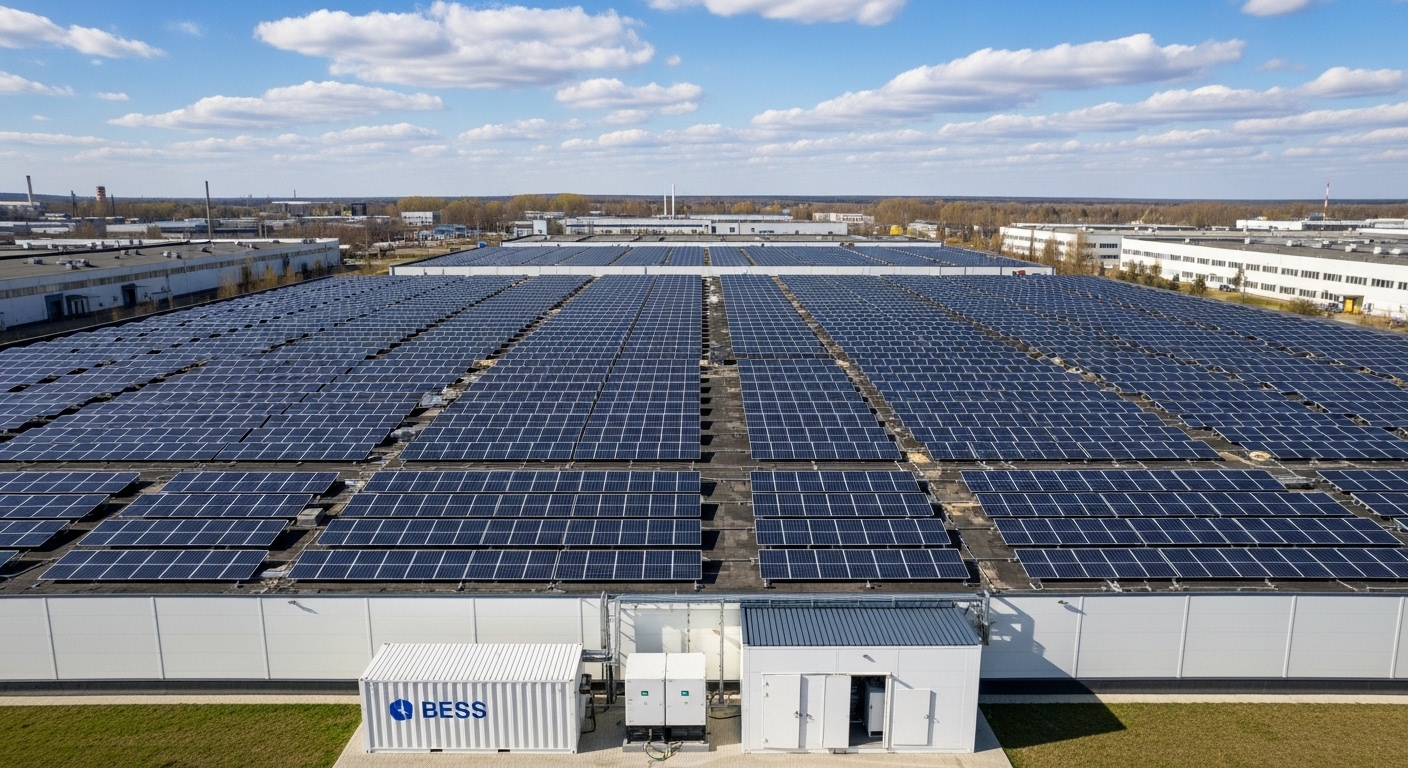
Industrial solar power plants from 100 kW to 5 MW of integrated BESS storage for maximum self-consumption and energy arbitrage.
Tier-1 TOPCon/HJT modules. LiFePO4 battery. AI-driven EMS platform.
Why businesses lose money
Electricity makes up 15-40% of the cost of industrial products. Tariffs are rising, the grid is unstable, and non-storage generation is only 30% used.
Increase in tariffs
Power bills for factories are increasing by 20-35% annually. Peak rates are 3 times higher than night rates. Every hour of downtime is worth thousands.
Network dependency
Blackouts and restrictions from DTEK/Oblenergo halt production lines. The diesel generator cannot cope with the continuous load.
Solar generation losses
A SES without storage uses only 25-35% of the generated energy. The rest goes to the network at a minimum price or simply merges.
Changes in the green tariff
The green tariff for new facilities is reduced. The bet on selling to the network no longer gives an acceptable ROI without self-consumption.
SES + BESS: Complete Energy Independence
The Solar + Storage hybrid system transforms solar energy from an unstable source into a manageable asset. Generate, store, use on the most profitable schedule.
80% self-consumption
BESS stores excess daytime generation and releases it during peak hours and at night. Self-consumption increases from 30% to 80%.
Peak Shaving in the afternoon
SES covers the base load, BESS cuts peaks. Savings on the power tariff up to 40% every month.
Energy for the night shift
The energy accumulated during the day feeds the night production. Complete independence from tariff peaks. Arbitration day/night.
ESG and balancing market
A green image for ESG reporting and participation in the balancing market as a prosumer. Additional income from flexibility services.
Configuration of the Complex
Solar Modules
TOPCon/HJT Tier-1 Bifacial
- • Longi, JA Solar, Trina Solar
- • Power 580-610 W per panel
- • Bifacial: +10-15% to generation
- • 30 years linear warranty
Network Inverters
Sungrow / Huawei from 100 kW
- • String or Central type
- • efficiency > 98.5%
- • MPPT trackers 6-12 pcs
- • Integration of EMS/SCADA
BESS Integration
LiFePO4 from 200 kWh
- • DC-coupled or AC-coupled
- • 6000+ cycles LFP Grade A+
- • Scaling up to 10 MW*h
- • Outdoor IP55 / Container
EMS Platform
AI-powered Energy Management
- • AI generation prediction
- • Maximization of self-consumption
- • Optimization of export to the network
- • 24/7 monitoring, mobile application
What is included in "Turnkey"?
- Insolation Assessment and PVSyst Modeling
- Obtaining TU and green tariff
- Designing structures and foundations
- Delivery and installation of equipment
- BESS connection and EMS setup
- Access to the green tariff and certification
SES without BESS vs SES + BESS
Comparing key metrics: why storage integration dramatically changes project economics.
SES without BESS
Standard networkSES + BESS
Hybrid SystemSES + BESS calculator
Preliminary calculation of capacity, generation and payback. The exact project — after the energy audit and simulation by PVSyst.
Object parameters
Preliminary calculation
Frequently Asked Questions
The typical payback of SES of integrated BESS is 3-4 years with self-consumption 80%. Without a storage device — 5-7 years. Key factors: electricity tariff, level of insolation (1100-1250 kWh/kW per year in Ukraine), and share of self-consumption. BESS allows you to use energy during peak hours, when the tariff is maximum, which significantly accelerates the return on investment.
Yes, legal entities can receive a green tariff for SPPs with a capacity of up to 150 kW (for rooftop facilities) or more, subject to participation in the auction. For capacities from 150 kW to 1 MW, the NCRECP auction mechanisms operate. At the same time, the strategy self-consumption + BESS often more profitable than pure sale to the network, because you save on the retail tariff, and not sell on the green.
For a land-based SPP with a capacity of 1 MW, approx 1.5-2 hectares territory On a flat roof - about 6000-8000 m² of usable area (taking into account the slope and passages). Modern modules of 580-610 W have a higher specific power, which allows you to place more kilowatts on the same area. BESS requires an additional 20-40 m² per container.
Yes, but there are nuances. Needed long-term lease agreement (minimum 10-15 years) of the right to install engineering systems. An alternative is the PPA model (Power Purchase Agreement), where the investor installs a CHP at your facility, and you buy electricity at a fixed price below the market price. The BESS container can be dismantled and moved to another facility.
BESS solves the main problem of solar generation — discrepancy between peak generation and peak consumption. Without storage, the SES generates a maximum at 12:00-2:00 p.m., and the enterprise also needs energy in the evening. BESS stores the surplus and gives it away when needed. In addition: peak shaving reduces the payment for power, arbitrage provides income from the difference in day/night tariffs, and backup power protects against blackouts. AI-EMS optimizes all flows automatically.
Useful materials
SES for business: real payback
Calculation of ROI for industrial SES 100 kW — 5 MW in Ukraine.
Hybrid: Sun + BESS + Diesel
Setting PMS priorities for maximum fuel economy.
Integration of BESS into the industrial network
6 stages of connection: from audit to launch.
Dry vs Oil transformer
Comparison of TCO and integration of BESS and SES.
Adjacent solutions
Megawatt Container
Container BESS for large-scale projects. Direct connection to 6-10-35 kV.
Arbitration and participation in the ancillary services market.
Transformers
Power and distribution transformers for SES and BESS integration.
KTP, SCHO, protection and switching systems.