
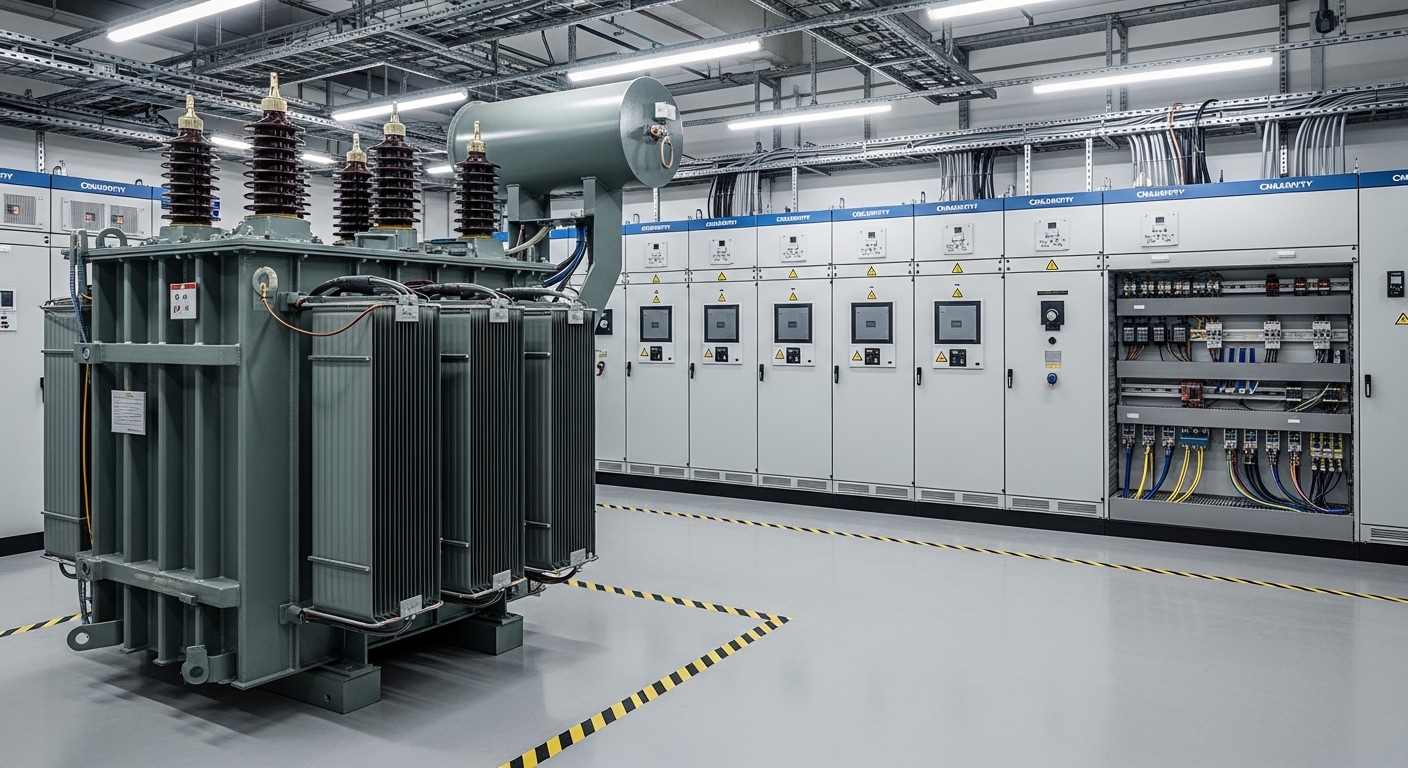
How to choose a transformer:
Dry vs oily for industry
The transformer is the heart of any industrial electrical system. The correct choice between dry and oil type depends not only on the reliability of the power supply, but also on the fire safety of the facility, maintenance costs and the possibility of integration of modern energy storage systems (BESS). For Ukrainian industrial enterprises, which work in conditions of an unstable network and frequent outages, this issue becomes critical.
How a transformer works: basic principles
A transformer is a static electrical device that converts an alternating current of one voltage into an alternating current of another voltage of the same frequency. The principle of operation is based on electromagnetic induction: an alternating current in the primary winding creates an alternating magnetic field in the core, which induces EMF in the secondary winding.
In industrial systems, transformers perform a key function: they reduce the voltage of the distribution network 6-10 kV to work 0.4 kV (380/220 V), which is used by the company's equipment. The reverse conversion is necessary when releasing excess energy from SES or BESS to the grid.
"The choice between a dry and oil transformer is not a matter of fashion or brand. It is an engineering decision determined by the conditions of the location, fire regulations and plans for the development of the facility for the next 25+ years." -- Chief engineer, BESS Ukraine.
Dry transformer: advantages and limitations
In a dry transformer, the insulation and cooling of the windings is provided by air or solid insulation (epoxy resin, cast compound). The windings are not immersed in liquid, which fundamentally changes the safety and maintenance characteristics.
Fire safety
Flammability class F1 (self-extinguishing). Does not contain flammable liquids. Placement inside buildings, on floors, next to production lines is allowed. Critical for shopping centers, hospitals, data centers.
Minimal maintenance
Does not require oil change, fluid level control, leak test. Maintenance is reduced to periodic cleaning of dust and checking of contact connections 1-2 times a year.
Environmental friendliness
The absence of transformer oil eliminates the risk of leakage and soil contamination. Does not require oil collection pits and fire barriers. Facilitates obtaining environmental permits.
Compactness
Smaller requirements for distances from walls and equipment. The possibility of installation in a limited space - basements, technical floors, container KTP. Ideal for modernization of existing objects.
Oil transformer: an industry classic
In an oil transformer, the windings and magnet wire are immersed in transformer oil, which simultaneously performs two functions: insulation and cooling. The oil removes heat from the windings, transferring it through the walls of the tank or radiators to the environment.
Lower cost
The price of an oil transformer is 30-50% lower than a dry one of similar capacity. For capacities from 1000 kVA and above, the difference becomes particularly noticeable -- tens of thousands of dollars.
Effective cooling
The oil provides better heat dissipation, which allows higher resistance to short-term overloads (up to 150% of the nominal value for 30 minutes). Critical for objects of sharply changing loads.
Great powers
Oil-type transformers are available in capacities up to 100+ MVA, while dry-type transformers are usually limited to 10-16 MVA. For large industrial facilities and 35/10 kV substations, the oil type is the only option.
Durability
With proper maintenance (regular oil change, PCB control, chromatographic analysis), an oil transformer can work for 30-40 years. A well-studied technology of predicted aging.
Comparison table: dry vs oily
A systematic comparison of key parameters for industrial transformers with a capacity of 250-2500 kVA:
| Parameter | Dry | Oily |
|---|---|---|
| Price (630 kVA) | $12 000 - $18 000 | $6 000 - $10 000 |
| Fire safety | Self-extinguishing (F1) | Flammable liquid |
| Placing | Inside buildings | Outside or special rooms |
| Service / year | $200 - $500 | $800 - $2 000 |
| Noise level | 45-55 dB | 35-45 dB |
| efficiency | 98.5 - 99.2% | 99.0 - 99.5% |
| Resistance to overloads | 120% up to 2 hours | 150% up to 30 minutes |
| Term of service | 25-30 years | 30-40 years |
| Integration of BESS | Simplified (in one room) | Requires separate accommodation |
| Environmental risk | Missing | Oil leak, PCB |
Total cost of ownership (TCO) for 10 years, 630 kVA
When calculating TCO, it is necessary to take into account not only the initial cost of the transformer, but also the costs of maintenance, construction and installation work, fire protection systems and oil disposal:
When to choose a dry transformer?
A dry transformer is the optimal choice in the following scenarios:
- Accommodation inside the building: Shopping centers, business centers, hospitals, data centers, underground parking lots. Wherever an oil-fired transformer is prohibited by fire regulations or impractical.
- Container KTP of BESS: When integrating the transformer of the energy storage system in one container, the dry type eliminates the risk of fire from oil leakage near the lithium-ion batteries.
- Objects of limited area: Smaller fire protection distances allow the transformer to be placed in tight technical premises.
- Food, pharmaceutical industry: No risk of product contamination with transformer oil.
- Facilities with minimal staff: Does not require qualified maintenance of the oil industry.
When to choose an oil transformer?
The oil transformer remains the best choice for:
- Large industrial enterprises: Capacities over 2,500 kVA, where the price difference is tens of thousands of dollars, and outdoor placement is not a problem.
- Rural area and agricultural sector: External placement, availability of space for oil collection pits, minimum noise requirements.
- Distribution substations 35/10 kV: A standard solution for network infrastructure. Technological maturity, availability of spare parts and service.
- Budget projects: When CAPEX is a critical factor and operating conditions permit outsourcing.
- Objects of sharply variable load: Foundries, welding shops, rolling mills - oil cooling better tolerates short-term overloads.
Integration of transformers of BESS
The energy storage system (BESS) is connected to the grid through a transformer, and the choice of transformer type directly affects the architecture of the entire energy node:
- Dry + BESS in one container: A compact solution for peak shaving and backup power. The transformer, inverter and batteries are housed in a single 20' or 40' container. The minimal footprint is ideal for urban facilities.
- Oil + separate BESS: Traditional scheme for large industrial facilities. Transformer on an open site, BESS in a separate container of its own air conditioning system. Requires additional cable routes.
- Two-transformer scheme: A separate transformer for the BESS (often dry 250-630kVA) and a main transformer for the load (oil). Provides independence and redundancy.
When designing a BESS of a transformer, it is critical to take into account transformation losses. Each transformer adds 0.5-1.5% losses. In a system of two transformers (mains + BESS), total losses can reach 2-3%, which reduces the overall efficiency of the storage system.
Frequently asked questions (FAQ)
How fast can you make a transformer?
Do you provide a warranty?
Conclusions of BESS Ukraine
For a modern industrial facility in Ukraine, the choice of a transformer should take into account not only the current needs, but also the perspective of the integration of BESS, SES and smart energy management systems. Our recommendations:
- For new objects of BESS: Dry transformer 400-1600 kVA. The higher initial price is offset by savings on construction and installation work, fire protection systems and maintenance.
- For the modernization of existing oil: Assess oil condition (chromatography) and remaining life. If the transformer is less than 15 years old -- leave the oil one, add the BESS separately.
- For projects with a limited budget: Oil transformer with the prospect of replacing it with a dry one during expansion. Design KTP with a reserve for future modernization.
Do you need help with the selection of a transformer and the design of a power plant? Click the button below or contact our AI assistant in the lower right corner of the screen.
Frequently Asked Questions about transformers and KTP
Can an oil transformer be installed inside a building?
What transformer power is required for a 200 kW BESS?
How much does a turnkey KTP of a transformer cost in Ukraine?
Is it necessary to replace the transformer when installing a SES or BESS?
Need a transformer?
Get a technical and commercial offer on the KTP of a transformer for your object in 24 hours.