Liquid Cooling vs Air Cooling for BESS:
What to choose for an industrial facility?
The temperature regime is the main factor that determines the actual service life of batteries in an industrial BESS. The difference between a properly cooled system and a system without proper thermal management is the difference between 15 years of trouble-free operation and replacing modules after only 5-7 years. In this article, we will take a detailed look at the two main approaches to BESS cooling: Air Cooling and Liquid Cooling, and help you determine which of them is optimal for your project.
Why is temperature critical for LFP batteries?
LiFePO4 cells have an operating range of -20 C .. +55 C, but the optimal temperature for maximum resource is a narrow corridor 15-35 C. Every degree above 35 C accelerates the chemical degradation of the cathode and electrolyte. According to the Arrhenius rule, an increase in operating temperature of 10 C cuts the life of the battery approximately in half.
But the problem is not only in the average temperature. The critical parameter is temperature gradient (deltaT) -- temperature difference between the hottest and coldest cell in the module. A large deltaT means that cells degrade at different rates, resulting in capacity imbalance, BMS overload, and premature failure of the weakest cells.
"We see this in real projects: a 500 kWh air cooling system in an unheated workshop loses 3-5% of its capacity per year due to uneven heating. A similar liquid cooling system is less than 1.5%. In 10 years, this is the difference between 70% and 85% of the remaining capacity." -- Chief Engineer, BESS Ukraine.
Air cooling: how it works
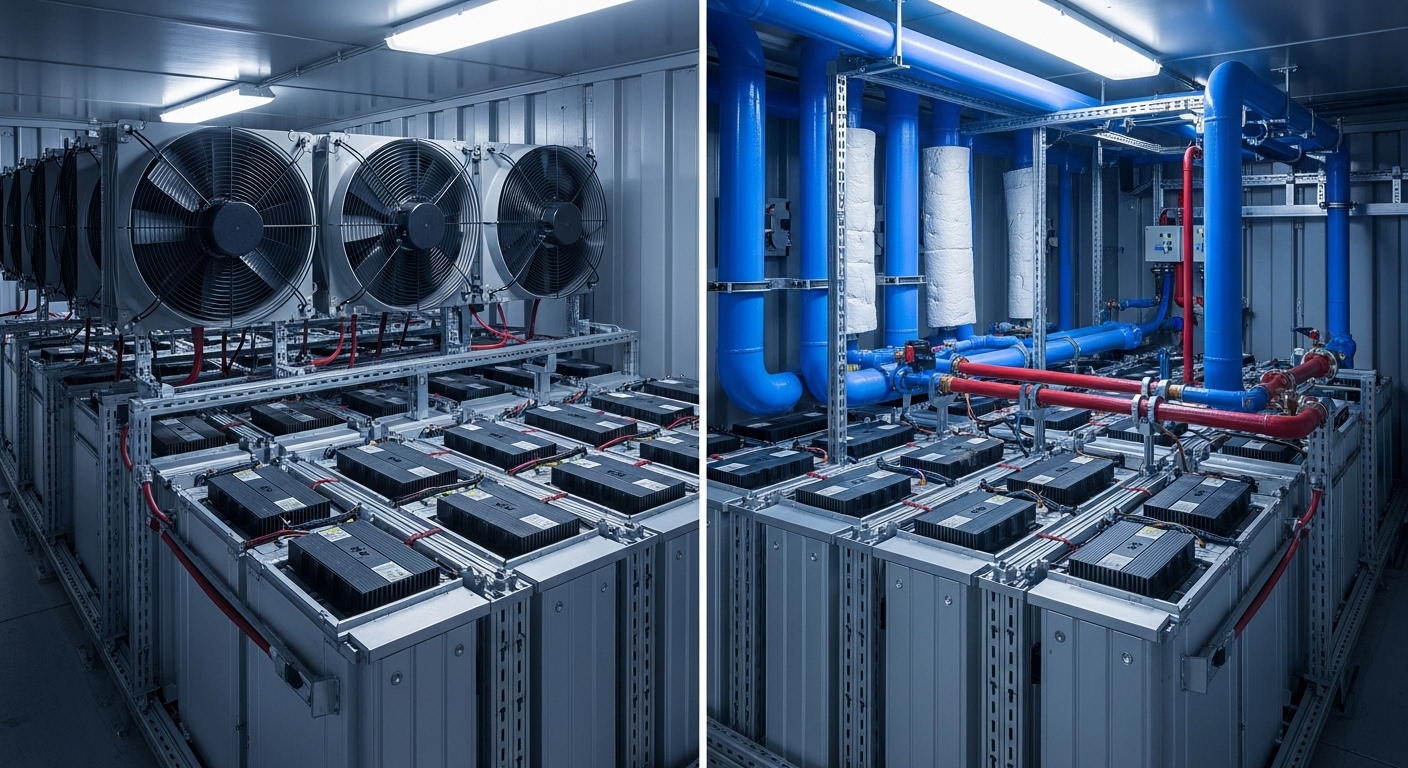
Air cooling is the simplest and cheapest method of BESS thermal management. The system uses forced air convection to remove heat from the battery modules. There are three main implementation options:
Direct air cooling (Direct Air)
The fans supply outside air directly to the battery modules. Air passes through channels between cells or modules, takes heat and is discharged outside. The simplest and cheapest design, but it completely depends on the temperature of the outside air. It is effective only in a moderate climate and at small capacities (up to 100 kW*h).
HVAC system (air conditioning)
Air in an enclosed space or container is circulated through an industrial air conditioner (split system or ducted HVAC). The temperature is maintained automatically regardless of external conditions. This is a standard solution for most indoor-BESS with a capacity of up to 200-300 kWh. Disadvantages: high HVAC consumption (3-8% of system capacity), noise, need for regular filter and compressor maintenance.
Indirect Air
A hybrid solution where external air is used to cool the heat exchanger, and the internal circuit of clean air circulates through the battery compartment. Protects batteries from dust and moisture. Used in some mid-range container solutions.
Liquid cooling (Liquid Cooling): how it works
Liquid cooling uses a coolant (usually a 50/50 mixture of water and propylene glycol) to remove heat directly from the surface of the battery modules. The system consists of several key components:
Cooling circuit
- Cold Plates: Aluminum or copper plates with internal channels for the coolant, which are installed between the cells or on the surface of the modules. Provide direct contact with the heat source.
- Circulation pump: It supplies the coolant through the circuit under a pressure of 1.5-3 bar. Consumption: 5-15 l/min for a typical 500 kWh system.
- Plate heat exchanger (PHE): Transfers the heat of the internal circuit (glycol) to the external circuit (chiller or dry cooler).
- Chiller (Chiller): Compressor refrigerating unit that removes heat to the environment. Industrial chillers with a capacity of 10-100 kW are used for large systems.
- Expansion tank and deaeration system: They compensate for the thermal expansion of the coolant and remove air from the circuit.
Advantages of liquid cooling
- Minimum deltaT: 5-8 C between cells versus 15-25 C with air. This is a key factor for longevity.
- Compactness: Liquid cooling takes up 30-50% less space than air ducts and HVAC.
- Silence: The noise level is 45-55 dB versus 60-75 dB in air systems.
- Efficiency: Cooling consumption is 1.5-2.5% of the capacity against 3-8% in air HVAC.
- Possibility of heating: The same circuit can be used to heat the batteries in winter (reversible chiller or electric heater in the circuit).
Comparison table: Air Cooling vs Liquid Cooling
| Parameter | Air Cooling | Liquid Cooling |
|---|---|---|
| Temperature uniformity (deltaT) | 15-25 C | 5-8 C |
| Impact on battery life | Basic (1x) | +25-35% resource |
| Noise level | 60-75 dB | 45-55 dB |
| Cooling consumption | 3-8% of capacity | 1.5-2.5% of capacity |
| Service | Simple (filters, fans) | More complex (heat carrier, pump, chiller) |
| CAPEX (in addition to BESS) | $5-15/kW*h | $15-30/kW*h |
| Dimensions (area) | Larger (air ducts) | More compact (-30-50%) |
| Optimal power | 30-200 kWh | 200+ kWh |
| Container BESS | Not recommended (>200 kWh) | Necessarily |
| Heating in winter | Separate heater | Integrated (reversible) |
Degradation of batteries at different temperature conditions
Below is a comparison of the capacity loss of LFP batteries over 10 years at different average operating temperatures. The data is based on laboratory tests and real projects:
Recommendations by type of project
The choice of cooling system depends on the capacity, location and budget of the project. Below are our recommendations for typical scenarios:
Indoor up to 200 kWh: Air Cooling
For systems in closed rooms with a controlled microclimate (server, technical rooms or air conditioning), air cooling is sufficient and economically justified. HVAC maintains 20-25 C year round. Savings on CAPEX: $10-15/kWh.
Outdoor 500+ kWh: Liquid Cooling
For systems outdoors or in unheated shops, liquid cooling is mandatory. Outdoor temperatures from -25 C to +40 C in Ukraine make air cooling ineffective. The liquid provides a stable deltaT of 5-8 C and the possibility of heating in winter.
Containerized BESS: Liquid Cooling is a must
In a 20/40-foot container with an energy capacity of 2-5 MW*h, the heat release is so intense that air cooling cannot physically cope. All leading manufacturers (CATL EnerOne, BYD MC Cube, Sungrow PowerTitan) use exclusively liquid cooling.
Peculiarities of the Ukrainian climate
Ukraine has a continental climate with a wide range of temperatures, which creates specific challenges for BESS cooling systems:
- Summer (June-August): The temperature is up to +38-40 C in the southern and central regions. Air cooling is limited or inefficient. The liquid chiller ensures a stable battery temperature.
- Winter (December-February): The temperature is up to -25-30 C in the north and east. Batteries need to be heated to a minimum of +5 C before charging. Liquid cooling with a reversible chiller or heater in the circuit solves both tasks with one circuit.
- Transitional seasons: Sharp temperature drops (up to 25 C per day) in spring and autumn. Liquid cooling reacts much faster and more precisely than air cooling.
- Dust and humidity: The industrial environment (cement plants, metallurgy, grain processing) has a high level of dust. Air cooling of direct air intake is clogged within 2-3 months. Liquid - a hermetic circuit, independent of the external environment.
Cost and payback of Liquid Cooling
Liquid cooling is more expensive at the CAPEX stage, but pays for itself by extending battery life and reducing operational costs:
- Additional CAPEX: $15-30/kWh ($15,000-$30,000 extra for a 1 MWh system).
- Savings on battery replacement: +30% resource means delaying the replacement of modules for 4-5 years. At a battery cost of $60-80/kWh for a 1 MWh system, that's $60,000-$80,000 in savings.
- Savings on electricity: 1.5-2% consumption for cooling instead of 5-8%. For a 1 MW*h system at a tariff of UAH 4/kW*h, this is a saving of ~$3,000-5,000/year.
- Liquid cooling ROI: Additional investments pay off in 2-4 years, then net savings.
Conclusions of BESS Ukraine
Choosing a cooling system is not a question of "better or worse", but a question of compliance with the scale and conditions of your project:
- Air Cooling: Optimal for small indoor systems up to 200 kWh in rooms with a controlled microclimate. Simplicity, low CAPEX, minimal maintenance.
- Liquid Cooling: A must for systems over 500 kWh, container BESS, outdoor installations and any projects with increased resource and reliability requirements.
- For the Ukrainian climate: Liquid cooling with a heating function is an investment that pays for itself in 2-4 years due to the extension of battery life by 30% and reduction of OPEX.
Need help choosing a cooling system? Our engineers will conduct a thermal analysis of your object and offer the optimal solution.
Frequently Asked Questions about BESS cooling
Can an existing Air Cooling BESS be upgraded to Liquid Cooling?
What liquid is used to cool batteries?
How much electricity does the BESS cooling system use?
Is cooling required for small BESS (30-50 kWh)?
Thermal analysis of the object
Get a cooling system recommendation for your BESS project. Free preliminary analysis in 24 hours.