Battery LFP 2026: CATL vs BYD vs EVE Energy
What to choose for an industrial BESS?
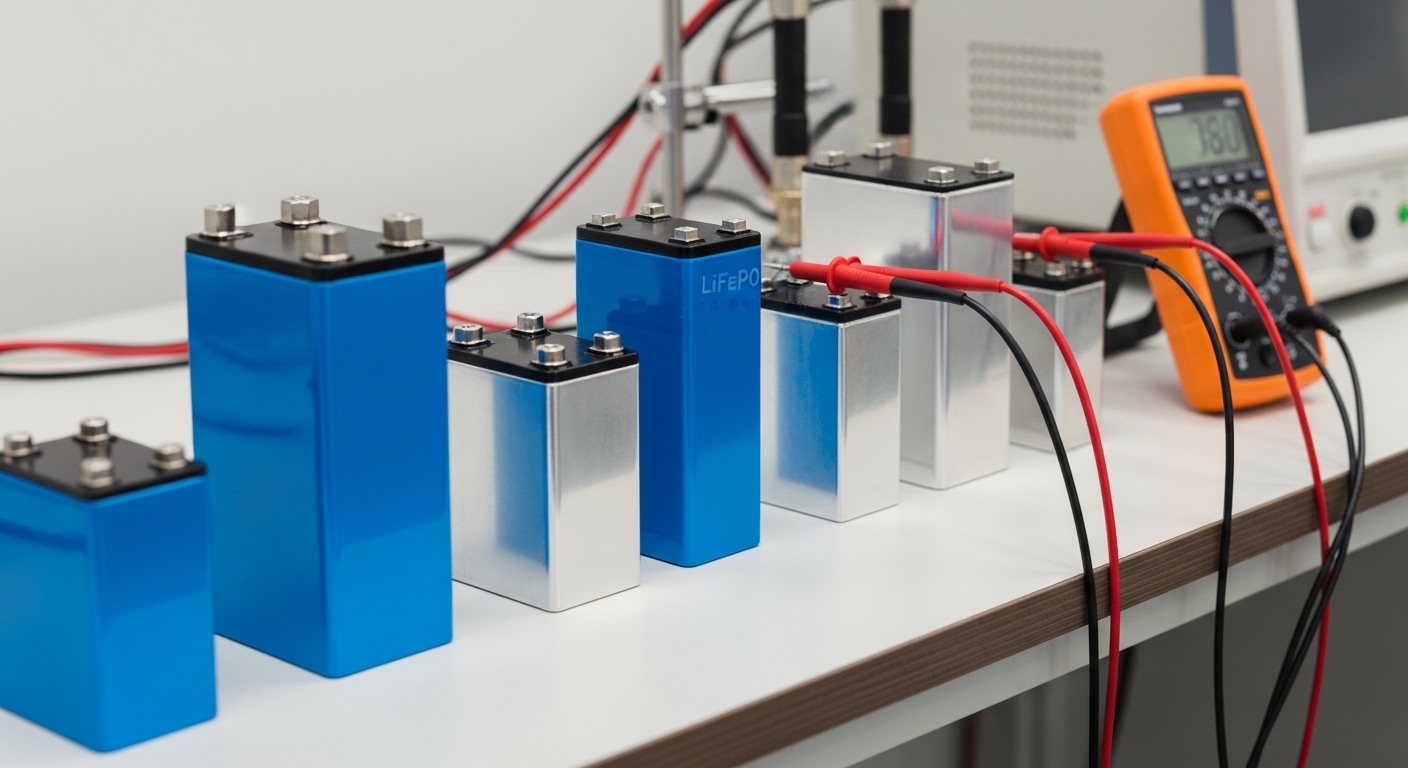
Lithium Iron Phosphate (LiFePO4) or (LiFePO4 / LFP) cells have become the absolute standard for industrial energy storage systems. But the market of 2026 years offers dozens of brands and hundreds of models. Three giants -- CATL, BYD and EVE Energy -- control more than 70% of the world production of LFP cells for stationary BESS. Which manufacturer to choose? How are their cells different? And most importantly, how not to fall for a fake or B-grade? Let's understand in detail.
Why LFP for industrial BESS?
Before comparing manufacturers, it is worth understanding why it is LiFePO4 chemistry that dominates stationary energy storage. Unlike NMC (nickel-manganese-cobalt), which is mainly used in electric vehicles due to its higher specific energy, LFP offers a unique combination of characteristics for industrial applications:
- Security: LFP does not enter the state of thermal runaway (thermal runaway) even in case of mechanical damage. The temperature of the beginning of the decomposition of the cathode is 270 C versus 210 C in NMC.
- Resource: 6,000 -- 10,000 cycles to 80% residual capacity at DoD 80%. This is 15-25 years of work with a daily cycle.
- Voltage stability: The LFP discharge voltage board is extremely flat (3.2-3.3V during 90% capacity), which simplifies inverter operation and increases efficiency.
- Price: In 2026, the cost of LFP cells reached $60-80/kWh -- the lowest price among all lithium-ion chemistries.
- Environmental friendliness: The absence of cobalt and nickel makes LFP more ethical and easier to recycle.
"For industrial BESS in Ukraine, LFP is the only reasonable choice in 2026. The question is not in chemistry, but in the manufacturer. The difference between an A-grade CATL cell and a B-grade of an unknown brand is the difference between 15 years of trouble-free operation and problems already in the third year." -- Chief Engineer, BESS Ukraine.
CATL: The world leader of the greatest experience
Contemporary Amperex Technology Co., Limited (CATL) -- the largest manufacturer of battery cells in the world with a market share of over 37% (2025). Headquarters -- Ningde, Fujian Province, China. Founded in 2011, CATL went public in 2018 and since then has been expanding production capacity at a rate of 50-80% per year.
CATL 280Ah Prismatic Cell
The flagship cell for stationary BESS is a prismatic LFP 3.2V / 280Ah (896 W*h). This is the industry standard around which most modules and river systems are built. Dimensions: 173.4 x 71.4 x 204 mm. Weight: ~5.7 kg. Operating temperature: -20 C .. +55 C. Resource: 6,000+ cycles at 0.5C / 80% DoD to 80% SOH.
CATL also offers ready-made modular solutions for BESS:
- EnerOne: 5.3 MW*h module in a 20-foot container. Liquid cooling, integrated BMS, IP55. Designed for utility-scale projects.
- EnerC: Compact rack module for the C&I (commercial & industrial) segment. From 100 kWh.
Advantages of CATL
- Scale of production: More than 400 GWh per year - the largest production capacity in the world. This ensures stable quality and minimal spread of parameters between cells.
- R&D budget: $3.5 billion per year (2025). CATL invests more than any other manufacturer in new technologies, including Na-Ion and solid state batteries.
- Global presence: Factories in China, Germany (Erfurt), Hungary. Service network in 50+ countries.
- Guarantee: 10 years or 6,000 cycles for industrial cells (subject to compliance with operating parameters).
BYD: Vertical Integration and Blade Battery
Build Your Dreams (BYD) -- the second largest producer of batteries in the world and at the same time the largest producer of electric vehicles. BYD is the only company that controls the entire chain from lithium extraction to the finished car. For BESS, this means optimization at a level not available to other manufacturers.
BYD Blade Battery
Revolutionary CTP (Cell-to-Pack) technology, where a long thin prismatic cell (960 mm x 90 mm x 13.5 mm) is at the same time a structural element of the module. Blade Battery passed the famous "Nail Penetration Test" - when pierced with a nail, the cell did not catch fire and did not explode, unlike NMC. This has made BYD synonymous with safety in LFP.
For stationary BESS BYD offers:
- MC Cube: Container solution based on Blade Battery. 20-foot container, 2.8 MWh, liquid cooling, IP55. Optimized for peak shaving and energy arbitrage.
- BYD Battery-Box Premium: Rack system for C&I segment. Modules of 2.56 kWh, scaling up to 983 kWh.
Advantages of BYD
- Blade Battery technology: Higher volumetric energy density due to CTP design. 50% less empty space in the module compared to the traditional approach.
- Vertical integration: BYD produces everything from cathode material to finished BESS. This reduces dependence on external suppliers and price volatility.
- Nail Penetration Test: Blade Battery is the only LFP cell that consistently passes the puncture test without igniting. This is critical for the insurance of industrial facilities.
- Guarantee: Up to 15 years on the MC Cube system.
EVE Energy: An aggressive contender for the best price
EVE Energy Co., Ltd. -- the third largest LFP cell manufacturer in China, established in 2001 in Huizhou, Guangdong Province. EVE is rapidly increasing its market share thanks to its aggressive pricing policy and high product quality. In 2025, EVE entered the top 5 global producers of batteries for stationary storage.
EVE LF280K and LF304
LF280K -- direct competitor of CATL 280Ah. Prismatic LFP 3.2V / 280Ah. Dimensions: 174 x 72 x 204 mm (virtually identical to CATL, which ensures compatibility with most modular solutions). Resource: 6,000+ cycles. Weight: ~5.6 kg. The key difference is the price is 10-15% lower than CATL with comparable quality.
LF304 -- new generation 2025 years of with a capacity of 304 Ah (973 W*h). Increased energy capacity at the same dimensions due to optimized cathode material and a thinner separator. Resource: 8,000+ cycles in laboratory conditions.
Benefits of EVE Energy
- Price: 10-15% lower than CATL and BYD with comparable characteristics. For a 1 MW*h project, this is a savings of $6,000 - $12,000.
- Compatibility: The LF280K has dimensions identical to the CATL 280Ah, allowing the use of existing modular solutions and racks without modification.
- New generation LF304: 304 Ah in the same form factor is +8.5% capacity without changing the infrastructure.
- Guarantee: 10 years per cell, UL, IEC, UN38.3 certification.
Detailed comparison: CATL vs BYD vs EVE Energy
Below is a full comparison of the three manufacturers' cell key features for industrial BESS:
| Characteristic | CATL 280Ah | BYD Blade | EVE LF280K |
|---|---|---|---|
| Nominal capacity | 280 Ah | 138 Ah (Blade) | 280 Ah |
| Nominal voltage | 3.2 V | 3.2 V | 3.2 V |
| Cell energy | 896 W*h | 442 W*h | 896 W*h |
| Specific energy (W*h/kg) | 157 | 166 (CTP) | 160 |
| Resource (cycles up to 80% SOH) | 6 000+ | 8 000+ | 6 000+ |
| Price ($/kWh, 2026) | $70-80 | $75-85 | $60-70 |
| Quality grade | A+ (stable) | A+ (only 1st tier) | A / A+ (depends on batch) |
| Guarantee | 10 years | Up to 15 years | 10 years |
| Working temperature | -20 C .. +55 C | -20 C .. +55 C | -20 C .. +55 C |
| Nail Penetration Test | Passes (no burning) | Reference result | Passes (no burning) |
| Certification | UL, IEC, UN38.3, CE | UL, IEC, UN38.3, CE | UL, IEC, UN38.3, CE |
Cycle resource: comparison of manufacturers
Price per kWh (2026, USD)
Strengths of each manufacturer
CATL: Reliability and scale
The largest producer in the world. Maximum consistency of quality between batches. The widest service network. An ideal choice for large projects (500+ kWh) where reliability and long-term support are critical.
BYD: Safety and innovation
Blade Battery is the safest LFP cell in the world. CTP design gives better volume energy capacity. Vertical integration. The best choice for facilities with increased requirements for fire safety and insurance.
EVE Energy: Price and compatibility
The best price among the top 3 manufacturers. Full compatibility of CATL format. New generation LF304 of increased capacity. The optimal choice for budget-oriented projects without compromising on quality.
How to check cell grade: A+ vs B-grade
One of the biggest risks when buying LFP cells is getting B-grade or even C-grade products that are sold at the price of A-grade. This is a common problem, especially when purchasing through intermediaries. Here's how to distinguish a quality cell from a fake:
What are graded cells?
- A+ Grade (1st tier): Cells that have passed a full cycle of quality control at the manufacturer's factory. The spread of capacity between cells in a batch is less than 1%. Internal resistance (IR) is minimal and uniform. The manufacturer's warranty is valid.
- A Grade: Cells of with a slight spread of parameters (1-3%). They can be of the "second line" of the manufacturer or from a subcontractor. Usually fully functional, but with a smaller guaranteed resource.
- B Grade: Rejection of the manufacturer or cell of with a noticeable spread (3-10%). May have a reduced resource, increased self-discharge or other deviations. The manufacturer's warranty is NOT valid.
- C Grade / Refurbished: Used cells of dismantled modules or electric cars. The residual resource is unknown. It is strictly not recommended to use in industrial BESS.
Verification methods
- QR code on the cell: Each CATL, BYD and EVE A-grade cell has a unique QR code that can be verified on the manufacturer's website or through its official distributor.
- IR (internal resistance) testing: Measure the internal resistance of each cell. For A-grade CATL 280Ah IR should be less than 0.25 mOhm, the variance in the batch is less than 5%.
- Capacitive test: Full charge/discharge cycle at 0.5C. The actual capacity must be at least 98% of the nominal capacity for A-grade.
- Documentation: Request a Certificate of Analysis (CoA) from the manufacturer of each cell's serial numbers, date of manufacture and results of incoming inspection.
Supply chain and logistics to Ukraine
Delivery of LFP cells from China to Ukraine is a complex logistics process that requires compliance with international standards for the transportation of dangerous goods (UN38.3, IATA DGR). Main routes:
- Marine (main): Shenzhen/Ningbo Port -> Odesa/Chornomorsk. Term: 35-45 days. Cost: $2,000 - $4,000 for a 20-foot container. Optimal for large batches (10+ tons).
- Railway: China -> Kazakhstan -> Russia -> Belarus -> Poland -> Ukraine. Due to sanctions restrictions, the route is complicated. Alternative: China -> Kazakhstan -> Georgia -> Ukraine. Term: 20-30 days.
- Air (urgent): Shenzhen -> Boryspil Term: 3-5 days. The cost is 5-8 times higher than the sea price. Only for samples or rush orders.
Customs clearance: LFP cells are classified as dangerous goods of class 9 (UN3481). Required documents: UN38.3 Test Summary, MSDS (Material Safety Data Sheet), Certificate of Origin, Invoice, Packing List. Duty: 0% (UKKTZED rate for lithium-ion batteries). VAT: 20%.
Conclusions of BESS Ukraine
All three manufacturers -- CATL, BYD and EVE Energy -- offer reliable industrial-grade LFP cells. The choice depends on the priorities of your project:
- Maximum reliability and support: CATL 280Ah. Time-tested standard, the widest service network, minimal risk.
- Safety and innovation: BYD Blade Battery. The best choice for facilities with increased requirements for fire safety (shopping centers, warehouses, factories).
- Optimal price without compromising on quality: EVE Energy LF280K/LF304. Ideal for large-scale budget-oriented projects.
Need help choosing cells for your project? Our engineers will analyze the requirements and offer the optimal solution, taking into account the budget, capacity and operating conditions.
Frequently Asked Questions about LFP cells
Which cell to choose for a BESS with a capacity of 100-500 kWh?
Is it possible to mix cells from different manufacturers in one module?
How to distinguish an original CATL cell from a fake?
How much does a turnkey BESS system on CATL/BYD/EVE cells cost in 2026?
Need LFP cells?
Get a comparative quote on CATL, BYD or EVE Energy cells for your project in 24 hours.