SES for Business 2026:
Real payback of industrial solar plants
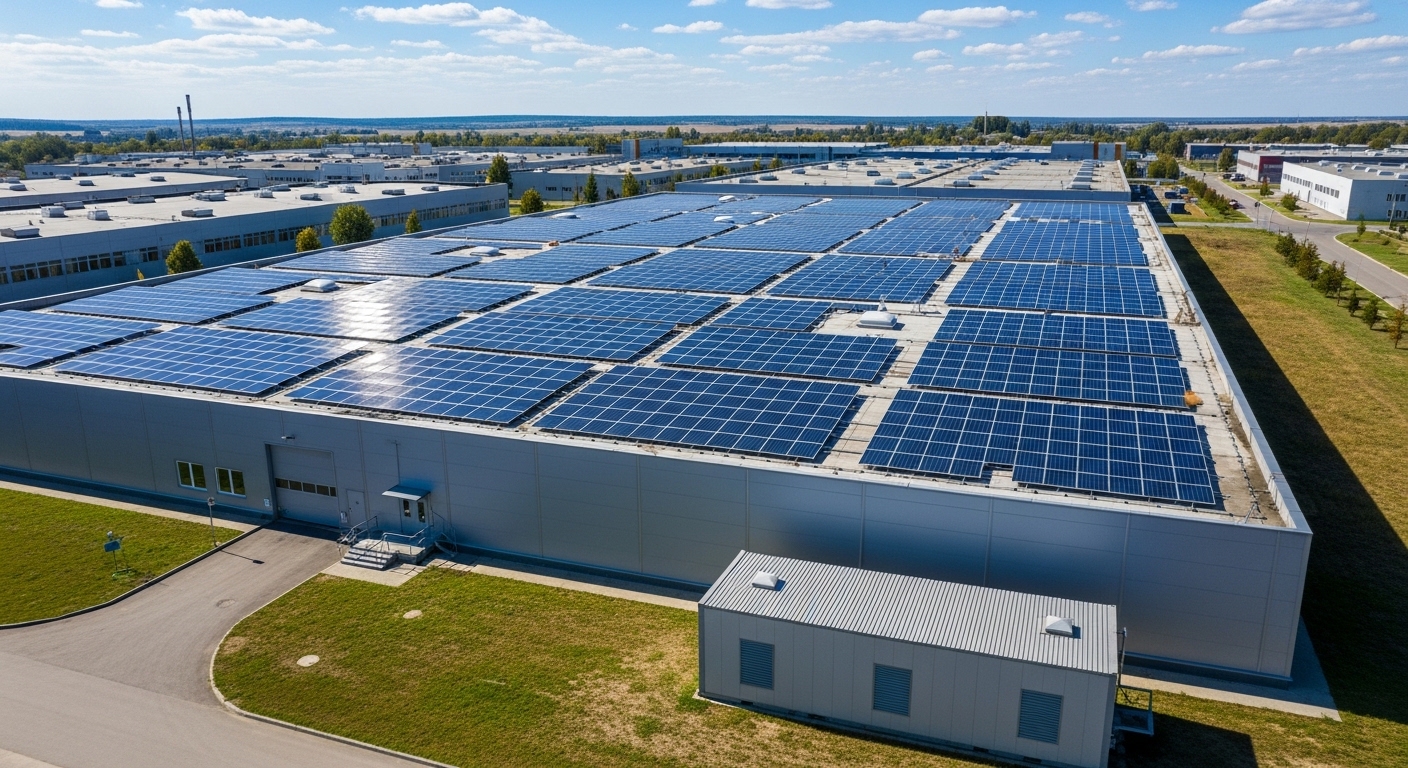
An industrial solar power plant (SPP) in 2026 is not just a "green" initiative, but a full-fledged investment tool with predictable profitability. For Ukrainian businesses, faced with electricity tariffs of 5 to 8 hryvnias/kWh and systematic outages, own generation becomes a matter not of ecology, but of survival. In this article, we will analyze the real payback figures of 100 kW - 5 MW industrial SES and show how the integration of BESS can increase ROI by 30-60%.
The state of the green tariff in Ukraine in 2026
The green tariff (feed-in tariff) is a state-guaranteed price at which the energy company is obliged to purchase electricity produced from renewable sources. In Ukraine, the green tariff is valid until 2030 years according to the Law "On Alternative Energy Sources".
As of 2026, the situation with the green tariff for industrial SPPs is as follows:
- Rate for SES introduced after 01.01.2025: The green tariff for land-based SPPs is approximately 0.12-0.14 EUR/kWh (taking into account correction factors). For roofers - 10-15% higher.
- Debt Challenge & Problem Statement: The accumulated debt of SE "Guaranteed Buyer" remains a key risk. Payments occur with a delay of 3-9 months, which significantly affects the cashflow and real IRR of the project.
- Auction system: There is an auction system for determining the green tariff for new SPPs with a capacity of more than 1 MW. Winning rates in 2025-2026 are 0.08-0.11 EUR/kWh, which is lower than the fixed green tariff.
- The trend towards self-consumption: Growing retail tariffs (5-8 hryvnias/kWh for businesses) make the self-consumption model much more attractive than selling at a green tariff.
"In 2026, we see a clear paradigm shift: industrial SPPs are not built for the sake of a green tariff, but for the sake of self-consumption savings. BESS adds another level to this model - storage of daytime generation for the evening peak, when the tariff is maximum." -- Financial Director, BESS Ukraine.
Self-consumption vs Feed-in: which is more profitable?
There are two basic approaches to the monetization of industrial SES: self-consumption and sale of electricity at a green tariff (feed-in). For Ukrainian business in 2026, the math is clearly on the side of self-consumption:
- Self-consumption: Each kWh consumed by the enterprise instead of purchased electricity "costs" as much as the enterprise pays for grid electricity -- 5-8 UAH/kWh (~0.12-0.19 EUR). This is immediate savings without intermediaries and payment delays.
- Feed-in (green tariff): Sale for 0.08-0.14 EUR/kW*h of the risk of payment delay for 3-9 months. The actual yield, taking into account the time value of money, is 20-40% lower than the nominal value.
- Hybrid model: The best option is to maximize self-consumption during working hours (8:00-18:00) and sell surpluses at a green tariff. The share of self-consumption for typical production is 60-85%.
Monetization efficiency (SES 1 MW)
BESS + SES: synergy that changes the economy
The integration of the energy storage system (BESS) of industrial SES opens fundamentally new opportunities for monetization of solar generation:
- Storage of daytime generation for the evening peak: SES generates maximum energy from 10:00 to 15:00, when the tariff is minimum. BESS accumulates surpluses and gives them in the evening peak (18:00-22:00), when the tariff is maximum. The difference in tariffs is 30-60%.
- Increasing the share of self-consumption to 90-95%: Without BESS, the enterprise consumes only 60-70% of SES generation (the rest goes to the network at a low tariff). With BESS - up to 95%, which maximizes savings.
- Backup Power Reliability: The BESS, charged from the SES, ensures autonomous operation of critical equipment during blackouts. For Ukrainian business, this is not just a convenience - it is the preservation of production.
- Peak shaving: Reducing peak loads on the network allows you to reduce connection capacity and corresponding payments. Savings -- 15-25% of the cost of electricity.
Comparison of ROI scenarios: 500 kW SPP for production
Below is a comparison of the payback of an industrial SES of 500 kW for a typical industrial enterprise with a consumption of 800 MW*h/year under different business models:
Annual income/savings according to the scenarios, SES 500 kW ($ thousand)
Comparison of business models of industrial SES
| Parameter | Green tariff | Self-consumption | Self + BESS |
|---|---|---|---|
| CAPEX (500 kW) | $200 000 - $250 000 | $200 000 - $250 000 | $320 000 - $400 000 |
| Payback period | 7-9 years | 4-5 years | 2.5-3.5 years |
| IRR (internal rate of return) | 8-12% | 18-25% | 25-35% |
| Share of self-consumption | 0% (all to network) | 60-70% | 90-95% |
| Risk of non-payment | High (SE "GP") | Missing | Missing |
| Backup Power Reliability | No | No | Yes (4-8 hours) |
| Peak shaving | No | Part | Yes |
| Profit for 25 years | $550 000 - $700 000 | $1 100 000 - $1 300 000 | $1 600 000 - $2 000 000 |
Capacity ranges: what to choose for your business?
The choice of the capacity of an industrial SES depends on the volume of consumption, available space, budget and business goals. Below are the characteristics of the main ranges:
100 kW: Small business
Roof area: ~600 m2. CAPEX: $40,000-60,000. Generation: ~120 MWh/year. Ideal for: shops, offices, small warehouses. Payback period for self-consumption: 3-4 years. BESS 50 kWh adds +$15,000 to CAPEX, but provides redundancy and peak shaving.
500 kW: Average production
Area: ~3000 m2 (roof or ground). CAPEX: $200,000-250,000. Generation: ~600 MWh/year. Optimal for: food enterprises, logistics centers, metal processing. BESS 200 kWh is a key element to maximize ROI. Payback Period of BESS: 2.5-3.5 years.
1 MW+: Big business
Area: 6000+ m2. CAPEX: $400,000-500,000+. Generation: 1200+ MWh/year. For: factories, agricultural holdings, industrial parks. It requires its own KTP and the agreement of the network operator. BESS 500+ kWh opens up opportunities for energy arbitrage and participation in the balancing market.
Key ROI factors for industrial SES
The Payback Period of an industrial solar power plant depends on many factors. Here are the most important of them for Ukrainian realities:
- Electricity tariff: The higher the tariff, the faster the payback. At a tariff of 7-8 UAH/kWh, the payback of the SES of BESS can be less than 3 years. At 4-5 hryvnias/kWh -- 4-5 years.
- Insolation level: Ukraine has a significant difference in insolation between regions. Southern regions (Odesa, Kherson, Mykolaiv) -- 1300-1400 kWh/m2/year. Center (Kyiv, Vinnytsia) -- 1100-1200. West (Lviv) -- 1000-1100. The difference in generation is up to 30%.
- Load profile: Enterprises with high consumption during daytime hours (8:00-17:00) have the highest share of self-consumption (80-90%) even without BESS. For enterprises of night shifts, BESS becomes mandatory to maximize ROI.
- Equipment price: The cost of solar panels in 2026 reached a historic low -- $0.15-0.22/W for Tier-1 single crystal. Inverters -- $0.04-0.08/W. Total turnkey CAPEX -- $0.40-0.55/W.
- Degradation of panels: Modern monocrystalline panels guarantee no more than 0.4-0.5% degradation per year. In 25 years - preservation of 87-90% of the initial capacity.
Conclusions of BESS Ukraine
Industrial SES in 2026 is a mature and predictable investment tool of IRR 18-35% depending on the business model. For Ukrainian enterprises that pay 5-8 hryvnias/kWh and face blackouts, investment in SES + BESS is one of the most effective solutions from the point of view of both economy and energy security. Our recommendations:
- Priority -- self-consumption: Design a SES for 70-80% coverage of your own daily consumption. The green tariff is only a bonus for surpluses.
- BESS is a mandatory element: Even a small BESS (2-4 hours of capacity) increases ROI by 30-60% due to peak shaving, tariff arbitrage and backup power.
- Phased implementation: Start of SES, add BESS after 6-12 months. This allows you to allocate CAPEX and verify the load profile before choosing the optimal BESS capacity.
Would you like to receive an individual calculation of the payback of SES + BESS for your company? Click the button below or contact our AI assistant in the lower right corner of the screen.
Frequently Asked Questions about industrial SES and BESS
Is SES profitable without a green tariff?
What is the optimal BESS size for a 500 kW SPP?
How much does a turnkey industrial SPP cost in 2026?
Does SES + BESS work during blackouts?
Calculate the payback of SES
Get an individual financial calculation of industrial SES + BESS for your facility in 24 hours.