
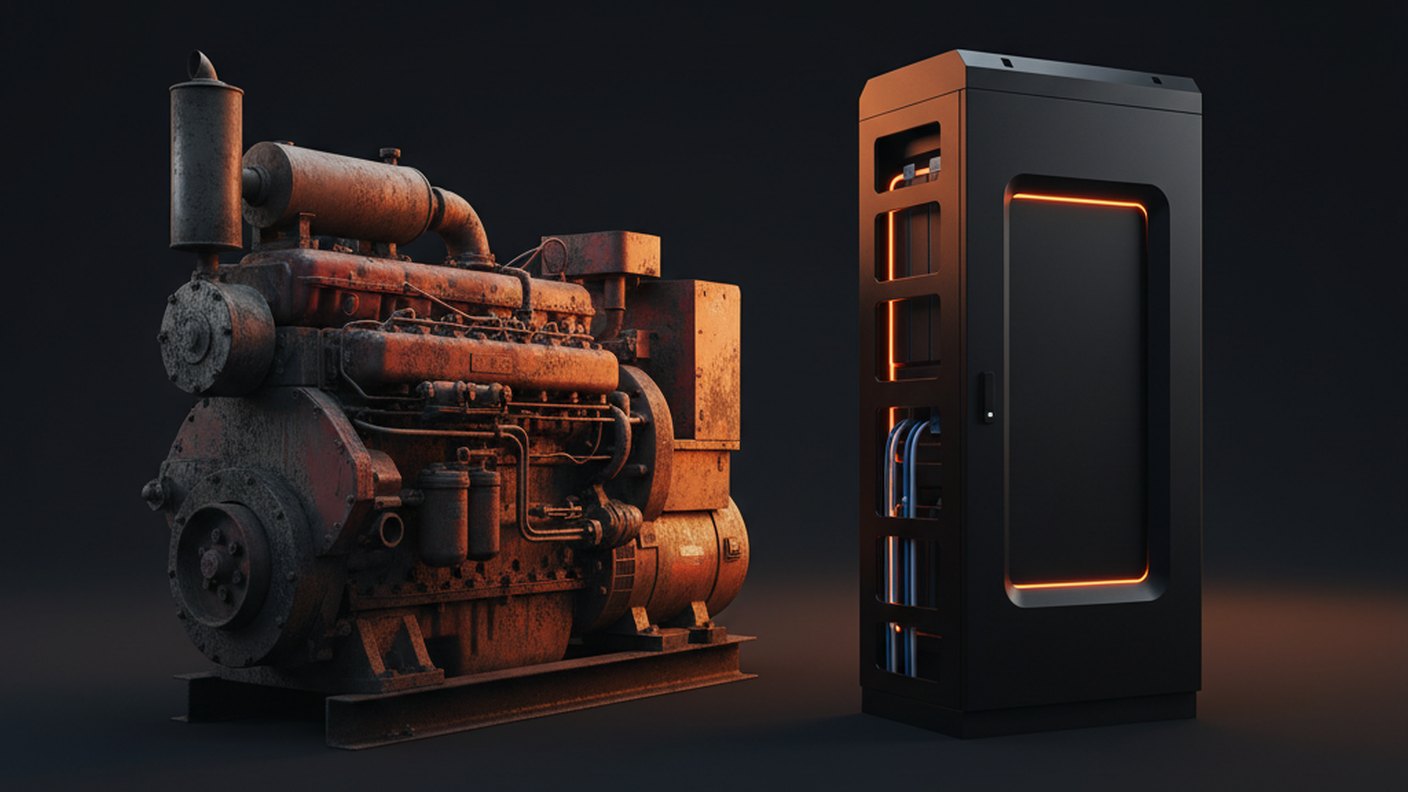
BESS vs diesel generator:
full TCO analysis 2026
A diesel generator has been synonymous with backup power for decades. It is cheaper at the start, familiar and "just works". But if you calculate not the purchase price, but the total cost of ownership (TCO) for 10 years - fuel, maintenance, resources, downtime, environmental restrictions - the picture changes radically. Approximately, diesel generation costs about UAH 28/kWh versus ~ UAH 10/kWh for BESS. In this material, there is an honest TCO analysis of 2026 without marketing: where diesel is still justified, and where BESS wins by a landslide.
"Diesel is cheap while it's sitting in the corner. As soon as it starts working, the fuel, engine-hour, and emissions meter turns the "cheap" solution into the most expensive kilowatt on the site." — Lead Engineer, BESS Ukraine.
Why the purchase price is misleading
Comparing diesel and BESS based on the price of equipment is like choosing a car based only on the price tag, ignoring fuel consumption and repairs. TCO (Total Cost of Ownership) takes into account all costs over the entire service life. For standby power, the key TCO components are diametrically different for diesel and BESS.
Fuel
Home diesel consumption article. Each engine hour burns fuel at the market price. In BESS, the "fuel" is cheap nighttime or solar power.
Service
Diesel engine requires regular maintenance, replacement of oil, filters, engine resource. BESS — minimal maintenance and remote monitoring.
Resource
Diesel engine resource is limited by engine hours. LiFePO4 — 6000–8000 cycles, 15+ years.
Simple vs income
Diesel idles 99% of the time as pure consumption. BESS earns daily from arbitrage and Peak Shaving.
Full TCO for 10 years: components
| Parameter | Diesel generator | Li-BESS (LiFePO4) |
|---|---|---|
| CAPEX (start) | Lower | Higher |
| The cost of kWh | ~28 hryvnias/kWh | ~10 hryvnias/kWh |
| Fuel | Constant consumption | Cheap network / SES |
| Service | Regular maintenance, engine life | Minimal |
| Switch time | 10–30 s (launch) | < 10 ms (online) |
| Daily income | None (reserve only) | Arbitration + Peak Shaving |
| Noise / emissions | High, need a platform | 0 dB, 0 emissions |
| Resource | Limited to engine hours | 6000–8000 cycles, 15+ years |
Cost per kilowatt: 28 vs 10 hryvnias
A key figure that is often overlooked when purchasing a diesel generator: the real cost per kilowatt-hour of diesel generation, including fuel and maintenance, is approximately three times higher than that of a BESS. While the generator is in reserve, it is invisible. But at the facilities of frequent or long-term outages, every motor hour works against the owner.
Multiply this difference by the actual number of generator hours per year, and you get the amount for which BESS pays for the higher startup CAPEX. And most importantly: BESS not only saves on expensive kilowatts, but also earns on days without outages, which diesel cannot do in principle.
Where diesel is still justified
An honest analysis requires admitting: diesel is not "dead". There are scenarios where it remains appropriate—usually as a third, "deep" backup layer, rather than a primary solution.
- Very long blackouts: when autonomy is needed for many hours or days in a row, and it is economically impractical to increase the BESS capacity to such a level.
- Rare emergency launches: objects where the reserve is needed literally several times a year for a short time and does not make sense in the daily economy.
- Available working DSU: it is wise to integrate it into the hybrid scheme and not to write it off.
- Limit power: some super-powerful short-term loads are easier to cover with a generator.
Optimum: hybrid BESS + diesel
For most Ukrainian enterprises, the best economy is not "either-or", but a hybrid. BESS takes over daily work (Peak Shaving, arbitrage) and instant backup for short and medium dips (milliseconds to several hours). Diesel remains as a "deep" reserve in case of long-term blackouts and is started many times less often - therefore, less fuel, fewer engine hours, less wear and tear. This is how the capital works as efficiently as possible, and reliability is the highest.
Want to see the honest TCO for your facility - diesel, BESS or hybrid? We will calculate all scenarios on your real data - click the button below.
Frequently Asked Questions
Why is the cost of diesel kWh almost three times higher than BESS?
Can BESS completely replace a diesel generator?
How much does BESS pay off the higher initial CAPEX compared to diesel?
What is TCO and why should it be counted, and not the purchase price?
Is it reasonable to integrate the existing diesel of the new BESS?
TCO for your facility
Let's calculate the fair cost of ownership - diesel, BESS or hybrid - based on your real data.