
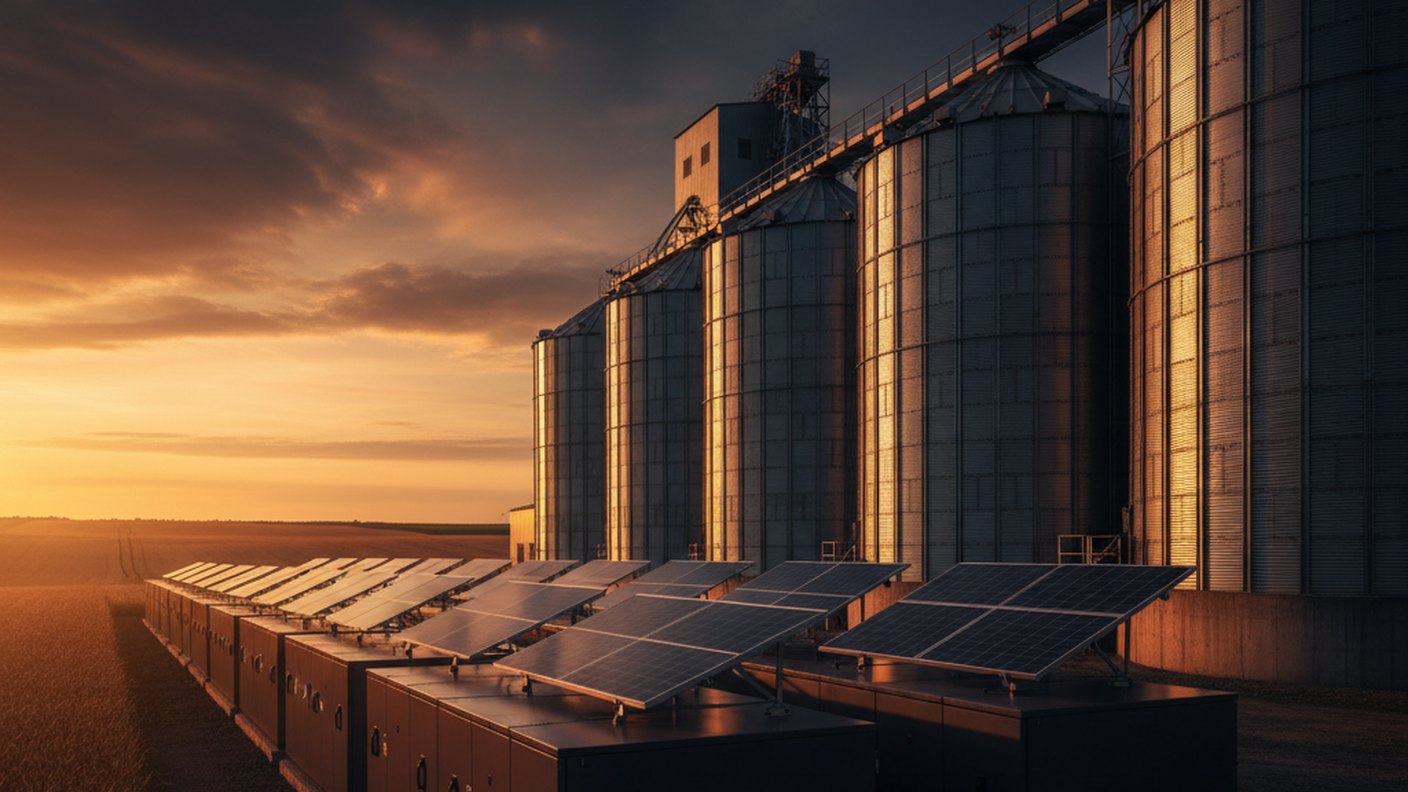
BESS for agro and elevators:
process protection and economy
The agricultural sector is one of the most energy-intensive and at the same time the most vulnerable to blackouts in Ukraine. A grain dryer that has stopped in the middle of a cycle spoils a batch of grain. Irrigation turned off in the heat is a lost crop. Refrigerated warehouses without power count losses for hours. At the same time, agricultural enterprises have a pronounced seasonal load and are often located in areas with a weak network. Industrial BESS solves all three pain points: protects critical processes, cuts drying peaks and earns from tariffs. This material shows how accumulation works in the agricultural sector.
"In agriculture, the cost of downtime is not measured in hryvnias per hour, but in damaged tons. Stopping the dryer at the peak of harvesting is a loss that BESS pays for in one season." — Lead Engineer, BESS Ukraine.
Three energy pains of the agricultural sector
Agricultural enterprise is not a uniform consumer. Its load jumps according to seasons and technological cycles, and the criticality of continuity depends on the specific process. Let's consider the key scenarios.
Grain dryers
Heavy consumers at the peak of harvesting. Stopping the cycle spoils the batch. Drying peaks inflate the contracted capacity and the bill.
Irrigation
Pumping stations work in the heat of the day - often when the tariff is highest and the network is weakest.
Cold and storage
Refrigerated warehouses, vegetable storages, dairy lines are a continuous load, where disconnection = spoilage of products.
Weak network
Many agro-industrial complex facilities are located in areas with limited TP capacity and frequent voltage dips.
BESS application scenarios in agriculture
| Object / process | Challenge & Problem Statement | The role of BESS |
|---|---|---|
| Elevator / grain dryer | Drying peaks, risk of stopping the cycle | Peak Shaving + backup of critical automation |
| Irrigation | Expensive daily tariff, weak network | Arbitration + maintenance of pump voltage |
| Refrigeration warehouse | Deterioration during disconnection | Uninterrupted supply of compressors |
| Animal husbandry / poultry farm | Ventilation and feeding are critical 24/7 | Life support reserve + OPEX reduction |
| Agro + own SES | An excess of sun during the day, a deficiency in the evening | Self-consumption, shift of energy for the evening |
Seasonality: why BESS is more flexible than diesel
Home feature of aggro is that the load peak is concentrated in time. For cereals, it is July-October (harvesting and drying), for irrigation - dry months, for cold - year-round, but with a summer maximum. A diesel generator for such a profile is either idle for most of the year, or does not cover the daily economy. BESS works differently: in the peak season it protects processes and cuts peaks, and in the off-season it continues to earn from tariff arbitrage and Peak Shaving of the base load.
The structure of benefits for the agricultural object
BESS + SES: the perfect pair for aggro
Many agro-enterprises have free space — roofs of warehouses, land next to an elevator — and have already installed or are planning a solar station. Challenge & Problem Statement of SES is that the generation peak (noon) does not coincide with the demand peak (morning and evening, night storage). BESS closes this gap: it accumulates the daytime surplus of the sun and releases it when it is needed, raising self-consumption to 70-80% and reducing dependence on the grid.
- Self-consumption: daytime solar energy is used in the evening rather than fed into the grid at low cost.
- Energy independence: SES + BESS connection reduces vulnerability to outages and price spikes.
- Green tariff / Net Billing: for legal entities — additional monetization of surplus.
- Scalability: the system is being expanded to expand the economy.
Do you have an elevator, irrigation, cold storage or your own CHP? We will analyze the load profile and seasonality and select BESS for your agricultural facility - click the button below.
Frequently Asked Questions
Will BESS protect the grain dryer from stalling when disconnected?
How does BESS help with irrigation in the heat?
Is BESS profitable for cold storage and vegetable storage?
How is agro seasonality taken into account when selecting BESS?
Can BESS of be combined with an existing solar station on the elevator?
BESS for an agricultural object
We will analyze the seasonal load profile of the elevator, irrigation or warehouse and select the system.