The licensing threshold is only one part of a BESS decision. It does not automatically determine permitted connection power, export rights or project economics. Procurement needs the correct operating model and metering boundary.
What changed
NEURC announced an increase in the energy-storage threshold from 150 kW to 5 MW through Resolution No. 789 of 26 May 2026. Apply the current text of Licensing Conditions No. 798 rather than only the news headline. The check needs to cover the power definition, measurement area and applicable exceptions.
Do not confuse power and energy
MW describes power; MWh describes stored energy. Increasing capacity with the same PCS is not the same as increasing power, but the configuration and documents must remain consistent. Cabinet count alone does not establish the regulatory treatment of the installation. Future expansion should be considered before ordering the first stage.
Before requesting a price
Collect the single-line diagram, metering information, PCS ratings, import and export limits and operating plan. If market transactions are planned, check the contracts and participant status separately from the licensing threshold. USK Energy selects equipment for the documented configuration; the legal position is confirmed against the particular site's documents.
What the 5 MW threshold actually describes
NEURC Resolution No. 789 of 26 May 2026 amended the licensing criterion by reference to installed storage power exceeding 5 MW at one metering site. It is not an energy-capacity threshold in MWh. Application to a particular business requires the current licensing conditions, relevant exceptions and a description of the intended activity. The wording should be checked in the official resolution.
This does not turn procurement preparation into a single “below the threshold” checkbox. Connection, permitted imports and exports, metering, contracts and equipment requirements remain separate questions. A quotation should distinguish the technical characteristics of the package from documents that the owner or another responsible participant must arrange.
Do not treat the number in an article title as permission to operate. Review requires an up-to-date diagram, a list of installations, the metering-site boundary and planned transactions. These materials establish how the rule relates to the actual site rather than to one isolated battery cabinet.
The amendment check is dated 2 November 2026. Resolution No. 1223 of 28 July 2026 was also reviewed; its storage-licensing changes do not replace this threshold. For a new order, check subsequent amendments and applicability again against the facility’s current documents.
Four quantities that must stay separate
Installed equipment power. Identify it from the relevant documentation and applicable definitions. An EMS setting that limits current discharge should not automatically be treated as a change in installed power. If an offer lists peak, nominal and available power, ask which value is used in each document and why.
Permitted grid import. This constrains the combined demand of the business and battery charging when they occur together. Even a relatively small storage system may require a different charging schedule if the incoming supply is already heavily loaded. Selecting only by desired autonomy does not show whether energy can be restored in time.
Permitted export. This is a separate boundary. Installing a powerful PCS does not create permission to export that power. A no-export arrangement needs a defined measurement scheme, limiting logic and behaviour following communication failure. A “zero export” label is not an approval of a particular implementation.
Stored energy. MWh describe the duration of support at a specified power and under stated conditions. Two packages with the same MW rating but different MWh will provide different durations. Identical MWh figures, in turn, do not establish identical peak-load capability or suitability for a particular market duty.
Start with the business operating profile
Collect interval consumption for a representative period. Mark production shifts, weekends, seasonal processes and interruptions. Energy sizing needs the load sequence over time; brief starting events may require measurements with finer time resolution. A single maximum on a billing statement describes neither the duration of a peak nor rapid load changes.
List the loads that actually need support. Record power, acceptable interruption and minimum operating duration for each group. Include model details and operating modes of existing generators, UPS equipment and solar generation. This separates backup requirements from peak limiting and avoids selecting the same package for fundamentally different duties.
Then examine charging opportunities. An illustrative 400 kWh energy requirement cannot be restored in one hour through a 100 kW charging path, even before losses. Less available supply headroom increases the time further. Perform this check before choosing a model: adding battery modules alone does not remove a charging-power restriction.
Make the enquiry diagram useful
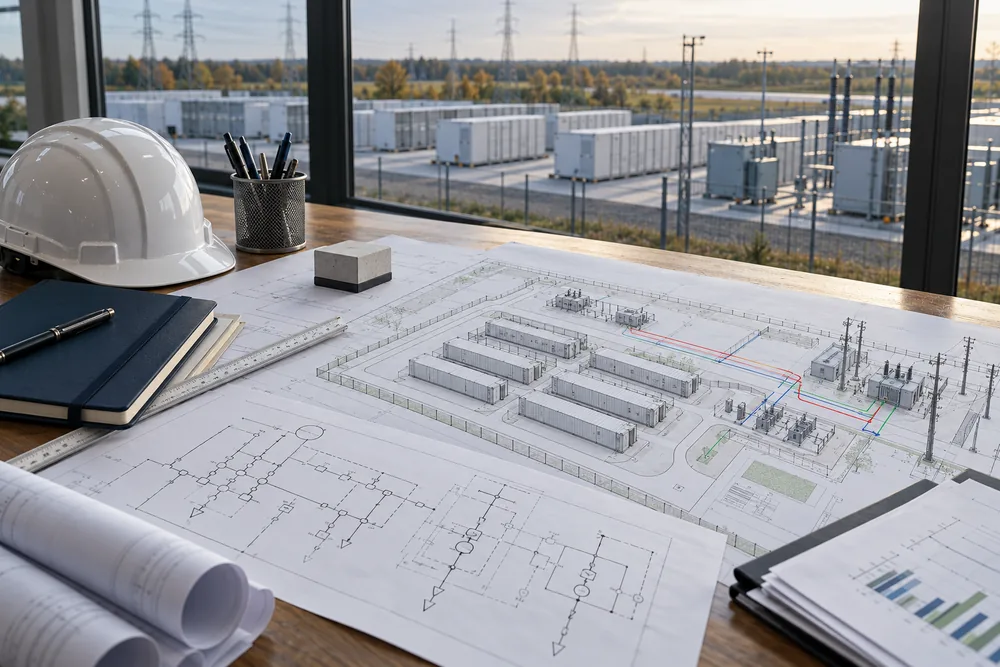
A preliminary diagram should locate the BESS connection, major loads, existing sources and measurement points. Identify which part of the facility must remain energised after separation from the external grid. If the arrangement is not yet approved, show that as an unresolved issue rather than presenting a sketch as a completed design.
The equipment supplier needs the required voltage, control interfaces, permitted modes and package boundaries. The network operator, designer and owner may hold responsibility for other parts of the preparation. A responsibility table prevents each participant from assuming that metering or an approval belongs to someone else’s scope.
Do not combine equipment, software functions, approvals and works in a single line called “everything necessary”. Specify the expected deliverable for each item, its acceptance party and its required stage. This allows the purchasing team to compare offers without guessing what is hidden inside a package price.
Plan phased expansion before the first order
For a phased BESS, assess more than the initial shipment. Additional PCS units can change the site’s aggregate characteristics and required procedures. Additional battery modules may extend duration without changing power, but still require compatibility, space, controls and warranty checks. These are different kinds of expansion.
Ask which first-stage components remain suitable after enlargement. Metering, communication, EMS, auxiliary power and restrictions on combining module batches deserve attention. “Unlimited scalability” is not a substitute for an agreed future configuration, including the limits of equipment purchased today.
Show future supply separately in the financial model because its price and timing remain uncertain. Do not make the first-stage offer appear artificially inexpensive by deferring essential items indefinitely. If the original duty cannot be achieved without a later stage, the buyer needs to know before signing the first contract.
Information for a meaningful equipment proposal
| Customer information | What it supports |
|---|---|
| Consumption profile and critical load groups | Power, energy and continuity requirements |
| Diagram and metering-site description | Correct technical and documentary boundaries |
| Permitted imports and exports | Achievable charging and discharging schedules |
| Existing sources and model details | Compatibility assessment of the offered package |
| Intended operating model | Separation of backup from market transactions |
| Future expansion intentions | Review of the eventual configuration |
Provide these materials to USK Energy before requesting a final equipment price. They support an agreed supply list, identified open questions and the documents required from the manufacturer. Compliance of the operating model is determined for the specific site using current documents; the technical offer should be prepared to match that model.
Before requesting a quotation
Mark questions for which you already have a confirmed answer. Save the list and send unresolved points to the supplier.
Compare the same scope of supply
Start with a scope-of-supply table. Battery modules, PCS, EMS, switching equipment, transformer, cooling and documentation may sit in separate price lines. A lower quotation may cover a smaller package. Ask suppliers to identify included items, options and exclusions, and name the party responsible for component compatibility.
Agree acceptance conditions before payment: documents supplied, parameters tested and how deviations are recorded. For a long-term purchase, spare parts, warranty procedures and operating restrictions matter. Separate equipment price, delivery and site work so that each contract has a clear scope.
Further verification
From calculation to equipment
Preparing an equipment purchase? Send the load, backup duration or specification. USK Energy will clarify the configuration, compatibility and delivery terms.