
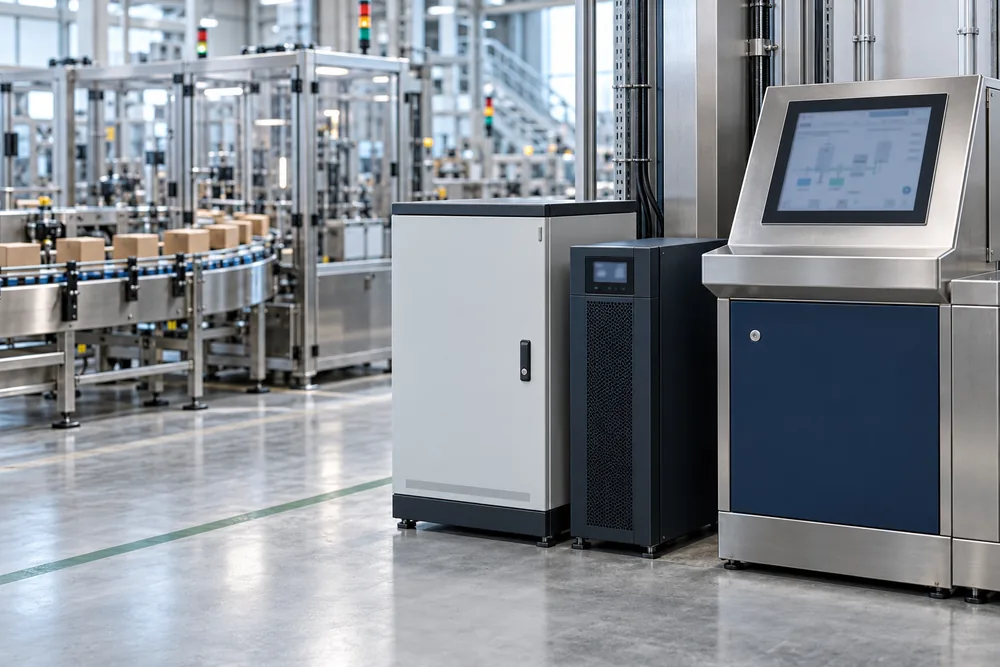
A BESS may store enough energy for hours of operation, yet a short interruption during backup transfer can restart a controller or halt a process. Purchasing should distinguish two tasks: extended backup for large loads and continuous power for controls.
Identify the circuit to keep powered
PLCs, HMI panels, industrial network switches, supervisory servers and measurement systems may need a different backup arrangement from motors, heaters and compressors. Separating the circuits helps define a focused UPS enquiry. It does not mean the entire line will continue running: that requires coordinated behaviour of both power equipment and controls.
First establish whether the application needs an AC online UPS or a dedicated industrial DC UPS, for example at 24 V. These are different equipment categories. Drives require separate checks for starting current, overload and possible regeneration; do not assume a general-purpose UPS is compatible.
What happens during BESS transfer
While backup switching and the BESS PCS move into the required mode, the online UPS supplies the agreed circuit from its own batteries. Once the backup source is ready, its voltage and frequency must be within the UPS input acceptance window. The system can then return to power from that input.
Double-conversion, battery and bypass modes differ. They are described, for example, in the Eaton 91PS/93PS user guide. ESS in a particular UPS menu may refer to a manufacturer’s energy-saving mode rather than an external BESS. Do not apply the characteristics of one operating mode to another.
Check discharge frequency before selecting lead-acid backup
An online UPS with VRLA AGM can be selected for short transfers. However, frequent outages during a shift may prevent full recharge. Yuasa distinguishes standby and cyclic applications. For purchasing, this means giving the supplier the actual outage frequency and required runtime, rather than simply asking for backup.
Do not compare a lead-acid UPS and LiFePO4 BESS on price per kWh alone. Ownership cost includes battery replacement, conversion losses, room conditions, maintenance and the consequences of shutdowns. A suitable package depends on your operating duty rather than a universal lifespan promise.
Compare the complete package
| Item | Purpose | Clarify before ordering |
|---|---|---|
| Online UPS | The agreed power mode for the critical AC circuit. | kW and kVA, phases, overload capability and conditions for BESS operation. |
| VRLA batteries and cabinet | Backup during transfer plus the agreed reserve. | Discharge power, DC voltage, temperature and recharge time. |
| Maintenance bypass | The specified arrangements for UPS servicing. | Compatibility, rating, power source and protective devices. |
| Monitoring | Signals for input loss, battery mode, bypass and faults. | SNMP, dry contacts or another agreed protocol. |
| Redundant power modules | The agreed availability following a module failure. | Actual installed capacity and usable capacity with N+1 redundancy. |
A 300 kVA modular UPS enclosure does not mean every power module for that rating is already included in the quotation. An external battery cabinet can likewise be supplied empty. Module quantity, batteries, protection and cable kits should be visible in the specification.
Account for charging after transfer
The BESS backup output must supply more than the critical load alone. After a discharge, the UPS may begin recharging its batteries and increase demand. Agree the permitted charging power and whether it can be limited. Some UPS systems provide dedicated inputs or settings for this control; verify availability on the selected model.
Before acceptance, agree scenarios for utility loss, repeated transfer, an unavailable BESS, bypass and depleted batteries. Define the acceptable equipment response rather than checking only that the UPS display turns on.
Request equipment selection and supply
Send the load list, phase arrangement, existing BESS details, required runtime and delivery address through the equipment questionnaire. The online UPS page covers the main package options; the UKRSK catalogue includes different UPS and power-supply categories. For related equipment, see USK protection relays and automation (Ukrainian). A separate article covers UPS selection for hospitals.
Start with the reason the production line stops
A factory can have enough stored energy and still lose a batch after a brief voltage dip. The weak point may be a small controller power supply, an industrial Ethernet switch or the server holding production recipes. Equally, putting the PLC on a UPS will not preserve the process if power contactors drop out, a drive loses its ready state or a machine needs to find its reference position again. Map the process dependencies before requesting equipment: what must keep running, what may stop without losing its state, and what must only restart under manual supervision.
Recent stoppage logs are useful purchasing evidence. Compare the incoming-power event, controller alarm, drive message and actual time at which production resumed. First reconcile their timestamps if the devices use different clocks. Otherwise, it is easy to buy backup for the device reporting the fault while the real cause remains elsewhere. This exercise gives the supplier a defined task and can materially change the critical-load list.
Define the outcome you are buying
There are at least three different requirements: keeping controls running through a brief source transfer, retaining data and shutting down in an orderly way if backup is unavailable, or continuing the entire manufacturing process. Each needs different power, runtime and interaction with the machinery. “A UPS for the factory” does not distinguish them; suppliers may interpret the same phrase as substantially different equipment packages.
Consider an illustrative packaging line. The owner wants the PLC, HMI, network and job data preserved but accepts that the motors will stop. Acceptance therefore means no restart of those protected devices and correct state retention, rather than uninterrupted conveyor movement. Another process may not tolerate even a brief pump stoppage, so that pump and its drive need their own assessment. The production requirement determines the scope; the total kW figure on an electricity bill does not.
Build a load schedule that can be checked
For each consumer, record operating active power, apparent power or power factor, phase allocation, startup behaviour and required support duration. Identify equipment planned for a defined expansion period separately. Adding every power supply’s maximum nameplate rating may provide a conservative bound, but it is not a measured operating profile. Conversely, average power over a shift does not show what happens when several devices start together. State which values are measured, which are documented and which remain assumptions.
For example, a total load of 24 kW distributed as 10, 8 and 6 kW across three phases is different from a balanced 8 kW per phase. Check the selected UPS’s phase-loading limits, unbalanced-load capability and output configuration. Include single-phase switch-mode supplies, nonlinear consumers and neutral requirements in the schedule. Give these data to the manufacturer for compatibility confirmation; adding active-power figures does not establish an acceptable neutral current.
| Load group | Selection inputs | Question for the supplier |
|---|---|---|
| PLC and HMI | Supply voltage, consumption, tolerated interruption | Is an AC UPS or a dedicated DC UPS appropriate? |
| Network and servers | kW, kVA, startup and dependencies | Which devices must remain powered to preserve communication? |
| Measurement systems | Supply requirements and data recovery | Which values must remain within limits during transfer? |
| Drives | Starting duty, overload and possible regeneration | Is operation with this UPS type expressly supported? |
Cover the complete transfer sequence
BESS takeover can involve detecting grid loss, switching operations, PCS readiness, voltage establishment and acceptance of that source by the UPS input. Some stages may overlap. A single advertised transfer-time figure does not describe the entire sequence. Ask for a state diagram showing the source feeding the critical load at each stage, including unsuccessful transitions: the BESS is not ready, its parameters are outside the acceptance window, or another outage occurs before reserve is restored.
Suppose the agreed sequence takes 40 seconds. That does not establish that a battery rated for exactly 40 seconds at nominal load is sufficient. Actual power, present charge, temperature, ageing and the time needed to complete an orderly stop if the BESS is rejected all matter. Choose the reserve against the defined requirement. The example is a way to examine the sequence, not a universal runtime rule for industrial sites.
Record what happens when the original source returns. A successful first transfer is only part of the duty. The line must also behave as intended during retransfer, battery recharging and any subsequent loss of input. A supplier response should address those states explicitly rather than leave them to assumptions made after the equipment arrives.
Read the lead-acid battery quotation correctly
An ampere-hour rating without its measurement conditions does not tell you whether a VRLA battery will sustain the required power for ten or fifteen minutes. Short-duration backup requires the discharge tables for the actual battery product. These specify duration, temperature and end voltage. Compare batteries under matching conditions, and ask the supplier to identify the table entry used and explain the applied correction factors.
Consider an arithmetic example, not a battery assembly instruction. The load is 12 kW and battery-to-output conversion efficiency at that point is 92%, so battery power is approximately 13.04 kW. If the manufacturer-approved configuration contains 240 series electrochemical cells, the average requirement is about 54.3 W per cell. Compare that requirement with the permitted power at the specified duration and end voltage, then apply the manufacturer’s required corrections. Nominal voltage is not a substitute for a discharge characteristic.
The selected UPS documentation determines block count, permissible DC voltage, parallel strings and protection. The example does not authorise arbitrary changes to a battery string. The quotation should identify battery model, quantity, configuration, cabinet or rack, protective devices, cables and required sensors. Agree how runtime will be demonstrated after delivery and how the requirement applies at the agreed end-of-use condition. A fresh battery calculation and an end-of-service requirement are different purchasing commitments.
Repeated outages change the VRLA duty
For an illustrative 24 kW load, one two-minute battery event delivers 0.8 kWh to the consumers. Six such events deliver 4.8 kWh over a shift, before losses. The total is not enough to specify the battery: the spacing between events matters. Six transfers with long charging opportunities and six closely spaced transfers impose different requirements on charging capability and remaining reserve.
Give the battery supplier the event timeline, not just a monthly outage count. Obtain the permitted charging conditions, realistic recovery time and a lifetime assessment for that duty. A site effectively using its standby VRLA battery for daily cycling must disclose that use during selection. Increasing battery capacity without checking charger capability may simply extend recovery after a deeper discharge. Ask which operating records must be retained to support later warranty assessment.
UPS charging is part of the BESS load
After accepting backup power, a UPS can supply its consumers while restoring its own batteries. For a 24 kW load and 94% AC-to-AC efficiency, the power-conversion path draws approximately 25.53 kW at its input. If the charging path adds 3 kW of AC-side demand, the source sees approximately 28.53 kW. These are illustrative balance figures. Use manufacturer data for the actual mode and avoid adding losses twice when they are already included in a stated input rating.
Check that the BESS can provide this power while supporting the factory’s other loads. If several UPS units start charging together, charging-current limits and the rate at which input demand rises become relevant. Ask the manufacturers to agree supported settings rather than applying an arbitrary multiplier to the PCS rating. Where a generator is also present, assess that operating mode separately: the UPS input voltage and frequency requirements must be met under the actual combined load.
Bypass and module redundancy solve different problems
A maintenance bypass supports an agreed servicing arrangement, but power delivered through it may not retain double-conversion conditioning or battery backup. Establish its source, permitted states and limitations for the critical load. This is a scope and operating-planning question. Switching procedures must come from the equipment documentation and be performed by trained personnel, not copied from a generic article.
For a modular UPS, request two figures: capacity with every fitted module available and capacity after one module is lost. Three illustrative 20 kW modules provide 60 kW in total and 40 kW after one is removed, provided the manufacturer supports the arrangement and all other limits are satisfied. An 80 kW frame does not supply a missing module. With a 36 kW load, the arithmetic margin in that condition is 4 kW; its adequacy still depends on kVA, phase loading, temperature and dynamic behaviour.
Ask which components remain common to the supposedly redundant arrangement. Module redundancy does not automatically duplicate the battery connection, control path, bypass source or downstream distribution. The supplier should describe the actual boundaries of the claimed redundancy. The buyer can then compare configurations that protect against the same failure, rather than compare two unrelated uses of the label N+1.
Give shift personnel useful information
A general “UPS alarm” does not explain the remaining time or the required response. Agree the necessary events: battery operation, unacceptable input, bypass operation, battery-circuit fault, power limitation and low remaining reserve. Each event needs a recipient, communication route and expected action. Recording an alarm without assigning responsibility does not ensure that somebody will respond.
Separate the physical presence of a network card from a working monitoring interface. Specify protocol, signal list, licences and local readout capability. If the monitoring server loses power with the grid, its alerts may disappear during the very event they are meant to report; the communication path has dependencies of its own. Keep event history available for investigating transfers and supporting warranty enquiries. Access rights should also distinguish observation from changes to operating limits.
The room conditions affect the supplied package
UPS and battery heat must be assessed for the actual duty rather than the cabinet’s nameplate alone. In the 24 kW example at 94% efficiency, the difference between conversion-path input and output is approximately 1.53 kW. Over eight hours, that represents about 12.26 kWh of lost energy. Other heat sources must be added to the room balance. This calculation does not determine battery ventilation requirements or replace the manufacturer’s installation conditions.
VRLA does not mean that the battery cabinet has no ventilation requirements. Confirm permitted temperature, airflow conditions, clearances, floor loading and maintenance access before dispatch. Otherwise, the buyer may discover on delivery that a cabinet cannot pass through a doorway or exceeds the capacity of its proposed location. Give the supplier information about dust, moisture and production contaminants, together with photographs and dimensions. A lower-cost enclosure is only comparable if it is suitable for the same environment.
Batteries have a storage history before they enter service
Agree manufacturing date, prior storage conditions and any required refresh charging before use. A new, unused battery cannot be assumed to remain indefinitely in storage without attention. Do not assign the same refresh interval to every brand: the relevant documentation and storage temperature govern it. A delivery with a long logistics chain needs a clear allocation of responsibility for battery condition before handover.
Check when the warranty starts and what happens if site readiness is delayed. A replacement requires more than matching dimensions and ampere-hours; it must be compatible with the charging regime, discharge characteristics and other batteries in the string. Any alternative model should be confirmed in writing. The owner should know how the batch is identified, where its documents are kept and who approves configuration changes. That information makes later replacements much less dependent on individual employees remembering an old order.
Rated power does not prove protection compatibility
During a fault, a UPS inverter output behaves differently from a strong utility supply. Protection coordination needs manufacturer data on overload capability, current limitation and possible bypass transfer. The supplier should provide these characteristics for the offered product, while the responsible designer assesses them in the factory’s electrical arrangement. Buying a larger UPS does not by itself establish correct disconnection of a faulted circuit.
Neutral, earthing and switching behaviour between sources also need explicit consideration. Include an up-to-date single-line diagram with the enquiry and ask the proposal to identify unresolved compatibility questions. Do not hide them inside a general “customer-side connection” exclusion. Site work may be a separate contract, but the equipment parameters needed to make a sound technical decision must be available before the purchase.
Agree the evidence for acceptance before payment
Distinguish characteristics demonstrated by factory documentation from behaviour that must be checked in the assembled system. IEC 62040-3 addresses AC UPS performance and testing requirements. Mentioning the standard alone does not establish compatibility with every production line; the actual model, operating mode, load and test conditions still need to be defined.
A useful acceptance record states initial SOC, connected load, configuration versions, event sequence and success criteria. “The UPS switched on” is not the same as preserving the required process state. Check the agreed outputs and critical consumers, including subsequent recharge behaviour, through an authorised safe test plan. A functioning production line should not become an uncontrolled trial of the proposed backup scheme.
Start an enquiry to USK Energy with the critical-load schedule, BESS data, required transfer outcome and delivery address. Compare two or three justified equipment packages with the same responsibility boundary. The price should come with an itemised list of UPS, batteries, bypass, monitoring and documents. This makes the purchase address a defined cause of stoppage and gives the buyer a clear basis for accepting what was supplied.
Two checks before selecting a UPS
Change the inputs and save the result to discuss the equipment package.
S = P / PF; E = P × minutes / 60. Compare both kW and kVA with the UPS ratings. The calculated kWh is load energy, not the required VRLA battery capacity. Select batteries using manufacturer discharge tables, including end voltage, temperature, losses and ageing.
Before requesting a quotation
Mark questions for which you already have a confirmed answer. Save the list and send unresolved points to the supplier.
What must remain powered during an outage?
Start with the loads that cannot stop. A server, a conveyor controller and the conveyor motor have different requirements: continuous power, retained process state and starting current. A single site power figure cannot describe all three. Separate loads into those requiring uninterrupted supply, those tolerating a brief interruption and those that can be shed during an outage.
A UPS bridges the transition for critical loads; a BESS provides stored energy; a generator can extend backup during a long outage. Check the UPS input requirements against the backup source output. Include battery recharge power after supply returns: restoring backup capacity must not overload the source.
- 1Grid lost
- 2UPS supports the critical load
- 3Backup source ready and accepted by UPS
Further verification
From calculation to equipment
Preparing an equipment purchase? Send the load, backup duration or specification. USK Energy will clarify the configuration, compatibility and delivery terms.