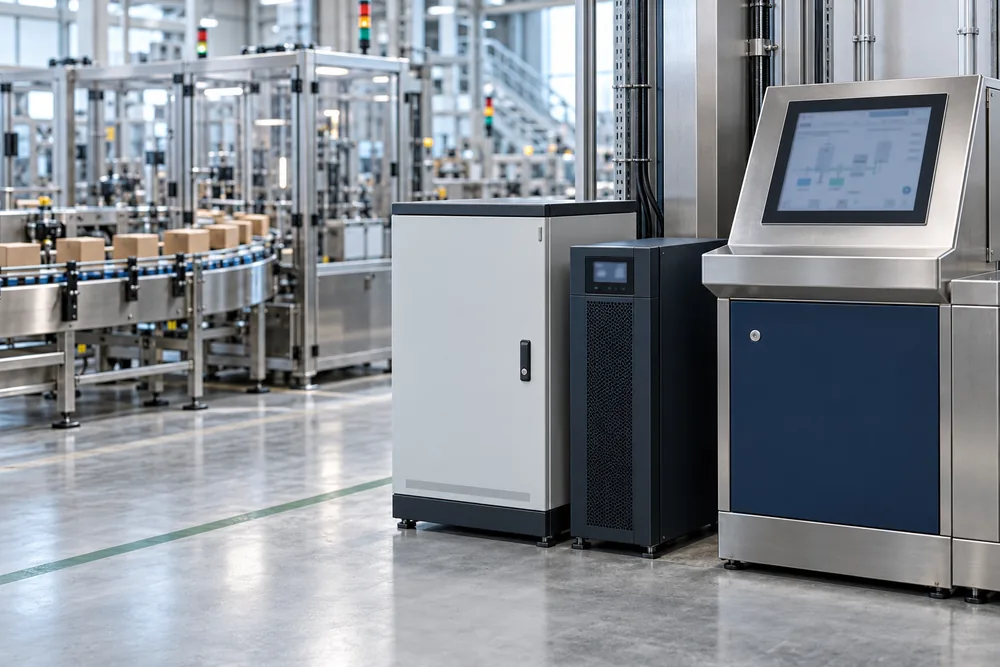
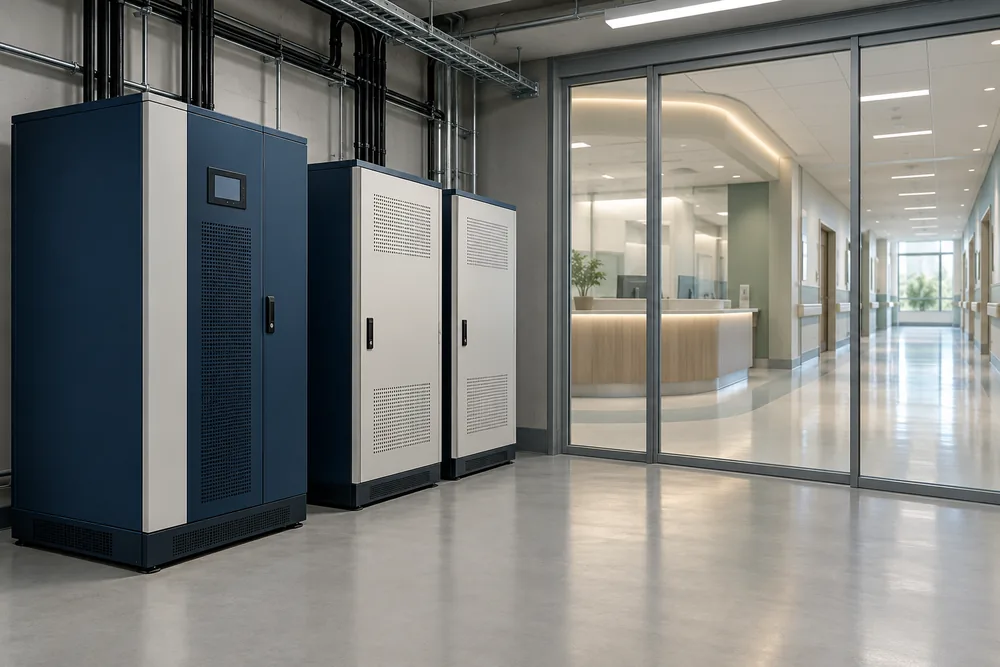
A hospital can have a large LiFePO4 BESS and still need a separate online UPS. Storage provides energy, but transfer to backup can take time. For loads that cannot tolerate that interruption, an equipment enquiry must define continuity requirements separately.
Start with the critical loads
Do not select a UPS solely from the total power of the building. List the equipment to support: information systems, communications, laboratory instruments and other agreed circuits. Medical equipment requires its manufacturer’s specifications, permissible interruption, and starting or pulse-load data. A scanner or large drive cannot be treated like a server cabinet simply because its kW rating is similar.
A suitably qualified designer determines room classifications and supply requirements. IEC 60364-7-710:2021 addresses electrical installations in medical locations. Certification of a UPS alone does not establish compliance of the complete installation.
Give the UPS and BESS separate roles
In double-conversion mode, an online UPS inverter continues supplying the load when its own battery takes over. Schneider Electric explains the absence of transfer time for this operating mode. ECO and bypass operation need separate assessment.
| Equipment | Primary role | Check before ordering |
|---|---|---|
| Online UPS with VRLA batteries | Support the agreed critical circuit during transfer. | Power rating, double-conversion mode, runtime and overload capability. |
| LiFePO4 BESS | Provide longer backup to the agreed supply input. | PCS island operation, readiness time, output parameters and power headroom. |
| Bypass and protection | Provide the specified maintenance and protection functions. | Bypass power source, protection coordination and servicing requirements. |
These are two separate battery packages. A BESS LiFePO4 bank cannot replace the UPS VRLA bank merely because the nominal voltages appear similar. Charger, DC operating range and BMS compatibility require manufacturer confirmation.
Where lead-acid batteries can fit
VRLA AGM can be considered for a UPS bridging a short transfer. Select the actual battery for power over the required duration, rather than Ah alone. A Yuasa data sheet lists short-duration power, longer-discharge capacity and temperature conditions separately.
With frequent outages, backup is no longer an occasional event. Account for consecutive discharges, incomplete recharge, temperature and planned battery replacement. A maintenance-free description does not remove the need for inspection, monitoring and battery condition checks.
Specify the necessary time allowance
Consider the whole sequence: fault detection, source transfer, BESS readiness and acceptance of its input by the UPS. If backup fails to start, the agreed reserve should cover the next source or another defined contingency. The site requirements determine the interval; there is no universal five-minute rule for every hospital.
An example to explain units: a 20 kW load uses 5 kWh in 15 minutes. This is output energy, not a finished battery specification. The battery package requires allowances for losses, discharge performance, temperature, ageing and the manufacturer’s permitted configuration.
What to request in the quotation
- UPS model, kW/kVA, phases and permitted operating mode for the critical circuit.
- Battery configuration, cabinet or rack, and substantiated runtime at a stated power.
- Bypass, DC protection, connection kits and the required monitoring interfaces.
- Compatibility with the BESS backup output and charging-power limits after transfer.
- Documentation, warranty terms, battery replacement provisions, delivery date and destination.
Also agree the checks for utility loss and return, bypass operation, and an unavailable BESS. Acceptance conditions should be known before purchase, rather than after delivery.
Select the equipment
Start with online UPS and battery packages, compare UPS equipment in the UKRSK catalogue and send a selection and pricing enquiry. For production controls, read the industrial UPS purchasing guide. For a larger energy reserve, see industrial BESS / ESS.
Separate the installation from the medical device
Purchasing backup power starts with an agreed requirement from the healthcare facility. Room classification, requirements for its circuits and the permitted behaviour of a particular medical device are related but different questions. A UPS datasheet does not answer all three. The buyer needs requirements from those responsible for the electrical installation and information from medical-equipment manufacturers. This defines an actual supply package instead of a generic request for a hospital UPS.
IEC 60364-7-710:2021 concerns electrical installations in medical locations, rather than setting the characteristics of medical devices themselves. Referencing it does not replace a device manual or make every UPS suitable for every room. Purchasing documents should distinguish installation requirements, receiving-equipment requirements and the characteristics of the proposed power source.
For the procurement manager, the practical question is who confirms that the load list is complete and its operating conditions are correct. Establish that responsibility before comparing prices. Where information is missing, retain it as an open question with an identified owner. Adding an arbitrary power allowance does not compensate for an unknown load characteristic or an unapproved supply arrangement.
Create a critical-load group record
Prepare a short record for each group: location, devices, normal and maximum power, phase arrangement, permitted interruption, required support duration and dependencies. Dependencies include what the group needs to perform its function, such as communications, a server, controls, ventilation or another agreed system. Backing up one device does not necessarily preserve the complete process.
| Field | Information to record | Insufficient substitute |
|---|---|---|
| Loads | Device names, quantities and simultaneous operating conditions | Total department power alone |
| Electrical data | kW, kVA, phases and short-duration maxima | One device's nominal current |
| Continuity | Requirements for the defined circuit and equipment | A medical-application label |
| Runtime | The event until which support is required | An arbitrary duration without a scenario |
| Recovery | Source acceptance and restoration of readiness | The mere presence of a generator or BESS |
Where measurements are used, state the period and operating conditions. A night-time profile does not represent simultaneous daytime use. Where nameplate maxima are adopted, explain which duty they represent. This transparency lets suppliers price the same task instead of appearing cheaper through an unnoticed reduction in assumed load.
Check kW and kVA together
Suppose an agreed group has a hypothetical active demand of 18 kW and true PF = 0.9. Preliminary apparent power is 18 / 0.9 = 20 kVA. Both requirements must be checked against the UPS. Short-duration conditions, phase distribution and rating conditions follow. The example does not select a model or establish an allowance for actual medical equipment.
Nonlinear loads require true power factor rather than displacement cos φ alone. A pulsed or starting condition may need additional manufacturer data. Equal kW figures do not make servers, laboratory equipment and a large diagnostic system equivalent loads. If a supplier proposes one rating for all of them, ask for verification of each significant operating condition.
For a modular arrangement, state the required output with an agreed module unavailable. Four 20 kW modules provide 80 kW in total, but one unavailable module leaves 60 kW before other conditions are considered. If demand exceeds that figure, module count alone does not establish the required redundancy. Common elements that are not duplicated by adding power modules need separate evaluation.
Runtime covers the entire route to an accepted source
Mark the loss of input, BESS readiness, arrival of acceptable electrical conditions at the UPS input and actual acceptance of that input. A further interval can exist between the BESS declaring itself ready and the UPS using it. The batteries support the complete route. Request confirmation for the proposed equipment pair and settings.
Include an unsuccessful backup-start attempt. The facility should define the next source or other agreed scenario if the BESS remains unavailable. Sizing a short battery reserve from normal transition delay alone may leave insufficient time for that case. The facility's requirements determine the duration; the supplier should explain how the proposed package meets them.
For example, 18 kW over twelve minutes requires 18 × 12/60 = 3.6 kWh at the UPS output. This checks the scale of the duty, but it does not mean a battery with 3.6 kWh nominal energy will perform it. Discharge characteristics, losses, agreed temperature and resource condition still matter. Compare package prices against verified runtime at the same stated load.
Read the VRLA calculation beyond ampere-hours
Request the exact battery model, number of cells or blocks in the approved arrangement, parallel-string count and runtime calculation. The discharge-table conditions matter: constant current or constant power, final voltage, temperature and duration. Without them, an Ah figure does not adequately describe the short discharge duty used in many UPS applications.
Confirm that competing calculations use the same battery condition. One supplier may show a new set at a favourable temperature while another uses the agreed resource condition. Different battery quantities may then reflect different assumptions rather than better selection. Put these assumptions in separate rows beside the stated runtime.
The UPS's permitted configuration matters too. Matching nominal voltage does not establish compatibility with any battery bank. Charging equipment, DC limits, protection and manufacturer documentation must suit the set. Do not replace VRLA with an arbitrary LiFePO4 bank from the external BESS. These are separate systems with separate functions and verified interaction through the agreed electrical arrangement.
Repeated outages change the battery duty
A UPS that once waited for a rare outage may begin discharging regularly. It then needs assessment of reserve restoration as well as the first runtime. A short interval of grid availability does not necessarily restore full charge. Request a time sequence containing several outages and the opening condition of each cycle.
Charging power shares source capacity with the load. A restricted external source requires agreed charge limits and priorities. Do not assume maximum load supply and maximum charging simultaneously without checking their combined demand. This is particularly relevant when the BESS feeds the UPS: restoring local VRLA reserve increases the upstream BESS load.
At an illustrative 18 kW output and 95% UPS efficiency, input for the load alone is approximately 18.95 kW. If agreed charging adds 2 kW at the input, the total is about 20.95 kW. This is a simplified constant operating point, not a product specification. Its purpose is to make charging and losses visible when selecting the source supplying the UPS.
Ask how charging is coordinated if several UPS units are supplied by the same reserve source. A limit applied to one unit may be adequate individually but insufficient for the combined group. The proposal should identify the total assumed recharge demand and any supported coordination. If no coordination is included, that should remain visible in the power balance rather than being assumed as a future feature.
Temperature, storage and physical access
Temperature near the batteries matters, not only a wall sensor elsewhere in the room. Request placement, heat-rejection and ventilation requirements for the actual cabinet. Riello highlights the effect of elevated temperature on VRLA ageing. That does not establish a universal replacement date; product documentation and measured condition remain decisive.
Manufacture date, transport and storage before service should be traceable. If delivery precedes readiness of the location, agree necessary actions and responsibility. Eaton discusses storage periods and timely recharging. A packaged battery cabinet is still affected by its storage conditions and waiting time.
Check weight, dimensions, delivery route and future replacement access. Being able to bring equipment in once does not always mean it can be serviced without affecting adjacent operations. State location constraints in the enquiry and agree access in the documentation. Work follows the facility's and manufacturer's procedures; procurement should provide a suitable package instead of leaving these questions until delivery.
Bypass is not a second battery reserve
Establish the bypass source, supported modes and the critical group's position during maintenance. If the load is transferred to a source without battery support, its protection changes. Bypass provides defined functions, but its presence alone does not establish continuity through every failure. Describe the scenario for the particular diagram.
Request a maintenance matrix: what can be withdrawn, what power and runtime remain and which additional failures become critical. Where an alternative path is proposed, check its shared elements with the primary path. Two devices depending on the same overlooked input or control cannot be described as fully independent merely because there are two of them.
Consider the battery-maintenance state separately from power-module maintenance. A system may retain output capacity while temporarily having less stored energy. The purchasing requirement should identify whether the agreed runtime must remain available in that state. This prevents redundancy claims based on one part of the system from being applied to every component.
Agree acceptance criteria before placing the order
| Check | Evidence needed by the buyer |
|---|---|
| Delivery scope | Models, batteries, cabinets, protection and options match the specification |
| Normal operation | Agreed UPS mode and load parameters are confirmed |
| Input loss | Recorded behaviour of the defined critical group |
| BESS acceptance | Agreed sequence without unexplained continued battery discharge |
| Grid restoration | Predictable recovery and agreed charge limitation |
| Alarms | Understandable events, timestamps and accessible logs |
Responsible facility specialists agree test methods and conditions. Tests should not be improvised on equipment supporting patient care. For purchasing, define criteria, configuration and result records in advance. Factory product data and verification of the installed system establish different things; neither should silently substitute for the other.
Specify what happens if a required result is not demonstrated. The contract can identify a review process, necessary evidence and correction of the configuration before acceptance. Avoid a situation in which a shipment is treated as proof of every operational claim. Delivery, documentation and agreed functional verification are separate milestones that should be visible to both parties.
Give every important alarm an owner
Monitoring is useful when a responsible person understands the event and knows how to escalate it. Ask for distinct indications of battery operation, insufficient reserve, a battery-circuit fault, unavailable bypass and lost communication. A single general alarm does not always reveal whether the required function remains available. Establish which events the UPS records itself and which depend on external monitoring.
Check the dependencies of each notification channel. A local log may remain available without internet access, while email cannot arrive without networking equipment and connectivity. Do not treat a cloud message as the only indication of system condition. Specify local signals, historical access and the responsible personnel's workflow. An interface being present does not establish that notifications are configured or reach the intended recipient.
Request a sample event record containing time, input, output and battery state, operating mode and the reason for a limit. Aligned UPS and BESS timestamps make it possible to reconstruct the sequence rather than guess. Personal medical information is unnecessary for this energy log; a defined set of technical parameters is sufficient for supply diagnosis.
Revisit selection when the protected group changes
Adding a device, relocating a room, changing operating hours or replacing the upstream source can change the original duty. Before connecting new demand, review kW, kVA, phase distribution and runtime. If the reserve was calculated for another equipment set, an absence of present alarms does not prove that every original condition is still satisfied.
Keep the original load list, battery calculation, supplied configuration and acceptance results together. For a later purchase, these records show what must change: battery reserve, UPS power, upstream source or the protected boundary. Comparing those details is more precise than ordering the same rating again because the department has the same name.
If a supplier substitutes an item before shipment, agree the effect on runtime, charging, monitoring and documentation as well as price. Calling a product equivalent does not remove the need for checking it. Record the change in the final specification and acceptance documents so that the facility receives the configuration for which the required duty was established.
Compare the full price and subsequent obligations
The comparison should include the UPS, battery set, bypass, monitoring, connecting components, documents and delivery. Show options and exclusions separately. If one offer uses longer runtime or a different resource condition, align the requirement first. Only then does the price difference have a clear meaning.
A longer-term budget should allow for battery-condition checks, possible replacements, support and compatible spare parts. Do not assign one service life to every VRLA product or to the complete UPS. Request warranty conditions, the support procedure, required logs and the process for supplying approved replacements. Support response time and replacement-equipment delivery time are different commercial parameters.
The initial USK Energy enquiry can start with the critical-group record, required runtime scenario and existing BESS or generator data. Online UPS units with lead-acid batteries and associated components can then be compared against common requirements. The outcome is a verifiable supply specification: what is purchased, which functions are confirmed, which documents are handed over and how the facility accepts the equipment.
Keep that record current when the department's equipment changes. A new device, a different operating schedule or relocation of a load can change both power and runtime. Reviewing the accepted configuration against measured demand is more useful than relying on the original department name. It also gives the supplier a clear basis for proposing a battery expansion, another UPS or a revised supply boundary.
Two checks before selecting a UPS
Change the inputs and save the result to discuss the equipment package.
S = P / PF; E = P × minutes / 60. Compare both kW and kVA with the UPS ratings. The calculated kWh is load energy, not the required VRLA battery capacity. Select batteries using manufacturer discharge tables, including end voltage, temperature, losses and ageing.
Before requesting a quotation
Mark questions for which you already have a confirmed answer. Save the list and send unresolved points to the supplier.
What must remain powered during an outage?
Start with the loads that cannot stop. A server, a conveyor controller and the conveyor motor have different requirements: continuous power, retained process state and starting current. A single site power figure cannot describe all three. Separate loads into those requiring uninterrupted supply, those tolerating a brief interruption and those that can be shed during an outage.
A UPS bridges the transition for critical loads; a BESS provides stored energy; a generator can extend backup during a long outage. Check the UPS input requirements against the backup source output. Include battery recharge power after supply returns: restoring backup capacity must not overload the source.
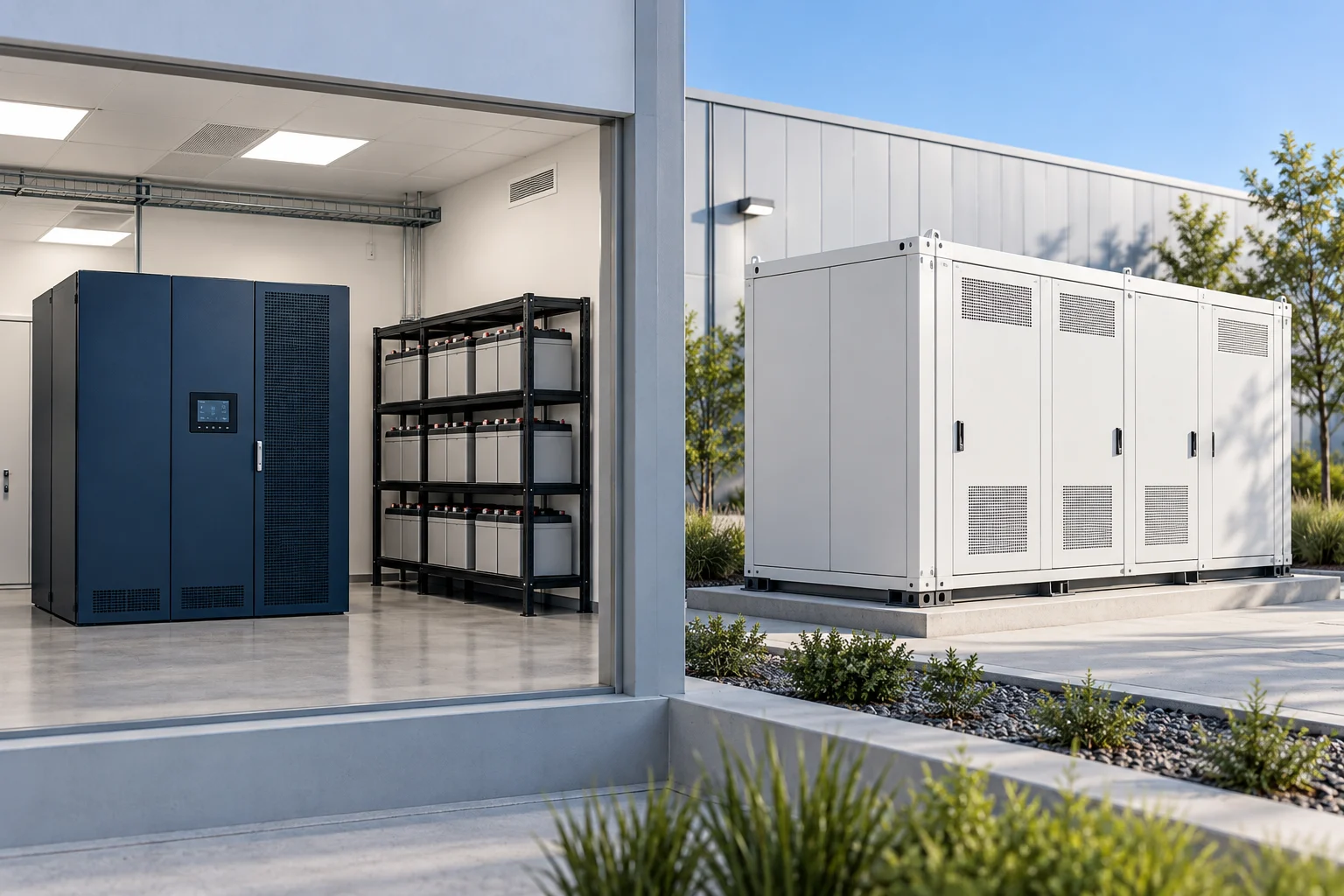
- 1Grid lost
- 2UPS supports the critical load
- 3Backup source ready and accepted by UPS
Further verification
From calculation to equipment
Preparing an equipment purchase? Send the load, backup duration or specification. USK Energy will clarify the configuration, compatibility and delivery terms.