
After a brief voltage interruption, a warehouse can spend much longer recovering: controllers reboot, scanners lose sessions and conveyors wait for operator acknowledgement. The backup task is to preserve defined control circuits, rather than simply install the largest battery.
Separate controls from drives
List PLCs, network switches, WMS servers, terminals and drives. Record acceptable interruption and recovery behaviour for each. A motor and its controller may have different requirements. A small uninterrupted group can sometimes retain process control even while the mechanical equipment pauses. Check this against the machinery manufacturer's operating requirements.
What zero transfer means
In normal double-conversion operation, a suitable online UPS supplies the load through its inverter without switching to another output path when input power fails. This is not a universal BESS property. Bypass, ECO, overload and fault behaviour require separate checks against the UPS documentation.
Extend the reserve
Where the BESS has a transition delay, a UPS can bridge it for the critical group. When the backup source appears, check input acceptance, battery charging and total power demand. Ask USK Energy to compare UPS, battery and BESS packages with stated compatibility conditions and autonomy at the actual load. The acceptance test should follow the complete transfer and recovery sequence, not just record that the battery turned on.
A warehouse has several different kinds of interruption
A scanner may lose connectivity, a conveyor controller may lose the state of an operation, and a refrigeration compressor may lose power. Their consequences and acceptable pauses differ. Turn a request for zero transfer time across the warehouse into a list of specific devices and processes. State what must remain continuous for each: power, data exchange, movement or retention of process state.
Follow one order through receiving, identification, movement, picking, packing and dispatch. Identify electrical and information dependencies at each stage. Backing up a workstation does not preserve data exchange if its network switch is unpowered. Keeping a server running does not guarantee access to an external system when the communication link is unavailable. Describe the energy equipment's responsibility boundary accurately.
The uninterrupted group is rarely identical to total demand
Servers, networking, controllers and selected workstations may belong to an uninterrupted group supplied by online UPS equipment in an agreed mode. Power loads such as conveyors, lifting mechanisms and compressors require their own assessment of power, starting and process sequence. Do not automatically apply a controller's requirement to every load, but do not assume that keeping the controller powered keeps its mechanism moving.
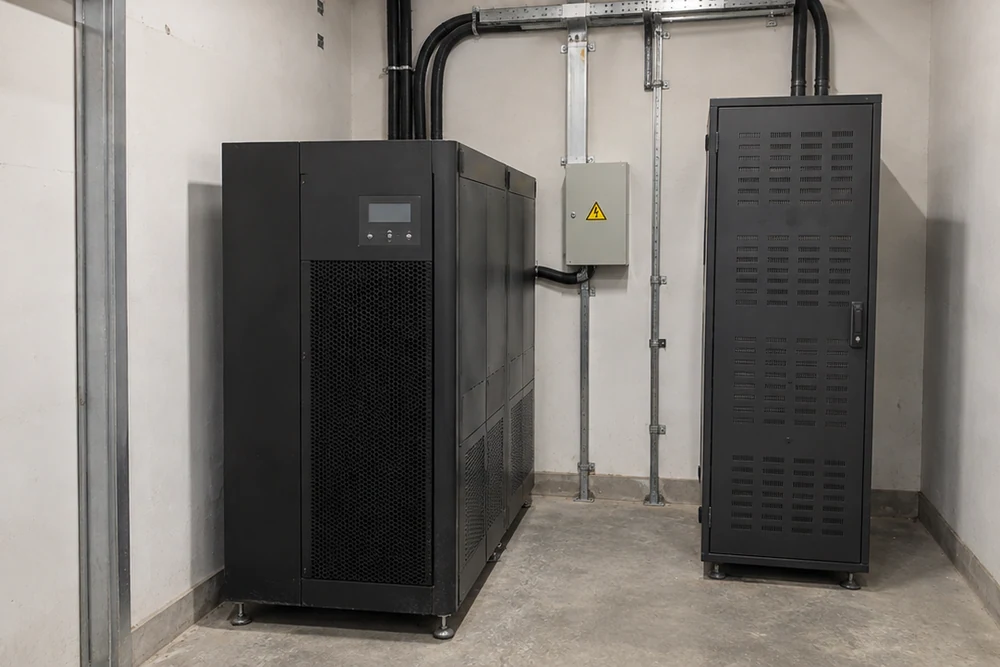
In normal double-conversion operation, an online UPS supplies the load through its output inverter. Loss of input, within the system's permitted conditions, does not require changing that output path. ECO, bypass, overload and fault conditions follow different scenarios. Specify the actual product mode and performance instead of relying on a zero-millisecond label. IEC 62040-3 is a useful reference for discussing UPS performance tests.
Assess the BESS transition separately
Where the BESS has a transition delay, a local UPS can support its defined load group through that interval and acceptance of the new source. The relevant duration is the entire time until acceptable power reaches the UPS input, not merely a BESS catalogue figure. Include source checks, possible retries and the agreed failure scenario. UPS battery reserve must meet that task under stated resource conditions.
Once the UPS accepts the source, it may start recharging its batteries. Charging adds to output demand and conversion losses. Several local UPS units can create significant simultaneous recharge demand for the BESS or generator. Request charge-limiting information and behaviour when available power changes, so restoring reserve does not create another reason for interruption.
Restart sequence can determine PCS size
After an outage, automation may attempt to restore several mechanisms together. That is a different source duty from supplying motors that are already running. Prepare a start list and agree the permitted sequence with those responsible for the process. Do not assume automatic movement can resume where the equipment's safety rules require another procedure.
| Area | Requirement to examine |
|---|---|
| Sorting | State of controllers, drives and communications after transition |
| Packing | Completion of an operation and the restart procedure |
| Cold storage | Required product conditions and compressor restart logic |
| Vehicle charging | Whether charging can be delayed or limited during backup |
| Dispatch | Workstations, doors and identification equipment |
This list helps avoid buying capacity for deferrable loads while overlooking a small but essential device. Ask the supplier to explain which loads determine PCS power, which determine battery energy and which need a separate UPS. Those different reasons should remain visible in the explanation of the proposed package.
Calculate two different runtimes
The first is the short reserve for the uninterrupted group until a source is accepted or a controlled finish is completed. The second is energy for longer operation of the agreed warehouse group. They have different loads and criteria. For example, a hypothetical 8 kW controls and IT load needs 2 kWh of delivered energy for fifteen minutes. That does not determine VRLA capacity in ampere-hours; manufacturer discharge tables and UPS parameters are still needed.
For longer backup, a hypothetical 45 kW group requires 90 kWh over two hours before losses and allowances. Another 30 kW of vehicle charging would materially change the purchase, but it may be deferrable. Agree that decision with the logistics schedule. Reduced energy use during the outage must not silently move downtime into the next shift because vehicles are no longer ready for work.
Consider where an interruption begins within the shift. A reserve calculated for a quiet period may not cover simultaneous picking, cold-storage operation and dispatch. Use a representative demanding period and include any agreed reduction in activity. If the business accepts lower throughput during backup, state that explicitly in the scenario rather than claiming full operation from a reduced-load calculation.
Examine the shift-change interval
At the start of a shift, a warehouse may increase goods movement, start workstations and finish vehicle charging at the same time. A daily average hides that combination. Select one demanding representative interval and identify operations that can be separated without reducing agreed throughput. Check the combined demand of the remaining operations instead of considering each zone's maximum independently.
In the recovery scenario, state who confirms line readiness and how an unfinished operation is prevented from being repeated incorrectly. That belongs to process and information-system control, not to the battery. Energy equipment supplies agreed electrical conditions; it does not know whether a particular handling unit has already been scanned. This distinction helps define the uninterrupted group without assigning WMS functions to the UPS.
Consider overnight operation with fewer staff. Identify the alarm recipient, available local indications and escalation route. Where notification depends on networking, include the relevant switch and router power. A useful check is whether the responsible person can receive and understand the event under agreed conditions, not simply whether an alarm appears in an equipment log.
Preserve the data needed to explain recovery
Request logs that reconstruct grid loss, UPS transition, BESS readiness and mechanism recovery. Aligned timestamps help distinguish an electrical pause from a network or WMS problem. Do not attribute every interruption to one source without evidence. Define monitoring equipment and log access in the supply scope before purchase.
The same records help evaluate a later change in operating pattern. Adding another conveyor or moving charging to a different shift changes the sequence seen by the reserve system. Retaining the accepted load profile and test results allows the buyer to assess that change with the supplier. A broad promise of zero transfer time provides no equivalent reference for expansion.
Send USK Energy the zone diagram, critical devices, power-load profile and permitted recovery sequence. Compare online UPS equipment, BESS and switching as components supporting a particular process. Acceptance should record agreed observations of critical devices as well as electrical measurements. The evidence should establish continuity for the named group, rather than making an unqualified claim about every operation in the warehouse.
Two checks before selecting a UPS
Change the inputs and save the result to discuss the equipment package.
S = P / PF; E = P × minutes / 60. Compare both kW and kVA with the UPS ratings. The calculated kWh is load energy, not the required VRLA battery capacity. Select batteries using manufacturer discharge tables, including end voltage, temperature, losses and ageing.
Before requesting a quotation
Mark questions for which you already have a confirmed answer. Save the list and send unresolved points to the supplier.
What must remain powered during an outage?
Start with the loads that cannot stop. A server, a conveyor controller and the conveyor motor have different requirements: continuous power, retained process state and starting current. A single site power figure cannot describe all three. Separate loads into those requiring uninterrupted supply, those tolerating a brief interruption and those that can be shed during an outage.
A UPS bridges the transition for critical loads; a BESS provides stored energy; a generator can extend backup during a long outage. Check the UPS input requirements against the backup source output. Include battery recharge power after supply returns: restoring backup capacity must not overload the source.
- 1Grid lost
- 2UPS supports the critical load
- 3Backup source ready and accepted by UPS
Further verification
From calculation to equipment
Preparing an equipment purchase? Send the load, backup duration or specification. USK Energy will clarify the configuration, compatibility and delivery terms.