The cold room rode through the first interruption. The mains are back and the controller shows a green light. What the shift supervisor needs to know now is how much usable energy will be left when the supply drops again. The IEA’s November assessment identifies a risk of shortages in Ukraine this winter. A store’s own changeover log is the place to find the durations and recovery intervals to use in its purchasing specification.
Identify the loads on the backup bus
Over a shift, record operation of compressors, fans, pumps, controls, temperature loggers and defrost heaters. Match those events to door openings and incoming warm stock. A closed room in steady operation draws a different load from a busy receiving bay. Capture short starting peaks separately. They can disappear in a fifteen-minute average.
Ask the refrigeration contractor to walk through the normal restart sequence. A controller may enforce a compressor delay or be completing a defrost cycle. Record the permitted delays and sequence for each group. The quality manager should set the acceptable product temperature and holding time using evidence for the actual product and room.
Run the numbers for a second interruption
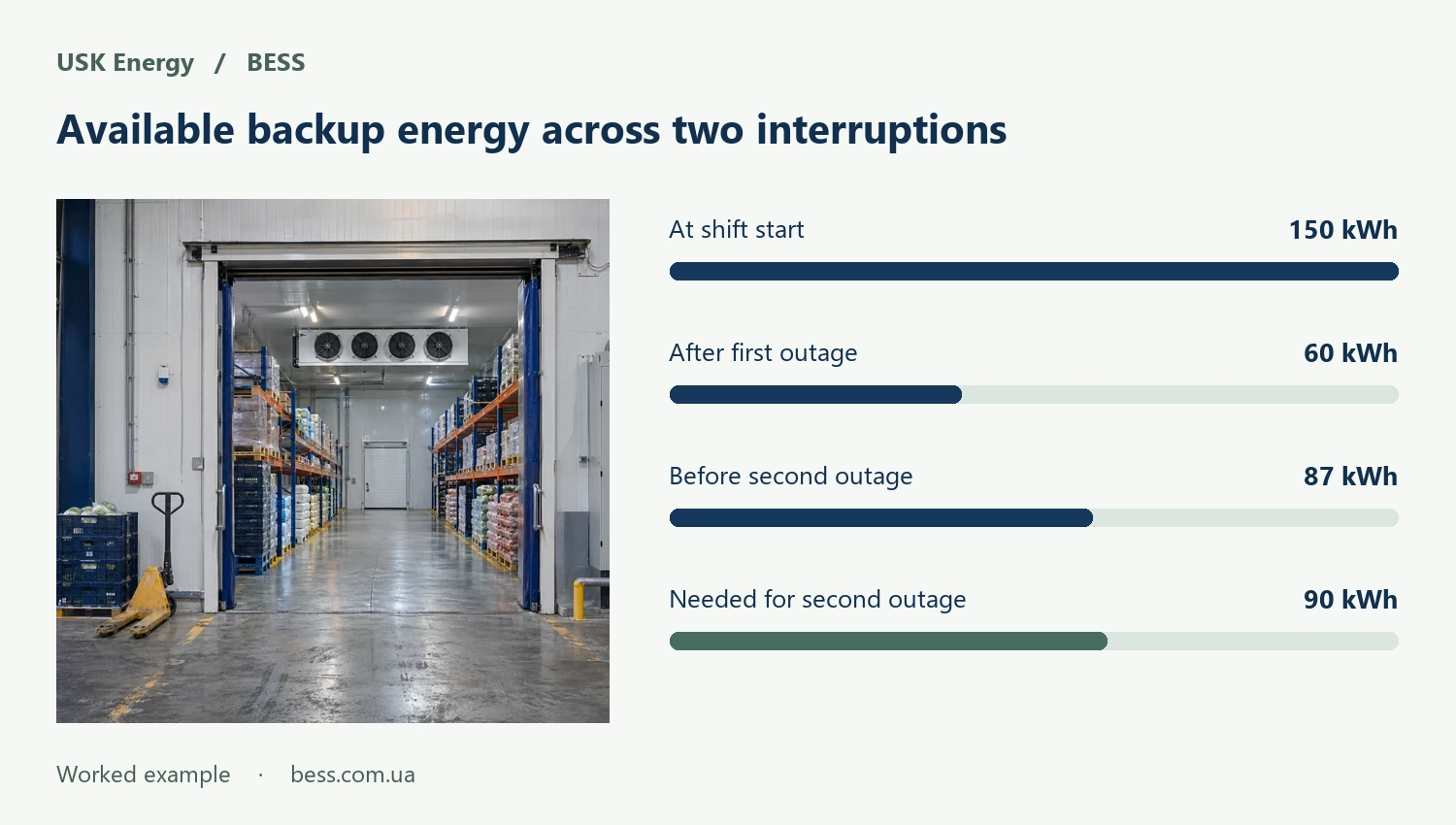
Assume the shift starts with 150 kWh deliverable at the backup bus. Critical loads average 45 kW. A two-hour outage uses 90 kWh, leaving 60. Power returns for one hour. With refrigeration running again, the site can spare 30 kW for charging. At an assumed 90% round-trip efficiency, the 30 kWh bought in that hour adds about 27 kWh of future output.
The second two-hour interruption begins with 87 kWh available against a requirement of 90. The simplified example is already 3 kWh short before allowing for forecast error. To restore the entire initial reserve, the system must replace all 90 kWh delivered. Under the same conditions that takes about three hours and twenty minutes of charging. Compare that interval with the site log.
Check a shift on your own meter readings
Start with readings at the backup bus. Enter the full usable output with which the battery begins the shift. Deduct any reserve that site procedures require you to keep untouched. For each outage, enter its duration and the average load during that particular interval. For charging, enter the power the warehouse can actually allocate to the battery after supply returns. If the connection has 50 kW to spare but the cabinet can take only 30 kW, enter 30.
- Shortfall in first outage
- 0 kWh
- Reserve before second outage
- 87 kWh
- Balance for second outage
- -3 kWh
Change the second outage duration and watch for a negative closing balance. The calculation caps replenishment at the initial usable capacity. It assumes steady average power within each interval and auxiliaries already included in the measured load profile. Starting overload and product temperature need separate checks. If the first outage already exhausts the reserve, the calculation shows the unserved energy and starts the recovery interval from zero.
Four readings for the shift log
Leave room on the shift sheet for four entries: deliverable energy just before the outage, the backup meter readings at changeover and at restoration, and the time charging actually resumes. The mains may return at 14:00 while charging starts at 14:18. In between, the controls qualify the supply, start compressor groups in sequence and bring the building load back up. Starting the recharge clock at the first green light on the incoming panel credits the battery with eighteen minutes it never had.
Ask the supplier what “remaining energy” on the screen means. One system reports energy in the cells, another predicts energy deliverable down to the lower operating limit. To reconcile that figure with the warehouse meter, both must refer to the same bus. If the supplier already guarantees usable AC output at the selected discharge rate, multiplying by a depth-of-discharge factor a second time understates the reserve. Write the definition beside the number so that the night and day shift use the same accounting.
What an extra half hour buys
Return to the example. If the grid stays on for ninety minutes instead of sixty, 45 kWh goes into charging and about 40.5 kWh becomes available as future output. That leaves 100.5 kWh before the second outage. Half an hour separates this outcome from the shortfall in the first scenario. Ask the shift supervisor what else normally starts during that half hour. A wash cycle or a receiving operation can use the very headroom the spreadsheet assigned to charging.
Another option is to keep the one-hour window and release 40 kW for charging. That restores about 36 kWh, leaving 96 kWh before the next interruption. The two alternatives have different purchasing implications. For the latter, check available site import, the cabinet’s charging limit and the power the battery will accept at its actual temperature. A discharge rating on a data sheet does not establish any of those three figures.
| Mains available | Charging headroom | Available before outage two | Balance after outage two |
|---|---|---|---|
| 1 hour | 30 kW | 87 kWh | 3 kWh short |
| 1.5 hours | 30 kW | 100.5 kWh | 10.5 kWh left |
| 1 hour | 40 kW | 96 kWh | 6 kWh left |
Did the warehouse run out of power or energy?
If the backup bus drops as the second compressor group tries to start, begin with the event timestamp and the converter alarm. A battery with plenty of charge can still trip on overload. Ask the storage supplier for its current-versus-duration envelope and the refrigeration contractor for a trace from an actual start. Comparing two numbers in kilowatts without the duration and starting conditions tells the buyer very little.
A different pattern calls for a different purchase decision. The bus holds, compressors run, and late in the shift the battery reaches its lower operating limit. Plot accumulated kWh over time. Check whether fan motors, pumps and controls serving an adjacent room were included. Staggering starts can remove a brief peak, but the motors still draw energy for the next two hours. A system that passes the starting test can therefore fall short on usable capacity.
Reading a temperature trace after an outage
An air probe near the door may respond almost immediately when a truck is unloaded. A probe at the far end of the room may respond much later. Mark the probe positions on a plan and note delivery arrival, unloading completion and which doors were open. The quality manager can then relate storage conditions to refrigeration operation. A single air-temperature line at the entrance says little about the condition of every pallet.
Agree how loss of communication with a temperature logger will be reported. A perfectly straight line can mean the dashboard is repeating its last value. Ask to see an export with timestamps and missing samples after a power interruption. This small detail in an enquiry helps establish whether the warehouse actually has a continuous record for the hour it most needs to explain.
Make competing quotations describe the same shift
Send each bidder the same shift file. Ask for a row at the beginning and end of each interruption showing energy available at the backup bus, energy delivered, energy purchased for charging and the closing balance. Add a column for outdoor temperature and the year of operation to which the figures apply. A price per kWh for a warm new battery cannot be compared directly with one based on guaranteed output towards the end of the warranty period.
Also ask what happens when the forecast reserve falls short. Who sees the alarm? Does the shift supervisor see minutes remaining at the present load, or only a percentage? How long does the site need to finish receiving a consignment and close the doors? Those answers determine a sensible operating margin. Put them in the enquiry before selecting a cabinet so that competing prices cover the same job.
What the quotation should cover
Ask for energy delivered at the bus at the agreed temperature and power, the short-duration overload envelope and the charging power available while compressors run. For an outdoor cabinet, ask about heater consumption and charge limits at low battery temperature. If offices share the system with the cold store, settle which loads take priority before comparing bids.
During an agreed acceptance test, retain three logs on a common time base: the backup bus meter, refrigeration controller events and room temperature. Together they can explain a slow recovery. The battery may have reached its operating limit, the compressor may have been waiting for restart permission, or defrost may have occupied part of the interval.