
How to choose a BESS supplier: 14 checks to make before the deposit
Which certificates a storage supplier must show, how to verify what cells are inside, what a warranty has to state, why "10 years" without MWh means…
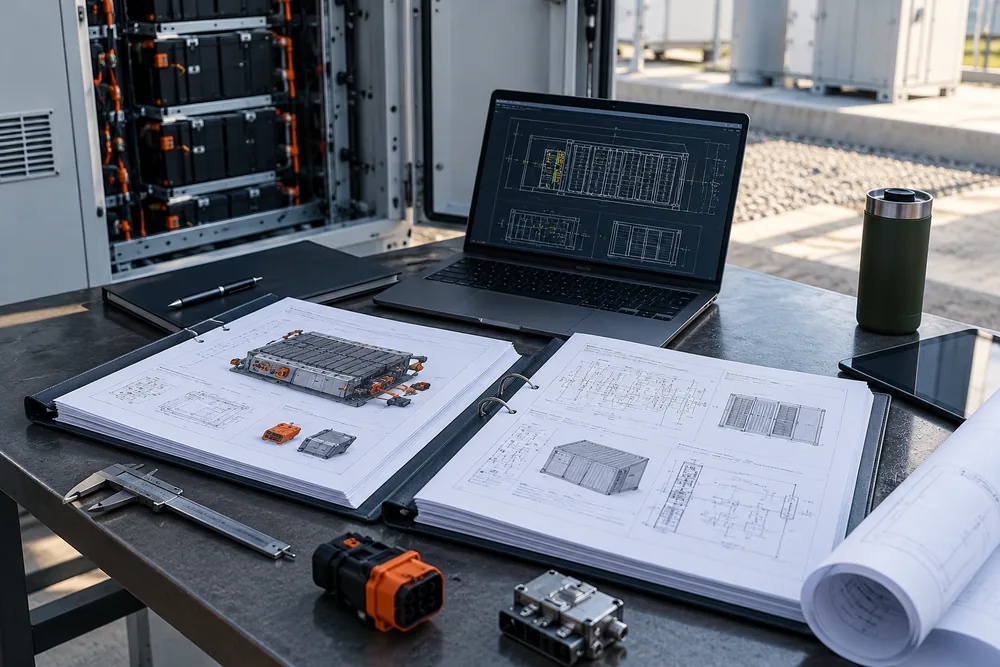
An industrial battery system is a fifteen-to-twenty-year purchase in which half the risk is not in the equipment but in whether anyone will still be servicing it in year five. Below is a list a technical director can work through without hiring a consultant.
Key parameters
Documents a supplier should send without hesitation
Not "after an NDA", not "the manufacturer has it" — a PDF in reply to an email. If one of these is missing, that is information in itself.
| Document | What it proves | What to look at |
|---|---|---|
| IEC 62619 | safety of industrial lithium cells and batteries | whether the cell model on the certificate matches the one in the quote |
| UN 38.3 | transport approval | without it the shipment will not clear customs |
| IEC 62477-1 | power converter safety | the voltage and current class must cover your system |
| IEC 61000 / EN 61000 | electromagnetic compatibility | especially near sensitive equipment |
| IEC 62443 | industrial control system cyber security | relevant whenever the EMS has an external link |
| System test report | that the assembled system was tested, not just the modules | date, laboratory, serial number |
| Declaration of conformity | admission to the Ukrainian market | issuer and the products covered |
On IEC 62443 in particular: if the control system has remote access — and it almost always does, otherwise there is no monitoring — this is not a formality. A battery reachable from outside is part of your industrial network, and its vulnerabilities become yours. The minimum worth demanding: a separate VLAN, no default passwords, signed firmware updates. More in the storage cyber security article.
Cells: how to verify what is inside
The most expensive part of the system and the easiest place to save money invisibly. Three questions settle it.
First: who made the cell and which model? Not the system brand — the cell. The answer should be specific: manufacturer, model, nominal capacity in ampere-hours. "Lithium iron phosphate from a leading Chinese manufacturer" is not an answer.
Second: new cells or second-life? A market for used EV cells exists and in some applications they are justified — but the price should reflect it. Ask about grade directly: A-grade (new, full datasheet), B-grade (parameter deviation), second-life (after a first life). The price gap between A and B runs to tens of percent, and so does the difference in service life.
Third: what is the manufacturing date? Lithium cells age on the shelf. A cell made two years ago and stored in less than ideal conditions has already lost part of its life. A normal interval from manufacture to commissioning is up to six months.
How to read the datasheet itself is covered on the cell chemistry page: five fields that determine the real life of the system.
Warranty: for what, and under which conditions
A warranty in years with no mention of energy means nothing. Batteries degrade with cycles, not with the calendar. "10-year warranty" without qualification lets the supplier decline if you ran two cycles a day instead of one. The correct wording looks like this: "retention of at least 70 % of initial capacity for 10 years or 25 MWh of throughput, whichever comes first, when operated within a 10–90 % SOC window at 15–30 °C".
- The capacity threshold. 70 % or 80 % — a difference of two to three years of real life.
- Operating conditions. SOC window, temperature, maximum C-rate. If your duty falls outside them, the warranty does not apply.
- What the supplier actually does when a claim succeeds: replace a module, top up the lost capacity, or refund. Three different obligations.
- Who pays for the work. The cell may be free while removal, shipping and installation are yours. It has to be written down.
Separately: the converter warranty is usually shorter than the battery warranty — five years against ten. That is normal, but it should be visible in the quote rather than discovered in year seven.
Service: the question people ask last and should ask first
- Who physically turns up. Company name, city, number of engineers. "A service partner in Ukraine" without specifics is not an answer.
- Response time in the contract. Not "promptly" but hours to a response and days to a site visit, split between critical and non-critical faults.
- Spare parts held. Which items sit in stock in Ukraine: module, fan, controller, BMS board. And the lead time for what does not.
- Access to the control system. Whether you, or a third-party contractor, could maintain the system if the supplier disappeared. Closed protocols and a hard dependency on the manufacturer's cloud are a real risk over ten years.
The last point is the most underestimated. Ask directly: can EMS data be exported in a standard format, is there a local web interface, does the system work when the manufacturer's cloud is unreachable. "Everything goes through our app" means you are tied to that company for the life of the asset.
Red flags in a quotation
Wording that deserves a follow-up question. None of it proves bad faith — each of them means something has been left unsaid.
| What it says | What to ask |
|---|---|
| "500 kWh capacity" without the word usable | nameplate or usable; across a 10–90 % window that is a 20 % difference |
| "10-year warranty" | to what capacity threshold and at what throughput |
| "2-year payback" | under which scenario, at which tariff, is degradation included |
| "Solid-state batteries" | the cell datasheet with the electrolyte type |
| "Turnkey price" with no scope list | does it include foundation, cable, earthing, fire systems, approvals |
| "Official distributor" | a copy of the distribution agreement or a letter from the manufacturer |
| Lead time under 8 weeks | is it stock, and if so how long have the cells been sitting |
And one note about ourselves, so the list is honest: we supply equipment and organise turnkey installation — design, delivery, commissioning and service are carried out by our team and vetted contractors, with the exact scope and schedule agreed by a manager according to location and situation. We do not call ourselves the official distributor of any brand and do not promise a free engineer visit before the scope is agreed. If a quotation carries all three promises at once, ask for the documents behind each.
A checklist for your own review is in the block below. Tick what the supplier has already closed; whatever stays unticked is your agenda for the next meeting.
Check your own quotation
Fourteen points that close most of the risk. Tick what the supplier has confirmed with a document rather than a sentence.
Nothing checked yet. Start with the cell datasheet — it answers several questions at once.
Frequently asked questions
Which certificates should an industrial battery system have?
How do I verify which cells are inside?
What counts as a proper storage warranty?
Why ask about service before buying?
What does dependence on the manufacturer's cloud mean?
What should I check in a turnkey price?
How long does supplier due diligence take?
Figures shown are indicative. We supply the equipment and size the system; design, installation and commissioning are arranged through contractors when needed and quoted separately. Exact sizing follows a load-profile analysis.
Need equipment?
Request a quotation.
Send a model, specification or describe your requirements. We will clarify the configuration, check supply terms and prepare a price quotation.