
LFP, NMC, sodium-ion and solid-state: which chemistry to buy in 2026
Four battery chemistries compared for industrial storage: cycle life, energy density, cold-weather behaviour, safety and price. Where sodium-ion already…
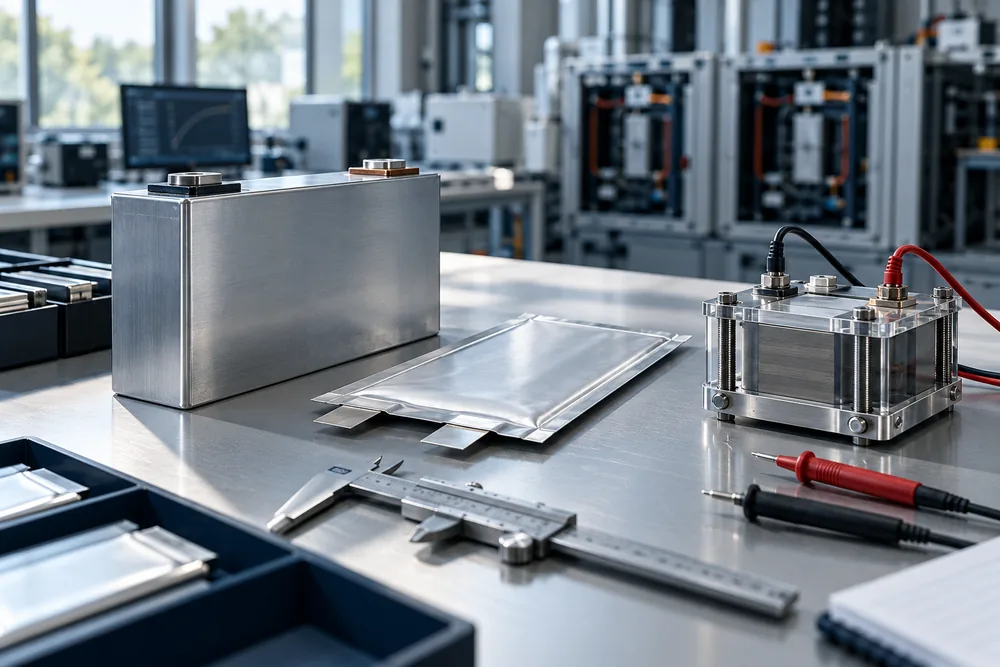
"Which chemistry is best" has no answer without a second question — best for what. A stationary industrial system that sits still and does one or two cycles a day for twenty years is judged on entirely different criteria than an electric car. Below: four chemistries against the criteria that actually drive the decision.
Key parameters
Four chemistries in one table
Figures are typical for industrial-grade cells as of 2026. Specific designs vary, which is exactly why the cell datasheet always outranks a general table.
| LFP (LiFePO4) | NMC | Sodium-ion | Solid-state | |
|---|---|---|---|---|
| Cycles to 80 % SOH | 6,000–8,000 | 3,000–5,000 | 4,000–6,000 | 5,000+ claimed |
| Specific energy, Wh/kg | 140–180 | 200–280 | 110–160 | 300–450 in samples |
| Cold weather | charge from 0 °C, heating needed | similar to LFP | charge to −30 °C | unknown at scale |
| Thermal stability | high, breakdown from ~270 °C | lower, from ~210 °C | high | potentially highest |
| Critical materials | lithium, iron, phosphate | lithium, cobalt, nickel | sodium, iron — no lithium | lithium plus ceramic electrolytes |
| Price per kWh | baseline | 10–25 % higher | still above LFP | several times higher |
| C&I availability | mass market, any volume | limited | first production batches | research samples |
Read the table top to bottom and it becomes obvious why industry settled on LFP: it wins on exactly the rows that matter for stationary storage — cycle life, safety, price, availability. It loses on the row that barely matters for a stationary system: energy per kilogram. A container does not care whether it weighs 18 or 24 tonnes.
Why industry settled on LFP
Cycle life per unit of cost. Eight thousand cycles against four thousand, at a price difference in LFP's favour, means the levelised cost of a stored kilowatt-hour (LCOS) is roughly half. For a system that cycles daily for twenty years, that is the number that decides.
Failure behaviour. LFP does not release oxygen during thermal runaway; iron phosphate begins to break down around 270 °C against roughly 210 °C for NMC, and far less energy is released. It does not make a system fireproof, but it directly affects fire authority requirements, insurance and whether a cabinet may stand inside a building. Insurers look at chemistry first.
Supply chain. LFP contains no cobalt and no nickel — materials with volatile prices and reputational questions. For exporting manufacturers that matters in ESG reporting.
The honest counterpoint: LFP charges poorly in the cold. Below 0 °C charging damages the cell through lithium plating, so industrial systems heat the battery compartment and part of the winter throughput goes into self-heating. In an outdoor container that is 1–3 % of annual output — a figure worth putting into the model from the start.
Sodium-ion: where it already makes sense
Sodium-ion cells have stopped being a laboratory subject: CATL, HiNa and several other manufacturers ship production batches, and they genuinely appear in stationary storage rather than only in presentations.
- Charging below zero. Down to −30 °C without heating. For a container on an unheated pad in northern or eastern Ukraine, that removes an entire subsystem.
- Safety. A sodium-ion cell can be discharged to zero and stored that way without degrading, which simplifies transport and storage.
- No lithium. Salt and iron, so the price does not follow the lithium cycle.
The weaknesses that keep it from displacing LFP: specific energy is 20–30 % lower, so the same capacity takes more space, and the price per kWh is currently above LFP rather than below it — cheaper raw materials, but an order of magnitude less manufacturing scale.
The 2026 conclusion: consider sodium-ion when the system stands on an unheated pad in a cold region and space is not constrained. In every other case LFP remains cheaper over the life of the asset. More detail in the analysis of sodium-ion systems.
Solid-state: what is true and what is a slide deck
A solid-state battery replaces the liquid electrolyte with a solid one — ceramic, polymer or sulphide. The promises: higher density, no flammable electrolyte, faster charging.
True as of 2026:
- Working samples exist and show 300–450 Wh/kg under laboratory conditions.
- Several carmakers run pilot lines with announced series dates.
- Semi-solid cells already ship in small volumes.
Not yet true:
- There is no series-production industrial storage system on solid-state cells. No C&I supplier in 2026 can deliver one with a warranty and a service contract.
- Price per kWh is several times LFP, and a fall is not expected before the end of the decade.
- Cycle life under real duty has not been confirmed by independent long-term data.
What follows for a decision today: if someone offers an industrial storage system "on solid-state batteries" at a price comparable to LFP, it is almost certainly a renamed semi-solid or ordinary lithium cell. Ask for the cell datasheet with the manufacturer's name and the electrolyte type. It is a normal question, and a normal supplier answers it with a document.
How to read a cell datasheet
Five fields decide how long the system really lasts. Everything else is secondary.
- Cycle life @ DOD
- Cycle count is always quoted with a depth of discharge and a temperature: "6000 cycles @ 80 % DOD, 25 °C". Without those conditions the number means nothing. When comparing two quotes, normalise them to the same DOD first.
- C-rate
- How fast the cell may be charged and discharged. 0.5C means a full discharge takes two hours. Peak shaving needs at least 1C; daily shifting is fine at 0.5C. High C-rate cells cost more, and paying for headroom you will not use is waste.
- Calendar life
- Ageing with time regardless of cycling. A battery sitting idle still loses capacity — typically 1.5–3 % a year at 25 °C and a correct storage SOC. For a system that rarely runs (pure backup), calendar ageing matters more than cycling.
- SOH and end of life
- End of life is defined as capacity falling to 80 % of the original. That is not a failure: the system keeps working with less capacity. What matters is that the manufacturer warrants that point.
- Throughput warranty
- A warranty in megawatt-hours passed through the system, not only in years. "10 years or 25 MWh, whichever comes first" is honest. "10-year warranty" with no mention of throughput or cycles leaves the supplier room to decline a claim.
Practically: ask for the cell datasheet separately from the system brochure. It should name the cell manufacturer, the model and all five fields above. If a system brochure arrives instead of a datasheet, that is itself the answer.
The full pre-payment checklist is on how to choose a BESS supplier.
Which chemistry fits your case
Choose what is critical for you. The suggestion rests on the same figures as the table above and says plainly when the difference does not matter.
—
A hint does not replace the cell datasheet: two manufacturers using the same chemistry give different cycle life. But it shows which way to look and what to ask the supplier.
Frequently asked questions
Which battery chemistry is best for industrial storage?
How does LFP differ from NMC?
Can sodium-ion storage be bought today?
Are there industrial storage systems on solid-state batteries?
What does "6000 cycles" actually mean?
How does a battery behave in winter?
What warranty should a supplier give?
Figures shown are indicative. We supply the equipment and size the system; design, installation and commissioning are arranged through contractors when needed and quoted separately. Exact sizing follows a load-profile analysis.
Need equipment?
Request a quotation.
Send a model, specification or describe your requirements. We will clarify the configuration, check supply terms and prepare a price quotation.