
Industrial energy storage: how it is built, what it costs, who it pays back
BESS, ESS, battery storage unit — the same equipment under different names. Three form factors of industrial storage, five ways it earns money, price per…
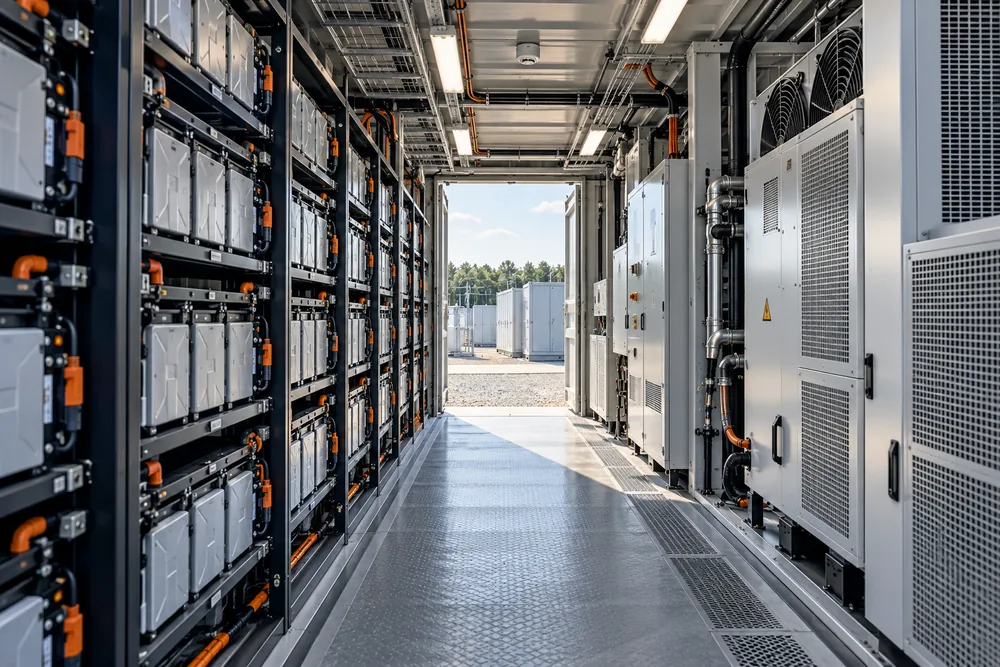
An industrial energy storage system is a cabinet or a container holding lithium cells, a power converter and a control system. It charges when electricity is cheap or self-generated, and discharges when it is expensive or absent. Below: what is inside, what it costs per kWh, and when it actually returns the money.
Key parameters
BESS, ESS, storage unit — are these different things?
No. They are the same equipment under names that come from different documents, and the confusion costs people time while they are still looking for a supplier.
- BESS
- Battery Energy Storage System — the abbreviation used in specifications, tenders and datasheets. In Ukrainian and Russian paperwork it is transliterated into Cyrillic as БЕС or БЕСС; both spellings appear, neither is formally standardised.
- УЗЕ / energy storage installation
- The wording used in Ukrainian grid codes and in technical conditions issued by distribution system operators. If you receive a connection document from a Ukrainian DSO, this is the term it will use.
- ESS
- Energy Storage System — a wider term that also covers non-battery storage: pumped hydro, flywheel, thermal. If a document says ESS without naming a chemistry, it is worth asking.
- C&I storage
- Commercial & Industrial — roughly 30 kW to 5 MW. Storage for factories and businesses, as opposed to residential units or utility-scale projects of hundreds of megawatts. Almost everything on this site is C&I.
The practical conclusion: if one supplier writes BESS, another writes ESS and a third writes "energy storage installation", they are quoting the same class of product, and the quotes are directly comparable. What actually needs comparing is capacity, usable capacity, converter rating and cell cycle life.
Three form factors: rack, cabinet, container
The form factor follows from how much energy has to be stored and where it will stand. The price per kWh between the extremes differs by roughly three times, which is why "just tell me the price" does not work.
| Format | Typical capacity | Where it goes | Notes |
|---|---|---|---|
| 19″ rack | 30–100 kWh | server room, electrical room | fits through a normal door, no foundation, most expensive per kWh |
| All-in-one cabinet | 100–500 kWh | indoor room or covered pad | converter and cooling built in, installed in 3–7 days |
| 20′/40′ container | 0.5–5 MWh | outdoor pad on a foundation | cheapest per kWh, needs crane access and fire sign-off |
Two numbers get mixed up in quotations more often than any others. Power in kilowatts is how much the system delivers at any instant — set by the converter. Capacity in kilowatt-hours is how much it delivers in total — set by the cells. A "500 kW / 1000 kWh" system holds 500 kW for two hours, and the two figures are sized separately against the load profile.
Five ways storage returns the money
One or two of these apply at any given site, rarely three. The question is never whether storage is useful in general — it is which revenue stream at your site is large enough to pay for the equipment.
| Scenario | Mechanism | Fits |
|---|---|---|
| Peak shaving | demand charges are billed on the period maximum; storage cuts that maximum | plants with hard starts — crushers, compressors, welding |
| Tariff arbitrage | charge in the night band, discharge in the peak; the spread across three daily bands reaches 2–2.5× | flat, high consumption on a time-of-use tariff |
| Backup power | replaces or offloads a diesel set, carries critical load with no break | food production, server rooms, hospitals, cold stores |
| Shifting own generation | midday solar is spent in the evening instead of being exported cheaply | sites with rooftop PV |
| Ancillary services | payment for standing ready to hold frequency reserve for the TSO | systems from 1 MW, qualified or via an aggregator |
The first three are calculated from your own electricity bills — no assumptions, only arithmetic. The fourth depends on how many kilowatt-hours of solar you currently export cheaply. The fifth needs separate qualification and suits very few sites: what the ancillary services market actually requires is set out on its own page.
What it costs
Price per kilowatt-hour falls with scale — the single most useful thing to know before the first enquiry. Ranges below are for equipment, ex-VAT, as we buy in 2026.
| System size | $/kWh, equipment | What is included |
|---|---|---|
| 30–150 kW | 240–400 | battery module, hybrid or grid inverter, BMS, cooling |
| 100 kW – 1 MW | 175–300 | the above plus a separate PCS, auxiliary panel, EMS |
| 1–5+ MW | 125–230 | containerised system, transformer, MV switchgear, SCADA |
Installation and commissioning add 8–18 % of the equipment cost, depending on how ready the site is. The top of that range is a site needing a new foundation, a cable route from scratch and its own earthing grid; the bottom is a prepared room, a free way in the switchboard and an existing route.
What is not in these figures and appears as separate lines: stepping up the voltage class if the site is fed at 400 V and the system exceeds 1 MW; fire detection and suppression as a separate design; DSO approvals. A detailed breakdown with a calculator sits on the BESS pricing page.
Who gets a 3–5 year payback, and who does not
This is the part suppliers usually skip. Storage is not universally profitable, and it is fairer to say so before the deposit than after.
Fast payback needs two things at once: consumption above roughly 100,000 kWh a month, and a pronounced daily shape — either sharp peaks or a wide spread between tariff bands. Then savings run into the tens of thousands of hryvnia a month and the system breaks even in three to five years.
Slow or no payback if consumption is flat around the clock, the tariff is single-rate and supply is reliable. Storage then becomes insurance rather than an investment, and it has to be evaluated against the cost of downtime, not against the electricity bill.
A separate case: sites where stopping is disproportionately expensive — a foundry with melt in the furnace, a hatchery, a server room, an operating theatre. There the payback question barely applies: one avoided incident covers the system.
The fastest way to find out which category you are in is the questionnaire — seven blocks of questions from which an engineer calculates a specific configuration and a price range rather than a brochure figure.
Work out payback from your own bill
Three numbers from your invoice and one slider. The result is an order of magnitude, not a quotation: the exact figure comes from a logged load profile.
The model assumes shaving 20 % off the measured maximum and one full arbitrage cycle a day over 22 working days. Equipment follows the site-wide price ladder; installation is taken at 12 %. Degradation, VAT and the cost of money are not included: this is an estimate, not a business case.
Frequently asked questions
Are BESS and ESS the same thing?
How much does an industrial energy storage system cost?
How is storage better than a diesel generator?
How long does an industrial battery system last?
What is usable capacity and how does it differ from nameplate?
Can storage be installed without permits?
How long do supply and installation take?
Figures shown are indicative. We supply the equipment and size the system; design, installation and commissioning are arranged through contractors when needed and quoted separately. Exact sizing follows a load-profile analysis.
Need equipment?
Request a quotation.
Send a model, specification or describe your requirements. We will clarify the configuration, check supply terms and prepare a price quotation.