
Microgrids for industrial sites: building a node that does not depend on the grid
An industrial microgrid: solar, storage, a genset and an EMS that runs them. Three levels of autonomy, what it is built from, what it costs, and when a…
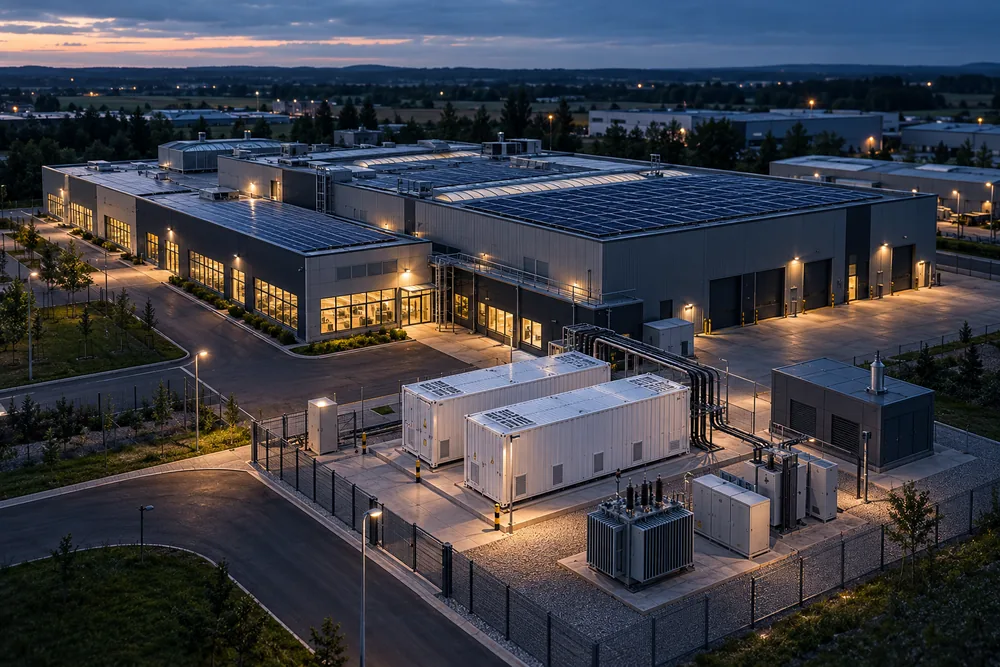
A microgrid is a section of a site's electrical network that can run both alongside the external grid and without it. Technically it is solar, storage, optionally a generator, and an EMS in charge of them; the key element is a grid-forming inverter, without which island operation is impossible.
Key parameters
A microgrid and plain storage are not the same thing
Ordinary storage works alongside the grid: it sees the voltage and frequency set by the network operator and follows them. Lose the external grid and the inverter shuts down, because it has nothing left to reference.
A microgrid is arranged differently. It contains a source able to set voltage and frequency itself — the storage system's grid-forming inverter. When the external grid fails, the isolating breaker opens, the inverter takes over, and the site keeps running on its own generation. When the grid returns, the system synchronises and reconnects without a bump.
The difference is in the control architecture, not the amount of equipment. Two systems with identical battery counts can be priced very differently precisely because one can hold an island and the other cannot. There is a full technical walk-through of the architecture elsewhere on the site.
Three levels of autonomy
The price gap between them is multiples, so this is worth settling before design.
Level 1. Backing up the critical load. The microgrid is a part of the site: the server room, the cold stores, a continuous line. Everything else stays on the grid and goes dark with it. The cheapest option and the usual starting point.
Level 2. Maximum self-consumption. Solar plus storage, tuned to buy as little from the grid as possible. Self-consumption of PV generation rises from a typical 30–40 % to 70–80 %. The site stays connected and only islands on a fault.
Level 3. Full autonomy. The site can run without the external grid indefinitely: solar covers the day, the battery covers evening and night, a generator covers an overcast week. The grid becomes a backup rather than the primary source. The most expensive level, and justified where a grid connection is absurdly expensive or simply not available.
What it is built from
- Storage with a grid-forming PCS. The heart of the system. Power is sized not against average consumption but against the largest simultaneous load, including motor starting currents.
- Solar. Roof or ground array. For a microgrid it matters that the PV inverters can follow a frequency set by the storage system and accept a curtailment command.
- A generator, if level 3 is the target. Inside a microgrid it starts rarely and runs at an efficient load instead of idling all night at 20 %.
- An isolating breaker with synchronisation control — the point where the microgrid separates from the external network.
- An EMS with a priority scheme: what is fed first, what is shed, at what SOC the generator starts.
- Protection reconfigured for two modes of operation. Settings for parallel operation and for island differ, and this is the part most often got wrong.
What it costs and when it pays back
A level-2 microgrid on a mid-size plant usually means 500–1500 kW of solar plus 500 kW / 1–2 MWh of storage. On the site's current price ladder that class of storage runs $175–300 per kWh of equipment; the solar array is costed separately.
Payback comes from three streams: the tariff spread, the diesel no longer burned, and the production that no longer stops. The first two are easy to count. The third is almost always the largest and the one most often left out, because counting it means knowing what an hour of downtime costs this particular plant.
A practical observation: sites that have already lived through a long outage work that number out themselves, unprompted. Sites that have been lucky usually underestimate it by half.
When a microgrid is not the answer
An honest list, because it saves both sides a month of talks.
If outages are effectively absent and the tariff is flat, there is nothing to save, and the system only pays back through backup — that is, very slowly.
If the critical load is a few kilowatts, you want a UPS, not a microgrid.
If the site is leased for two or three years. The payback period does not fit inside the lease, and the equipment cannot always be taken with you.
If the dominant load is a single large furnace or compressor with a starting current several times its rating. It is technically possible, but the inverter has to be sized for the start and the economics collapse. Soft starters come first here.
Microgrid topology
The same site, now with an isolating breaker and a grid-forming inverter: when the external grid disappears, the plant keeps running.
Frequently asked questions
What is a microgrid in simple terms?
How is a microgrid different from a BESS with backup?
How long can a microgrid hold a site?
Does a microgrid need network operator approval?
How fast is the transfer to island mode?
Does a microgrid work without sun?
Figures shown are indicative. We supply the equipment and size the system; design, installation and commissioning are arranged through contractors when needed and quoted separately. Exact sizing follows a load-profile analysis.
Need equipment?
Request a quotation.
Send a model, specification or describe your requirements. We will clarify the configuration, check supply terms and prepare a price quotation.