
Two vans arrive back at base together. One leaves again in 45 minutes. The other stays overnight. Split the available power equally and the first driver may miss the dispatch slot. Size a stationary battery for every connector running flat out and the depot may pay for capacity that sits idle for most of the day.
Start with dispatch records
For each trip, record the actual return time, latest departure and energy that must be added by departure. Include late arrivals and days when cabin heating raised energy consumption. Put the warehouse import profile on the same timeline. Sorting by departure deadline shows which charging sessions can move without changing the delivery schedule.
Check the boundary of the energy figure. A vehicle reporting energy added to its traction battery gives a different number from a meter at the charger input. Allow for losses when translating the former into a site load. Look at the vehicle’s charge curve too. A bigger charger buys little time towards the end of a session if the vehicle has already reduced the current it will accept.
Work through one busy interval
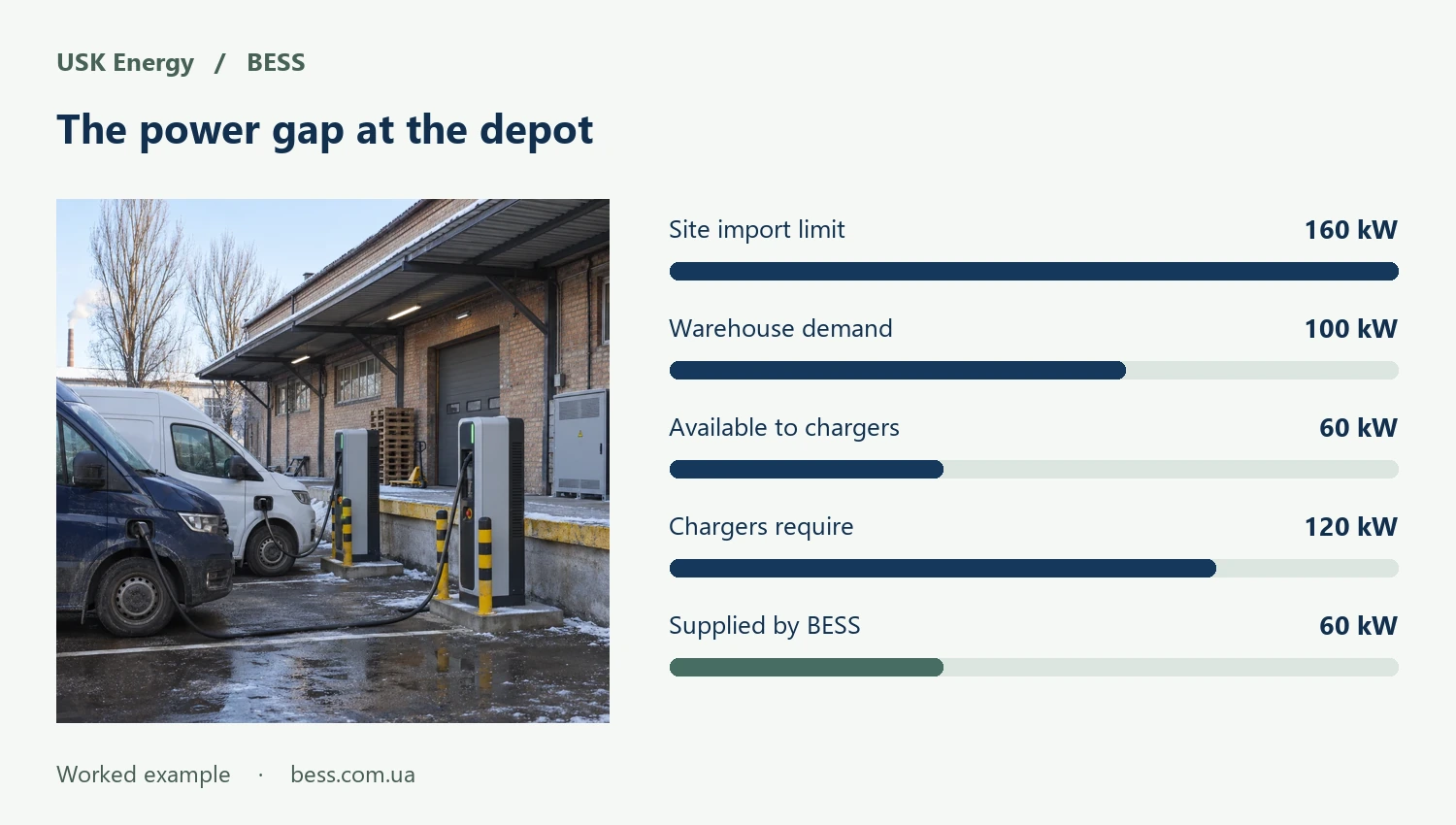
Assume a 160 kW import limit and a 100 kW warehouse load. That leaves 60 kW for chargers. Even after rescheduling flexible vehicles, urgent departures need 120 kW at the charger inputs for 45 minutes. Storage has to supply the missing 60 kW. Over three quarters of an hour, that amounts to 45 kWh delivered on the AC side.
This is the minimum useful output for one interval. If those vehicles can stay for 90 minutes, the grid alone can deliver the same 90 kWh at 60 kW. Rescheduling covers that case, provided the vehicles accept the power and building demand stays level.
Size the support for one charging interval
Choose the hardest interval remaining after dispatch has moved the flexible sessions. Enter the total input power of the chargers and the building load separately. If all you have is a common site meter reading, subtract charger power for the same moment to get the building load. Otherwise the chargers will be counted twice. Enter the minutes for which these loads actually overlap rather than the entire time the vehicle spends at the depot.
- Output power required
- 60 kW
- Support energy
- 45 kWh
- Energy to buy for recharge
- 50 kWh
This model assumes a common connection and steady demand within one interval. Reduce charger power as far as the departure deadlines allow and compare the two results. Zero output means the grid can cover this particular interval. For consecutive waves, carry the results into the shift schedule and account for stationary battery recharge between waves. Energy set aside to run the building during a complete grid outage is outside this result.
Translate one route into electricity at the charger
Dispatch usually knows the distance of the next run and the remaining range on the dashboard. A depot power calculation needs one more step, from energy in the traction battery to energy at the charger meter. Suppose the next route and its agreed driving reserve require 58 kWh, and the vehicle returns with 22 kWh available. The battery needs another 36 kWh. With an assumed efficiency of 90% between the station input and the traction battery, the site has to buy 40 kWh.
With exactly one hour to departure, the average input power would be 40 kW. An hour on the premises rarely guarantees an hour on the cable. Ten minutes spent unloading and moving to a free bay leaves fifty minutes of charging. Delivering the same energy now takes 48 kW on average. Look at plug-in records for several shifts. A buyer can find a considerable difference between gate arrival and session start before spending anything on another cabinet.
Allocate power backwards from departure
Draw up a dispatch sheet for a busy evening. For each vehicle enter the earliest plug-in time, the required energy at the charger input, the latest unplug time and a compatible bay. Start allocating power to the nearest deadline. The first van through the gate may come last in the power queue. Discuss that rule with dispatch before buying a controller, while it is still easy to test the consequences on paper.
In the example below the depot has a constant 60 kW of headroom. Losses have already been included in the input energy and both vans are plugged in. The urgent vehicle needs 40 kWh within an hour. The second needs 50 kWh within two hours. Both can leave on time on the existing connection. If the controller shares the first hour equally at 30 kW each, the urgent vehicle leaves 10 kWh short even though there is enough energy available over the two hours.
| Dispatch interval | Urgent van | Second van | Total station input |
|---|---|---|---|
| First hour | 40 kW for one hour | 20 kW for one hour | 60 kW |
| Second hour | Out on route | 30 kW for one hour | 30 kW |
When stationary storage changes the decision
A battery can do two distinct jobs. During a short interval it can supply the power missing above the grid ceiling. Over a longer period it can shift previously purchased electricity to the hours when the warehouse occupies the connection. For the first check, find the highest simultaneous power gap. For the second, add up battery output across consecutive intervals until an opportunity to recharge appears. A five-minute peak and an hour at the same power call for different energy capacities.
Test the case where the building exceeds the limit by itself. Suppose the warehouse briefly draws 170 kW on a 160 kW connection. There is already a 10 kW excess with the chargers switched off. A battery controlling the common site meter has to cover that excess as well as the chargers. A battery confined to the charging feeder may be unable to serve the building. In that configuration the building needs a separate demand limit. Ask the bidder to mark the control point on the single-line drawing.
What two occupied connectors can actually deliver
Two outlets on the same cabinet may share a set of power modules. Ask for the simultaneous output table and the conditions under which modules can move between outlets. Find out whether each connector accepts a separate power ceiling, how fine the adjustment is and what dispatch sees when the vehicle itself tapers the current. The rating on one outlet tells the buyer very little about what two drivers will receive when they plug in together.
A remote depot also needs a defined response to a lost data connection. Write the observable result into the enquiry: total import remains within the agreed limit, authorised local sessions continue and the log uploads with original timestamps when communication returns. Who holds the settings, and who can read the session records after the service agreement ends? The answers can change the purchase decision between otherwise similar packages.
Buying the next stage of fleet capacity
Ask for three separate prices: another parking bay with a connector, higher simultaneous station power and additional usable BESS energy. More bays reduce the queue for a cable. Another power module shortens charging for vehicles capable of accepting that power. More battery modules extend the support interval if paired with a suitable converter. Paying for one component seldom fixes all three constraints.
Give each bidder one normal day and one late-return day. Request a charging completion time and energy shortfall for each vehicle, together with the highest site import. If the model assumes constant charging power right up to departure, substitute at least one actual winter charging session. The difference between a predicted and a measured finish matters most on the vehicle with the earliest departure deadline.
Find the next recharge window
At an assumed 90% round-trip efficiency, replacing 45 kWh of output takes about 50 kWh of purchased electricity. With only 20 kW of headroom later on, replenishment takes at least two and a half hours. Mark those hours on the dispatch chart. If a second wave returns sooner, the storage requirement changes. Ring-fence any energy the warehouse wants to keep for an outage.
What to send with the enquiry
Send anonymised route records, the site meter profile and the charger models with their supported power-limit commands. Request two schedules: managed charging on the existing connection and the same departures served with a BESS. Give both suppliers the same acceptance criterion. Every priority vehicle receives its required energy by departure, and measured site import stays inside the agreed limit. Specify the local power ceiling that should apply if communication with dispatch is lost.