Two bids both say 200 kWh. One quotes nominal cell energy. The other guarantees energy at the cabinet output. Before comparing prices, put a metering point on the single-line diagram and write down the operating conditions under which both parties will read that meter.
Mark one boundary on the drawing
For a buyer backing up a production line, the AC bus that actually receives power is a useful boundary. A converter, transformer and cable may sit between the cells and that bus. A reading at the converter terminals leaves downstream losses outside the measurement. Agree how to account for separately supplied cooling and controls. Their consumption must appear once in the balance.
Follow a complete cycle
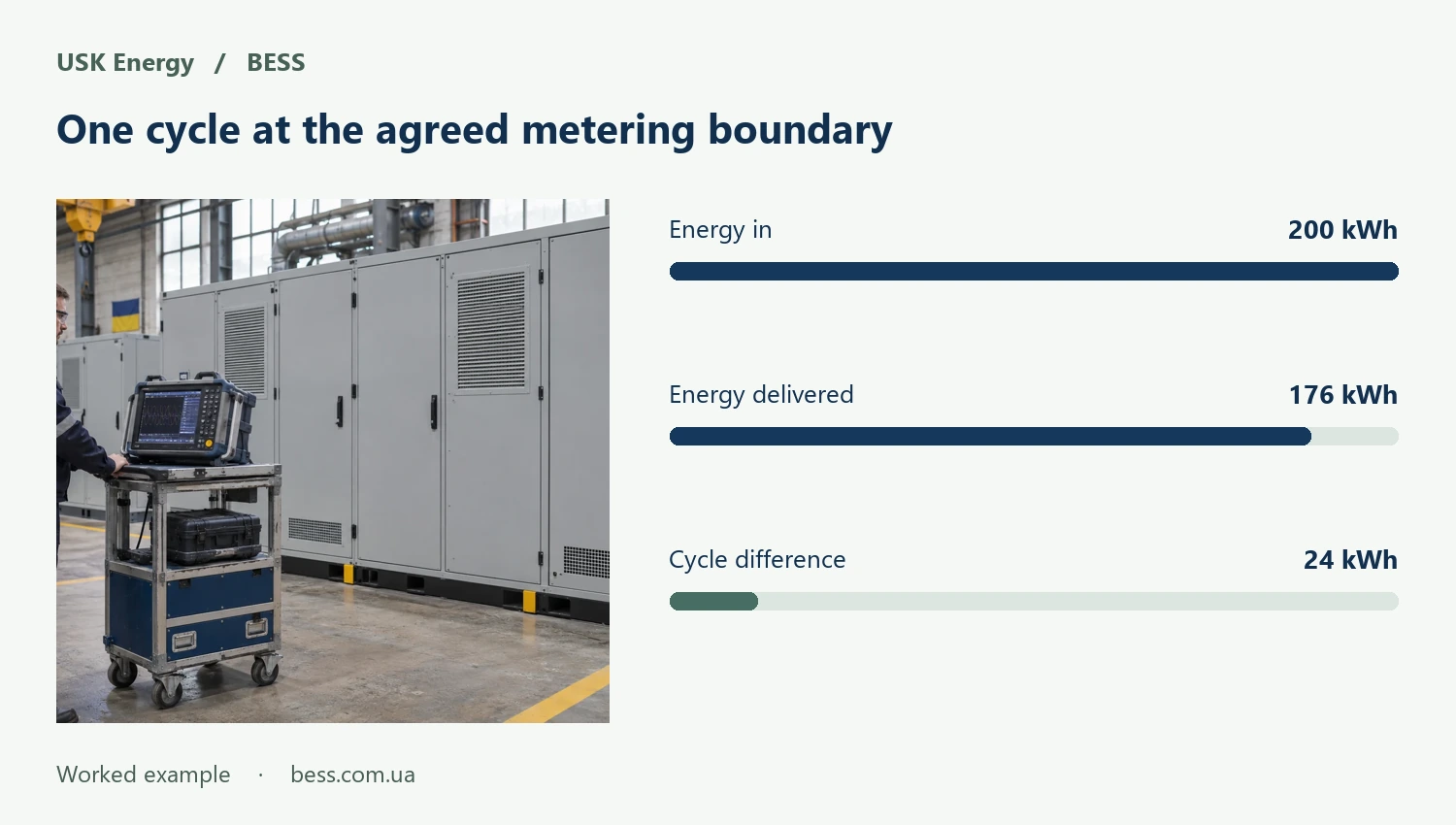
In this example the battery starts at its agreed lower state-of-charge limit. The meter records 200 kWh in during charging and 176 kWh out during the subsequent discharge. The battery ends at its initial state, both readings come from the same boundary, and auxiliaries are included. Round-trip efficiency is 176 / 200 = 88%. The 24 kWh difference belongs to the entire cycle. Those two readings alone cannot tell you inverter efficiency or how much cell capacity has faded.
At an average output of 88 kW the measured energy represents two hours of service. Verify performance separately for a different discharge rate, temperature or long standby period. PNNL’s field measurements illustrate why a test record should state the rest interval and how the auxiliary supply was metered.
Reconcile an acceptance cycle
Enter the change in each meter register over the whole agreed cycle. For example, if the import register read 12,530 kWh at the start and 12,730 kWh at the end, enter 200 in the first field. For output use energy actually delivered to the agreed bus. Add the separately purchased auxiliary supply only if it was metered over the same interval and is outside the recorded import. Leave the third field at zero when everything is behind one meter.
- Total input
- 200 kWh
- Cycle difference
- 24 kWh
- Round-trip efficiency
- 88 %
The tool returns the cycle difference and the ratio of useful output to total input. If output exceeds input, check the starting and ending charge limits, register directions and timestamps. Those readings cannot establish the efficiency of a completed cycle. Keep the full original meter readings in the acceptance record. The percentage on screen is rounded for readability. Use the precision and decision rule agreed in the contract when assessing the guarantee.
Put two prices on the same delivery boundary
Ask each bidder to complete one line: how many kWh will the buyer receive at the selected bus, at what power and temperature, in which year of service and after what period on standby? Only then divide the price by guaranteed output. If the only available denominator is nominal cell energy, leave the comparison blank. Converting the number with a brochure figure for inverter efficiency would conceal losses elsewhere and the battery’s permitted operating window.
Suppose bid A promises 180 kWh at the cabinet output and bid B guarantees 176 kWh at the plant bus. The first configuration has a transformer between the cabinet and the bus. Those figures cannot establish a winner. Asking bidder A to restate the guarantee at the bus is often simpler than agreeing on a correction for the transformer. Among other things, standby losses depend on how many hours it remains energised.
Record what happens between the beginning and the end
Mark four times: start of charge, end of charge, start of discharge and end of discharge. At each point save both meter registers and the reported battery state of charge. A year later the buyer can reconstruct the balance from those readings. Compare battery temperature, active power limits and the stop reason at the appropriate endpoints. A cycle stopped by dispatch and one stopped at the battery’s lower limit describe different operating conditions.
List the equipment left running between the steps. The cabinet chiller may run during a pause on a hot day. In winter the heater may draw power instead. If the purchase is intended to provide two hours of backup after a night on standby, specify the standby interval. A discharge immediately after charging answers a different question. The contract can include both runs when the owner intends to shift daily demand as well as back up production.
| Entry in the test record | Why the buyer needs it |
|---|---|
| Increase in the import register, kWh | Reconstruct purchased energy over the entire agreed interval |
| Increase in the export register, kWh | Recover the output measured at the common boundary |
| Stop reason and power-limit log | Establish whether the operating limit was reached or the run was interrupted |
Accounting for a separate auxiliary meter
Consider the original 200 kWh of charging energy and 176 kWh delivered. If the main meter already captures cooling and controls, the result stays at 88%. Now suppose an independently fed auxiliary circuit bought a further 4 kWh from the grid over the complete cycle, outside the recorded 200 kWh. With 176 kWh still delivered as useful output, total purchased input at the combined boundary becomes 204 kWh. Round-trip efficiency comes to about 86.3%. Moving a metering boundary changed the reported result without changing the equipment.
An auxiliary feeder may serve several cabinets. Its total reading does not automatically belong to the unit under test. Agree on dedicated metering or an allocation method and its precision before signing the specification. If separate data cannot be obtained, record that limitation on the certificate. Explaining a small gap between the measured and guaranteed figures later becomes difficult, especially if a neighbouring cabinet was also being cooled during the run.
Reading a result close to the guarantee
Agree at what stage to round the figures. With a 176 kWh threshold, a raw reading of 175.6 looks like 176 on a whole-number display. Two parties can walk away with different conclusions about the same test. Ask for the original meter resolution, details of the current transformers, calibration or verification records as applicable, and the decision procedure for borderline results. The contract should identify who can call for a repeat and who pays for it.
Read the output trace as well. If the buyer requires 100 kW continuously, total energy alone does not show that the requirement was met. The system could have reduced power halfway through a run and recovered part of the energy by discharging longer. Specify the permitted duration of a dip and the logging interval for power. Otherwise one supplier’s minute average may be compared with another supplier’s one-second maximum.
What will still be useful a year from now?
Keep the marked single-line drawing, module serial numbers, firmware revision, agreed charge limits and original logs with the acceptance record. A panel photograph is handy for a quick review, but it rarely identifies the full system configuration after a module swap. Give copies to both the purchasing organisation and the party handling warranty claims. Check that someone on the buyer’s side can actually open the files without the supplier’s online service.
For a repeat test a year later, attach the original cycle profile. Record any changes to the transformer, cooling settings, available charging power or reserved state-of-charge limits. That gives both sides a way to discuss a shortfall. An initial measurement at the cabinet and a repeat measurement beyond the transformer cannot, by themselves, establish that the usable capacity of the battery changed.
Put the test conditions in the supply contract
Agree on upper and lower charge limits, power level, rest periods, temperature, meter accuracy and acceptance tolerance. Ask for time-stamped power, energy, temperature and alarm records in a format the buyer can open without a service account. Set a retest procedure in case the grid fails halfway through a run. A shared file of original readings will do more for a future warranty claim than a photograph of the final display.
What the European battery passport adds
From 18 February 2027, Article 77 of EU Regulation 2023/1542 provides for an electronic passport for industrial batteries over 2 kWh placed on the EU market or put into service there, among other categories. For procurement in Ukraine, establish the batch’s intended market and request serial numbers, the applicable warranty revision and access terms for the data. The passport identifies the battery. The signed test record documents how much energy the delivered system supplied at your bus.