Battery Energy Storage for Printing Houses: Registration Protection and Backup Power
Offset presses lose registration when voltage sags or dips even for a few cycles. The web and ink go to scrap, and you pay for it twice: in wasted materials and lost production. A properly sized BESS acts as an instant-response UPS and a bill-reduction tool, with payback typically under 4 years.
Key parameters
The Physics of the Problem: Why Your Presses Scrap Jobs
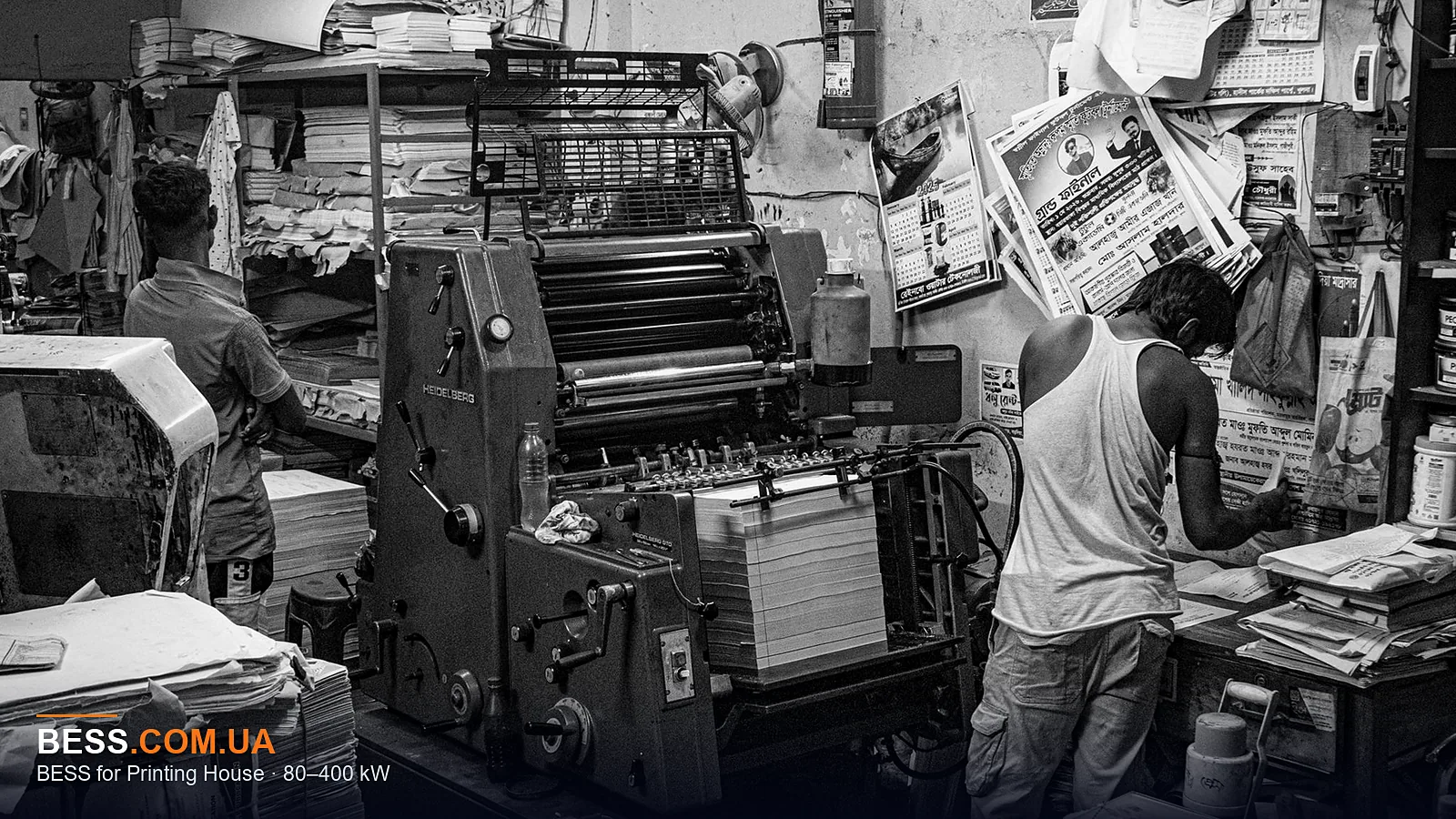
An offset press is a synchronous machine. The plate and blanket cylinders must stay locked to the web within a few microns. When grid voltage sags below ~85% of nominal, motor torque drops, the cylinders slip, and registration is lost. At 0.4 kV, even a 100 ms dip can shift the print by several millimetres. You may not see it until the next inspection, but by then you have a full pallet of scrap.
The grid does not care about your press. Nearby industrial loads—welding, motor starts, capacitor banks—cause repeated micro-dips. Your press's internal controller cannot correct a mechanical slip that already happened. The only fix is to supply the press with clean, stable power that does not sag.
Where the Money Leaks: Bill Decomposition and Hidden Costs
Your electricity bill has three parts: energy (UAH/kWh), capacity/demand (UAH/kW of peak demand), and reactive power penalties. For a printing house with 80–400 kW load, the capacity charge is typically 20–30% of the bill. But the biggest leak is not on the bill—it is in scrap. A single registration failure on a 1-tonne web can cost 10,000–20,000 UAH in paper and ink, plus 2–4 hours of downtime.
Storage attacks all three. It shaves peaks to cut the capacity charge, it provides reactive power correction if you have inductive loads, and it bridges short dips to prevent scrap. The energy arbitrage (buying cheap at night) is a minor bonus, not the main case.
Sizing: Power and Capacity for a Printing House
Power sizing is straightforward: take the worst-case press load during a dip. If your largest press draws 150 kW, you need at least 150 kW of inverter output for the duration of a typical dip (0.5–2 seconds). But to also cover a press hall backup of 10–15 minutes, you need more energy. For a 200 kW average load, 15 minutes is 50 kWh. So a 150 kW / 100 kWh system covers both.
For capacity, use the formula: E = P_avg × t_backup / DoD. With LiFePO4, DoD is 80–90%. If you want 30 minutes at 200 kW, you need 200 × 0.5 / 0.8 = 125 kWh. A 150 kW / 150 kWh system gives you a comfortable margin. Always oversize inverter power by 20% to handle motor inrush currents.
If you size too small, you get the worst of both worlds: you pay for a system that still lets dips through, and you cannot shave peaks effectively. The press still scraps, and the payback stretches to 7+ years. Sizing wrong is more expensive than not buying at all.
Input Data an Engineer Needs for a Feasibility Study
To give you a precise number, not a guess, we need three things. First, a 12-month load profile at 15-minute intervals—from your smart meter or a temporary logger. Second, your last 12 electricity bills, to see the peak demand and reactive power charges. Third, a single-line diagram of your 0.4 kV switchboard, showing which presses are on which feeders.
Without the load profile, any payback figure is rough. We can estimate, but the difference between a 3-year and a 5-year payback depends on your actual peak pattern. A site visit is mandatory—we check voltage quality with a power quality analyser for at least one production week.
What We Deliver: Turnkey BESS from Audit to Service
BESS Ukraine Engineering Group is a full-cycle EPC contractor. We do the audit, design, supply, installation, commissioning, and service. For industrial storage from 50 kW to 5 MW, we use LiFePO4 cells from CATL and other Tier-1 suppliers, with liquid cooling, BMS, EMS/SCADA, and IP55/C4 outdoor cabinets or 20/40 ft containers. We do not do residential—those go to SolarProm.com.ua.
We have done feasibility studies for printing houses in Kyiv and the regions. We know the grid conditions, the tariff structures, and the press behaviour. Call us at +380 44 339-50-20 or write to engineering@bess.com.ua. We will give you a concrete number, not a brochure.
Frequently asked questions
What size BESS do I need for a 200 kW printing press?
Will a BESS really prevent registration loss?
What is the typical payback period for a printing house BESS?
Do you provide financing or leasing options?
Can you install a BESS outdoors?
Figures shown are indicative. Exact sizing follows a site survey and load-profile analysis.