Battery Energy Storage for Livestock Farms: Keep Ventilation and Milking Running
A livestock farm loses money the moment the grid fails. Ventilation stops, milk pumps stall, and animals start dying within an hour. This page explains why battery storage is the right backup for your farm, how to size it, and when a diesel genset or UPS still makes sense.
Key parameters
The Physics of Farm Power Failure: Why an Hour Matters
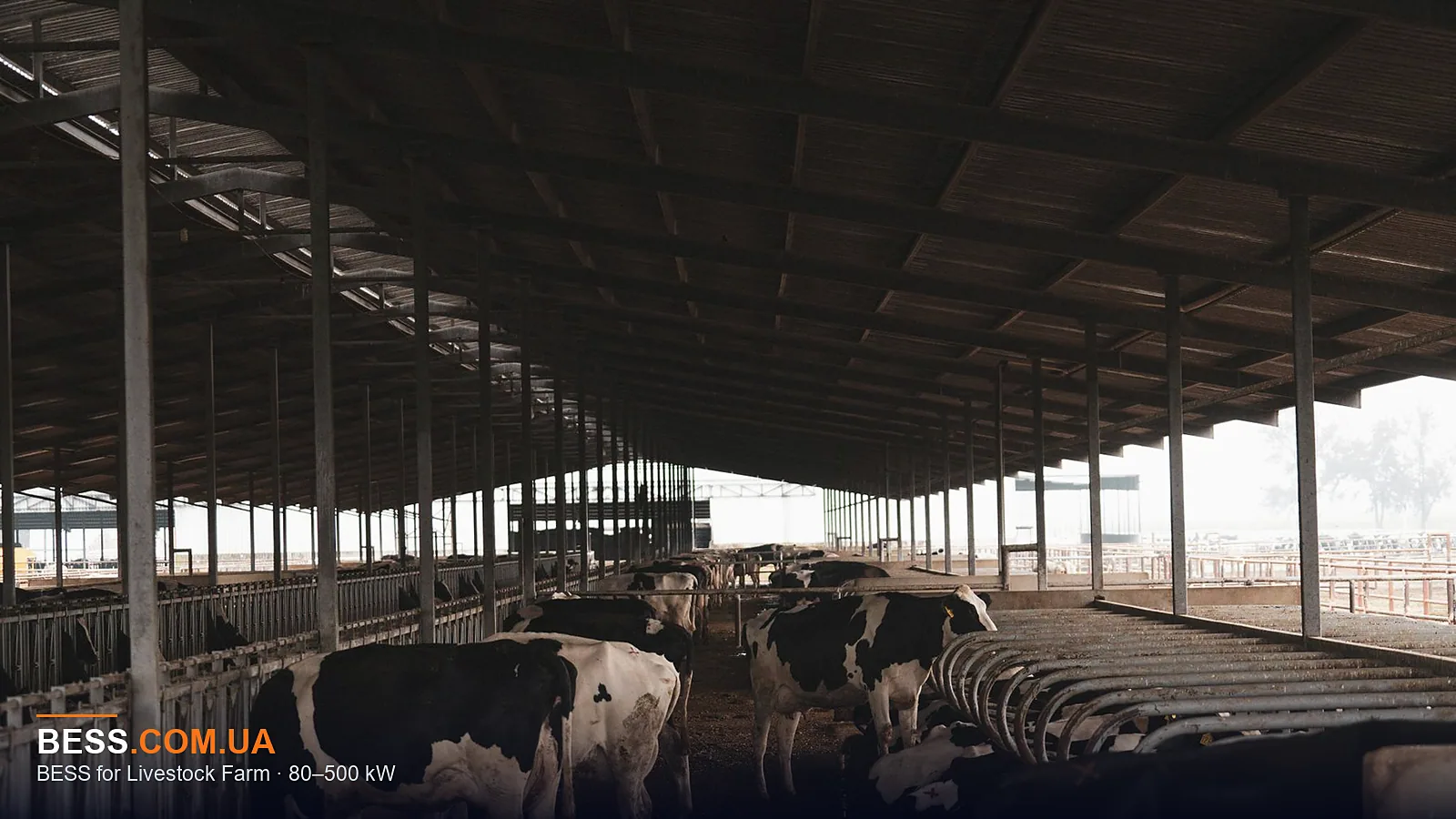
Your farm is a controlled environment. Cows, pigs, and poultry depend on continuous ventilation to remove heat, moisture, and ammonia. When the grid drops, ventilation fans stop. In a closed barn, temperature and humidity climb rapidly. For dairy cows, heat stress starts above 25°C; for pigs, above 30°C. Within 60 minutes, you can see reduced feed intake, lower milk yield, and in extreme cases, death.
Milking systems are equally critical. A vacuum pump and milk cooling system need stable power. A short outage of 10 minutes can cause milk to spoil in the lines, and a longer outage means you cannot milk at all. Water pumps for drinking and cleaning also stop, creating a cascade of problems.
The load profile is not constant. Ventilation fans run continuously, but with variable speed drives. Milking happens 2-3 times per day, each session lasting 2-3 hours. So your backup system must handle both a steady base load and short, high-power peaks.
Alternatives Compared: Diesel Genset, UPS, Grid Upgrade, or Storage
Diesel genset is the traditional choice. It can run for days, but it needs fuel supply, regular maintenance, and starts in seconds. However, it is noisy, emits fumes, and requires a weekly test run. For a farm, the total cost of ownership is high: fuel, oil, batteries, and engine overhauls. A 100 kW genset costs about 200,000 UAH, plus installation, and fuel costs around 25 UAH per kWh generated.
UPS (uninterruptible power supply) is designed for short outages, typically 10-30 minutes. It is not sized for hours. Using a UPS for a farm is like using a phone battery to power a house. It fails when you need it most.
Raising contracted capacity means paying the grid operator for more power. This does not help during a grid outage—you are still disconnected. It only helps if you are tripping breakers due to overload, which is a different problem.
Battery storage bridges the gap. It starts instantly, runs for hours, and can be recharged from solar or the grid. It also provides power quality benefits, like voltage support and frequency regulation. For a farm, 4-6 hours of backup is usually enough to cover the critical period until the grid returns or you start a genset.
Sizing Your BESS: A Practical Method
First, define the critical loads. Ventilation, milking, and watering are non-negotiable. Measure or estimate their power draw in kW. For a typical dairy farm, ventilation might be 20-40 kW, milking 15-25 kW, and water pumps 5-10 kW. So the total critical load is often 40-75 kW. For a poultry farm, ventilation can be 50% of the total load, so a 100 kW system is common.
Then, decide the backup duration. The minimum is 1 hour, but we recommend 4 hours to cover extended outages. Multiply the power by the duration to get energy in kWh. For example, 60 kW for 4 hours = 240 kWh. Add a 20% safety margin, so 288 kWh. A 300 kWh battery system is a realistic size.
Power rating is the inverter size. It must handle the peak starting current of motors. A 100 kW inverter can start a 50 kW motor, but check the inrush. Use the load profile to confirm. Also, the battery C-rate: a 300 kWh battery with a 100 kW inverter is 0.33C, which is fine for LiFePO4.
What Happens When You Size It Wrong
If you undersize the power, the inverter trips on overload when the milking pump starts. That is exactly when you need backup. If you undersize the energy, the battery runs out after 2 hours, and you are back to square one. Animals start dying, and you lose production.
If you oversize, you waste money. A 500 kWh system for a 50 kW load is overkill. Payback becomes too long, and the system may never pay for itself. We have seen farms that bought a used UPS and tried to run it for hours—it failed within minutes. Also, a system without proper cooling in a dusty barn will derate. That is why we use IP55 cabinets with liquid cooling.
Engineering Inputs We Need from You
To design a BESS that works, we need three things:
- Load profile: a 24-hour log of your power consumption, ideally from a power quality analyzer, for a week. This shows the peaks and cycles.
- Utility bills: 12 months of bills to understand your tariff, demand charges, and outage frequency. This helps calculate payback.
- Single-line diagram: the electrical layout of your farm, showing the main panel, loads, and any existing generators. This tells us where to connect the BESS.
Without a load profile, we can only give a rough estimate. For a typical 200 kW farm, a 150 kW / 600 kWh system is a starting point, but that figure is rough.
Frequently asked questions
How long can a BESS power a livestock farm?
Can I use solar panels with the battery?
What is the payback period for a BESS on a farm?
Do you install residential systems?
What is the warranty on the battery?
Figures shown are indicative. Exact sizing follows a site survey and load-profile analysis.