
Dry-type transformers: when they are worth it and what Ecodesign means
An honest comparison of cast-resin and oil-immersed transformers: price, fire safety, losses, noise, maintenance. How to size a rating in kVA and what…
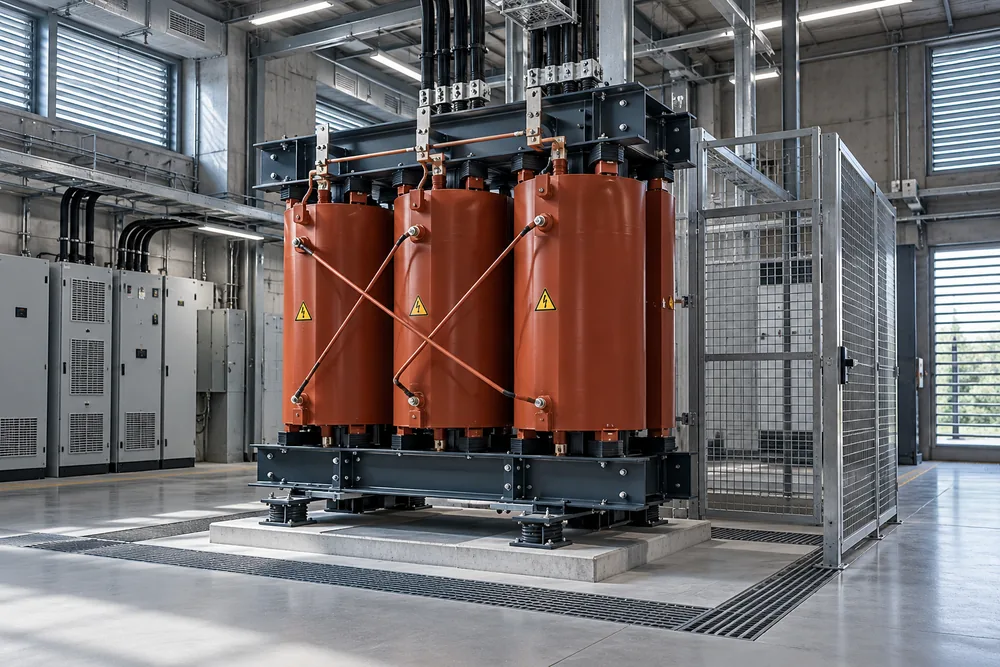
A dry-type transformer costs roughly one and a half to two times more than an oil-immersed unit of the same rating. That does not make it better or worse — it makes it the right answer to a specific set of conditions. Here are those conditions, and how to cost total ownership rather than the price tag.
Key parameters
Dry-type versus oil-immersed, without the sales pitch
Both do the same job. They differ in the medium that insulates and cools the winding: transformer oil in one case, cast epoxy resin or impregnated insulation with air cooling in the other.
| Criterion | Dry-type (cast resin) | Oil-immersed |
|---|---|---|
| Price at equal rating | 1.5–2× higher | baseline |
| Fire behaviour | class F1, self-extinguishing, no flammable liquid | needs an oil containment pit and fire measures |
| Where it can stand | inside a building, near the load, in a basement | separate room or outdoors, with mandated clearances |
| Maintenance | inspection and blowing out dust | oil level checks, oil sampling, top-up |
| Moisture and dust | needs an IP enclosure, dislikes condensation | sealed tank, works outdoors |
| Noise | 3–6 dB higher | lower |
| Overload capability | lower, less thermal mass | higher, oil stores heat |
| Service life | 20–25 years | 25–30 years with oil care |
| Disposal | simpler, no liquid | oil is a separate waste class |
In short: dry-type when the transformer has to stand inside — in a shopping centre, a hospital, on an upper floor, in the basement of an office block, near people. Oil-immersed when there is outdoor space or a separate room, and the priority is overload capability per unit of money.
For energy storage there is one more angle: containerised BESS from 1 MW are normally supplied with a dry-type transformer, because it sits inside the container or in a skid next to it, where an oil pit is impossible.
Ecodesign: why losses are now regulated
Until 2015 a less efficient transformer was simply cheaper and the buyer decided whether to pay for losses or for the unit. Loss levels are now mandated.
EU Regulation 548/2014 set maximum no-load and load losses in two stages: Tier 1 from 2015 and the stricter Tier 2 from 2021. The corresponding Ukrainian standard is DSTU EN 50588-1, and serious suppliers state the loss level explicitly in the specification, in a form such as Ao Bk or Tier 2.
What the figures mean in practice. No-load loss (P₀) is carried continuously, all year, whatever the load — 8,760 hours. Load loss (Pk) scales with the square of loading. For a typical 630 kVA unit the difference between an older design and Tier 2 is roughly 600–900 W of no-load loss alone.
| Rating | P₀, Tier 2, indicative | Pk, Tier 2, indicative | No-load energy per year |
|---|---|---|---|
| 250 kVA | ~360 W | ~2,750 W | ~3,150 kWh |
| 400 kVA | ~520 W | ~3,850 W | ~4,560 kWh |
| 630 kVA | ~730 W | ~5,400 W | ~6,400 kWh |
| 1000 kVA | ~1,100 W | ~9,000 W | ~9,640 kWh |
| 1600 kVA | ~1,700 W | ~14,000 W | ~14,890 kWh |
These are indicative for Tier 2 dry-type units; exact values always come from the datasheet of the specific design. But the order of magnitude makes the point: over twenty years the cost of losses is comparable to the cost of the transformer, and sometimes exceeds it. That is why industrial tenders compare total cost of ownership — price plus capitalised losses, not the price. The calculator below does exactly that.
How to size the rating
Three mistakes that repeat from project to project.
First: sizing in kilowatts. Transformers are rated in kilovolt-amperes — apparent power. The active power delivered equals kVA × cos φ. On a plant with induction motors cos φ is 0.8–0.9, so a 500 kVA unit delivers 400–450 kW. If you genuinely need 500 kW of active power, the answer is 630 kVA.
Second: sizing right up to the peak. Running continuously at 100 % of rating accelerates insulation ageing: every extra 6–8 °C on the winding roughly halves its life. Design loading is set at 70–80 %, and that is standard engineering practice rather than caution.
Third: forgetting storage and charging. A 500 kW BESS in charge mode is another 500 kW of load on the same transformer. So are forklift chargers. Taking the next rating up once is far cheaper than replacing the substation in two years.
The standard rating series: 25, 40, 63, 100, 160, 250, 400, 630, 1000, 1250, 1600, 2000, 2500 kVA. Intermediate values are not standard — a "500 kVA" unit exists in some manufacturers' catalogues, but the base series is the one above.
What drives the price
- Rating. The largest factor, but not linear: price per kVA roughly halves between 100 and 1600 kVA.
- Dry-type or oil. A multiplier of 1.5–2 in favour of oil.
- Loss class. Tier 2 costs 10–20 % more than older designs and repays that in four to seven years through losses.
- Voltage class. 6 and 10 kV are baseline; 35 kV is noticeably more.
- Tap changer. Off-circuit is included; an on-load changer adds 25–40 %.
- Enclosure and climate rating. A bare dry-type unit is IP00; most rooms need IP21–IP54, which is a separate line item.
- Scope. A complete package substation with MV cubicle, LV board and metering costs substantially more than the transformer alone — and installs in a day.
Price ranges by rating and a breakdown of package substations are on the transformer pricing page. For a selection against a specific supply arrangement, a single-line diagram and the load maximum are usually enough — both are in the questionnaire.
What twenty years of losses cost
A transformer is bought once and its losses are paid every month. See what a difference in loss class costs at your tariff.
Loss values are typical for Tier 2 dry-type units under DSTU EN 50588-1. No-load loss runs 8,760 hours a year regardless of load; load loss scales with the square of loading. For a specific design take P₀ and Pk from the datasheet.
Frequently asked questions
Why choose a dry-type transformer over an oil-immersed one?
How much does a dry-type transformer cost?
What is transformer Ecodesign?
How do I calculate the transformer rating I need?
What do transformer losses cost over twenty years?
Which insulation class is required?
Can a dry-type transformer be installed outdoors?
Figures shown are indicative. We supply the equipment and size the system; design, installation and commissioning are arranged through contractors when needed and quoted separately. Exact sizing follows a load-profile analysis.
Need equipment?
Request a quotation.
Send a model, specification or describe your requirements. We will clarify the configuration, check supply terms and prepare a price quotation.