
What is BESS? Power, capacity and equipment selection
How battery storage, PCS, BMS and EMS work; how BESS differs from an online UPS; and what a business needs to specify before buying equipment.
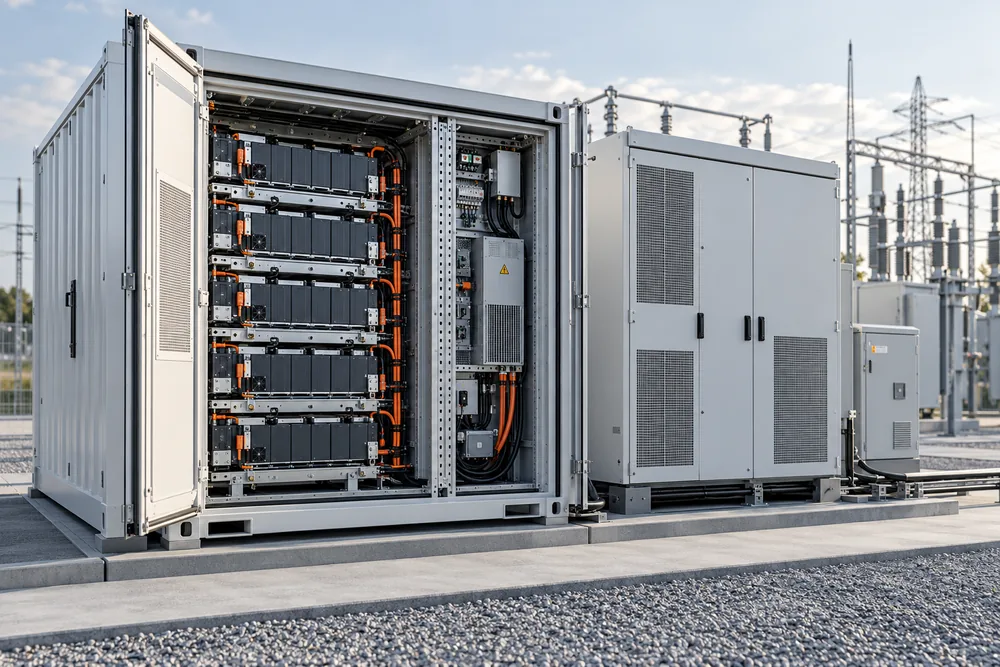
BESS stands for Battery Energy Storage System. The battery stores energy, PCS converts between DC and AC, BMS supervises the battery, and EMS controls operating schedules. Depending on the configuration, a business can use it for backup, generation management or load management.
kW and kWh answer different questions
Power in kW determines the simultaneous load a system can support. Energy capacity in kWh determines the stored energy. A 100 kW load consumes 200 kWh in two hours; that is not yet the required battery nameplate capacity because losses, SOC limits and ageing matter.
Choosing capacity alone can leave a plant short of power during equipment starting. Choosing a kW rating alone does not establish backup duration.
BESS, ESS and online UPS
ESS is a broader category of energy storage; BESS is its battery-based subset. A double-conversion online UPS supplies the load through an inverter and has no output interruption when changing to battery in normal online operation. ECO mode, bypass and overload require separate assessment.
BESS should not automatically be treated as a UPS. Island operation, black start and transfer time depend on PCS, switching and controls. Loads that cannot tolerate an interruption may need a separate online UPS supplied by a compatible longer-duration backup source.
What storage can actually do
Support selected circuits; reduce peaks within the PCS rating; shift surplus PV generation; reduce generator running in a compatible arrangement. The outcome depends on the time-series load, energy contract and available battery charge.
Storage has conversion losses and auxiliary consumption. Fans, pumps and cooling equipment may generate noise. Claims of loss-free operation, silence or guaranteed payback do not replace model-specific data.
Start with the purchase requirements
Identify critical circuits, running kW and starting currents, allowable interruption, backup duration and spare capacity for recharge. Include the PV, generator, voltage and proposed location.
USK Energy can use these requirements to prepare an equipment specification. Agree the models, quantities, documentation and warranty terms before ordering.
From calculation to equipment
Preparing an equipment purchase? Send the load, backup duration or specification. USK Energy will clarify the configuration, compatibility and delivery terms.
Need equipment?
Request a quotation.
Send a model, specification or describe your requirements. We will clarify the configuration, check supply terms and prepare a price quotation.