
Turnkey BESS: supply, installation and commissioning on your site
Turnkey industrial battery storage from 30 kW to 5+ MW: equipment supplied by us, installation and commissioning by vetted contractor crews. Cost split,…
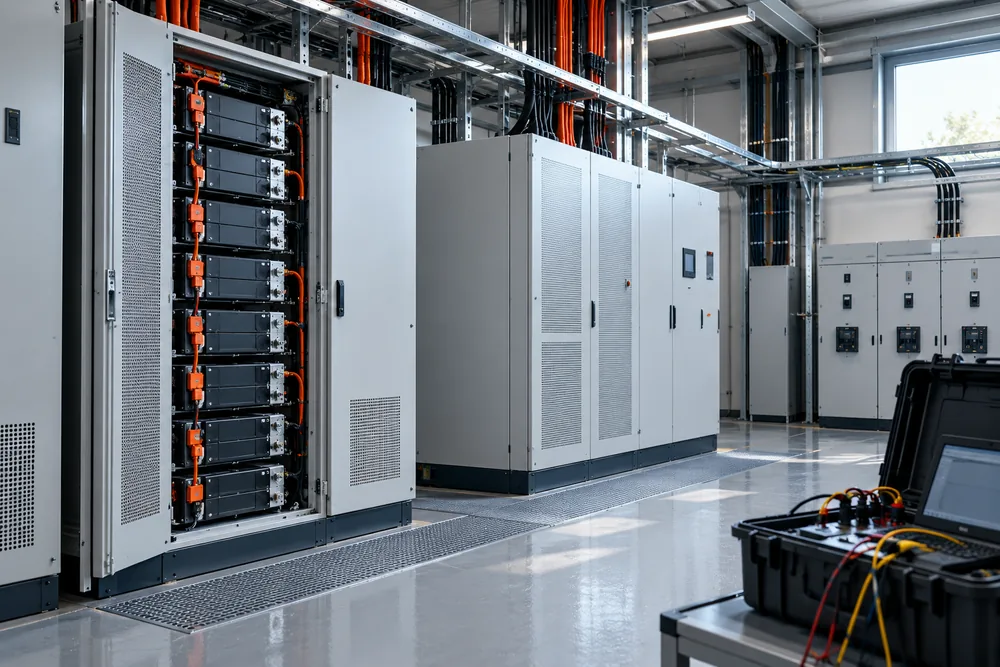
Turnkey here means we size and supply the equipment, and installation, connection and commissioning are carried out by contractor crews we coordinate. You get one schedule and one point of contact, with equipment and works quoted as separate lines.
Key parameters
What turnkey covers, and what is quoted separately
The word means different things to different vendors, so start with the boundary. We are answerable for a working system on your site: sizing, supply, coordinating the installation, commissioning, documents and the manufacturer's warranty. The electrical work itself is done by contractor crews — the ones we have already worked with in that region. That distinction is not paperwork: if something goes wrong, the equipment is our liability and the site work is the contractor's, and both need to be written down.
| Stage | Who does it | Whose line in the quote |
|---|---|---|
| Sizing power and capacity | our engineer | free, from the questionnaire |
| Equipment supply | us | equipment quote |
| Design and DSO approvals | design office | separate line |
| Civil readiness of the site | client or contractor | separate line |
| Electrical installation and cabling | contractor crew | separate line |
| Commissioning, EMS setup | contractor + our engineer | separate line |
| Equipment warranty | manufacturer, through us | included |
| Service after start-up | service crew | maintenance contract |
Which of these you actually need is settled with the manager after the questionnaire. Roughly half of our clients have their own electrical department and take equipment plus supervision only. The other half would rather not hunt for contractors, and we assemble the whole chain. The prices differ, and it is better to know that at the start than halfway through.
How the budget splits
A quote always has three parts, and the proportion between them is fairly stable.
Equipment — 75–88 % of the budget. LiFePO4 modules, the bidirectional converter, BMS, EMS, cabinet or container, climate control, fire suppression, switchgear. The rate per kilowatt-hour falls as the system grows: $240–400 for 30–150 kW racks, $175–300 for 100 kW – 1 MW cabinets, $125–230 for containers above 1 MW.
Installation and commissioning — 8–18 % of the equipment cost. The low end is 0.4 kV, an existing room and a short cable run. The high end is 6–10 kV with its own switchgear cubicle, an outdoor position needing a foundation, long runs, or work that cannot stop production. The exact figure comes from the contractor after a site survey.
Design and approvals — from a few thousand dollars. Not always required. A system that only serves on-site consumption, exports nothing and does not change the contracted demand needs very little. The moment export or a change of supply arrangement appears, it becomes a full design with the distribution system operator.
Which is why a turnkey price quoted without input data is a number off the ceiling. We will not give one, even roughly, before seeing the power, the voltage class and where the equipment goes. How the equipment price is built up is a separate matter.
How long it really takes
Six to fourteen weeks from a completed questionnaire to a working system. The spread is wide and mostly outside our control.
Weeks 1–2. Sizing and budget proposal. An engineer sizes the system against your load profile. With metering data it is a calculation; without it, an estimate, and the configuration has to carry margin.
Weeks 2–4. Site survey and the works quote. The contractor looks at where the equipment stands, where the cable runs, whether there is room to service it and how ventilation will work. The second half of the quote follows.
Weeks 3–10. Supply. Stock items take 2–4 weeks. Built-to-order containerised systems take 8–12. This is the longest and least flexible stage, so the order is placed the moment the specification is signed.
In parallel. Site preparation. Foundation or floor reinforcement, cable routes, ventilation, earthing. Done while the equipment travels — which is why the total is not the sum of the stages.
Final 1–2 weeks. Installation and start-up. Installing a 200–500 kW system takes 3–7 days. Commissioning takes another 2–5: insulation testing, phasing, protection settings, EMS modes, a timed transfer-to-backup test, and a run under real load.
What we need from you to start
Six things. You already have five of them.
- A single-line diagram of the site supply — a phone photo of the board drawing is enough.
- Contracted demand and the incoming voltage class: 0.4 / 6 / 10 / 35 kV.
- Electricity bills for 6–12 months, which show the tariff and the seasonality.
- A load profile from your metering system if you have one. This is the single most valuable file on the list: it turns an estimate into a calculation.
- Somewhere to put it, with dimensions. A room, an outdoor pad, or space for a container.
- The objective. Ride through outages, shave peaks, arbitrage the tariff, burn less diesel — this is what decides how many hours of capacity to specify.
The simplest way to gather it in one place is the requirements questionnaire: five to seven minutes, saved in your browser, and you can come back to it. Skip anything you do not know — the engineer will ask separately.
When turnkey gets complicated
Better said in advance than in the middle of an installation.
No position with sensible access. A battery cabinet weighs 1.5–4 tonnes. If it has to go up a narrow staircase to the first floor, that is a logistics project of its own, and an outdoor container is sometimes cheaper.
A 6–10 kV supply with no spare cubicle in the switchroom. Then a cubicle, or a whole switching station, joins the budget, and it is not a small line. This is settled at the survey, not later.
Production that cannot stop even for an hour. The connection is made through a bypass and at night. It costs more and takes longer, but it is done.
Tired existing cabling. Sometimes the incoming cable is already at its limit and the storage system has to be fed on its own run. That shows up at the survey, which is why the survey happens before the works quote is signed rather than after.
Work out the order of magnitude
The sliders give a range, not a quotation: the real figure depends on the load profile, the voltage class and where the equipment stands. The order of magnitude, though, is honest.
Equipment follows the site-wide price ladder: $240–400/kWh up to 150 kW, $175–300 up to 1 MW, $125–230 above. Installation runs 8–18 % of equipment. Ex-VAT.
Is your site ready
Seven things the contractor checks during the survey. Tick what already exists — the rest becomes separate lines in the quote.
Effectively no site yet — budget the full preparation.
Frequently asked questions
Can I order equipment only, without installation?
Who is liable if something does not work after installation?
How much does BESS installation cost?
Do you work across the whole of Ukraine?
Is a design and grid approval needed?
What if I have no metering data?
How long does such a system last?
Can the system be expanded later?
Figures shown are indicative. We supply the equipment and size the system; design, installation and commissioning are arranged through contractors when needed and quoted separately. Exact sizing follows a load-profile analysis.
Need equipment?
Request a quotation.
Send a model, specification or describe your requirements. We will clarify the configuration, check supply terms and prepare a price quotation.