Using Hithium High-Capacity Cells in Industrial BESS: Pre-Design Survey Checklist
Before specifying a battery energy storage system (BESS) with Hithium cells, you need to verify site conditions, grid parameters, and the cell's real-world performance. This page is a checklist for the pre-design survey we run on every industrial project in Ukraine, 50 kW to 5 MW.
Key parameters
Where Hithium Cells Sit in the BESS Topology
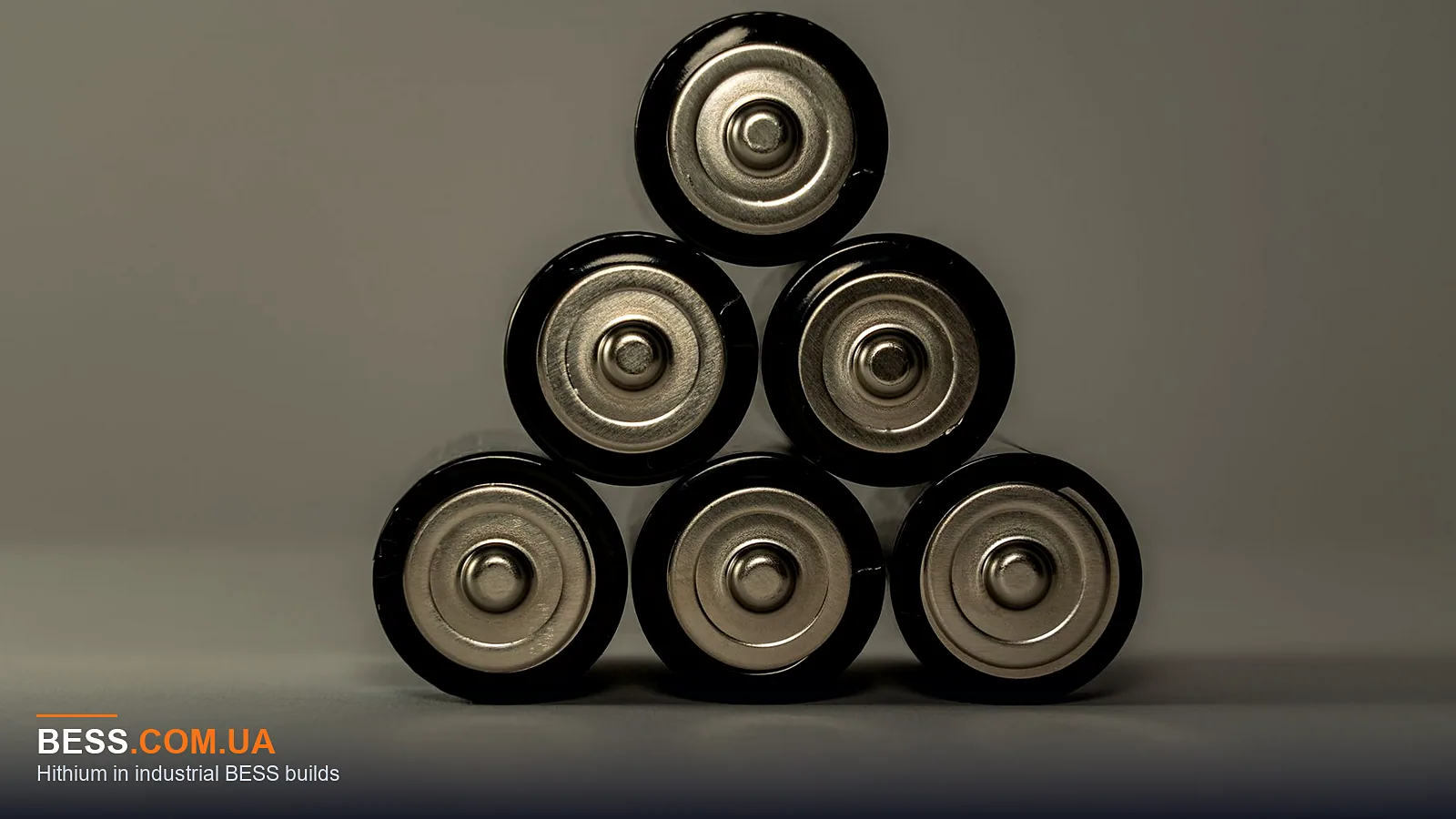
Hithium manufactures high-capacity lithium iron phosphate (LiFePO4) cells, typically 280 Ah to 1130 Ah, rated up to 12,000 cycles. They are the electrochemical core of the storage block. In a typical industrial BESS, the cell is the basic unit: cells are grouped into modules, modules into racks, racks into battery clusters, and clusters are connected to a DC bus.
That DC bus feeds a power conversion system (PCS) — usually a bidirectional inverter — which converts DC to AC for the grid. The battery management system (BMS) monitors cell voltage, temperature, and current, and balances the cells. The energy management system (EMS/SCADA) oversees the entire plant, including grid interaction.
When we design a system around Hithium cells, we focus on the integration boundaries: the DC bus voltage, the PCS input range, thermal management (liquid cooling is standard for these large cells), and the mechanical enclosure (IP55 outdoor cabinets or 20/40 ft containers).
Incoming Inspection and Acceptance of Hithium Cells
On delivery, we check the cell packaging for damage during transport. Each cell should have a datasheet with a specific capacity, internal resistance, and voltage. We verify the batch number and the date of manufacture — cells older than six months may need a formation charge.
We measure open-circuit voltage (OCV) on a sample (typically 5% of the batch) and compare it to the manufacturer's spec. If any cell deviates by more than ±50 mV, we flag it. We also check the insulation resistance between the cell terminals and the case — should be above 100 MΩ at 500 V DC.
We recommend a capacity test on a full rack before commissioning. That means a full discharge at the rated C-rate, usually 0.5C, to confirm the actual capacity is at least 95% of the nameplate. This is a contractual acceptance test.
Grid Constraints to Verify Before Design
First, you need the grid connection parameters: nominal voltage (0.4 kV, 10 kV, 35 kV, or 110 kV), short-circuit power at the point of common coupling (PCC), and the maximum allowed power injection/absorption. Without this, we cannot size the PCS or the transformer.
Second, the local grid code: in Ukraine, for systems above 50 kW, you need a technical connection agreement with the distribution system operator (DSO). That agreement defines the ramp rate, frequency response, and reactive power capability. We've seen projects where the DSO required a 10% ramp limit, which affects the EMS logic.
Third, the load profile. If you are doing peak shaving or arbitrage, we need at least 15-minute interval load data for one year. If you are doing frequency regulation, we need the exact performance requirements from the transmission system operator (TSO). Without that, the battery size and cycle life estimates are rough.
Warranty, Service, and Spare Parts in Ukraine
Hithium offers a standard warranty on cells: typically 10 years or 8,000 cycles, whichever comes first, with a capacity retention of at least 80%. But the warranty is only valid if the cells are operated within the specified temperature, current, and voltage windows. We document our thermal and electrical design to ensure compliance.
In Ukraine, spare parts for Hithium systems are not always stocked locally. That means we plan for a critical spares kit at the site: a few spare modules, BMS boards, fuses, and contactors. We also work with the distributor to establish lead times for replacement cells — usually 6-8 weeks from China.
We provide local service through our engineering team in Kyiv. We have experience commissioning Hithium-based systems and can offer a remote monitoring contract for proactive maintenance. The service contract includes an annual preventive visit and 24/7 remote support.
Our Integration Experience and Approach
We have built BESS projects using Hithium cells in the 280 Ah and 314 Ah formats. Our typical configuration is a 1 MW / 2 MWh containerized system with liquid cooling. The cell voltage is 3.2 V nominal, and we arrange them in series to reach a DC bus voltage of 800-1500 V, depending on the PCS.
We have experience with both new installations and retrofits. In a retrofit, we might replace the cells in an existing BESS container while keeping the PCS and BMS if they are compatible. That requires checking the cell's impedance and voltage vs. the old cells — mixing cell generations is not recommended.
We are not an official distributor of Hithium. We are an engineering contractor that integrates Hithium cells into complete systems. We procure cells through authorized supply chains, but our value is in the design, integration, and commissioning. For residential storage, we refer clients to SolarProm.com.ua.
Frequently asked questions
What is the typical cycle life of Hithium cells in a BESS?
How do I know if Hithium cells are compatible with my existing PCS?
Can I get spare Hithium cells in Ukraine?
What is the cost of a Hithium-based BESS per kWh?
Do you provide maintenance for Hithium systems?
Figures shown are indicative. Exact sizing follows a site survey and load-profile analysis.