Battery Storage for Warehouse & Logistics: Where Your Bill Leaks and How to Stop It
Your warehouse electricity bill has three parts: capacity charge, energy charge, and demand peaks. Forklift charging creates a predictable peak that you pay for all year. A correctly sized battery shifts that load to the night tariff and pays for itself in 3-5 years.
Key parameters
The Physics of a Warehouse Load Profile
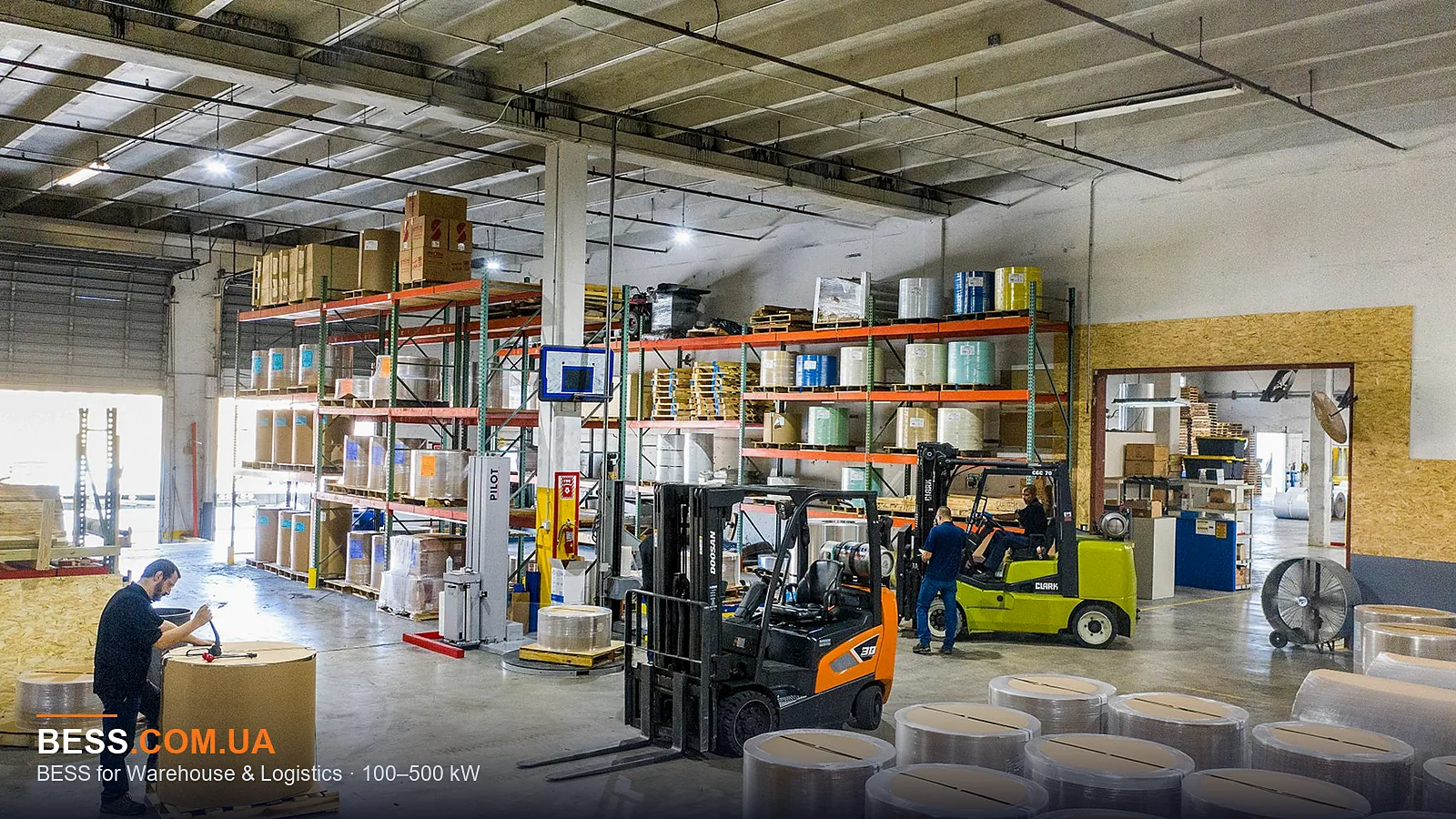
A warehouse with 20 forklifts draws 10–15 kW per charger during charging. That is 200–300 kW added to your evening peak, right when the grid tariff is highest. Cold rooms cycle with a 30–40% duty cycle but their inrush current can be 6–8 times running current. Doors and conveyors add short spikes that trigger demand charges.
Your electricity bill is composed of three components: the energy charge (UAH/kWh), the capacity charge (UAH/kW of declared maximum), and the demand charge (UAH/kW of the highest 15-minute average). The capacity charge is paid every month, based on the absolute peak, even if it lasts only 15 minutes. Forklift charging is the biggest offender.
Storage removes the demand peak by charging at night (23:00–07:00) at the low tariff and discharging during the afternoon peak. It shaves the 15-minute maximum, reducing both the capacity and demand charges simultaneously.
Sizing: Power and Capacity for 100–500 kW Sites
Power (kW) must cover the peak load you want to shave. For a typical warehouse, that means 100–250 kW of discharge power. Capacity (kWh) must cover the duration of that peak – usually 2–3 hours of forklift charging plus cold room backup. That gives 300–750 kWh for a 100 kW / 300 kWh system.
Use your actual 15-minute load profile from the past 12 months. Identify the top 20 peaks and their duration. Size the battery to shave the top 10% of those peaks. If you don't have a load profile, we can install a logger for two weeks – that is the only honest way.
For backup of cold rooms and conveyors, you need a separate UPS path or a hybrid inverter. The battery alone cannot handle 100% of loads without a transfer switch and a carefully designed control system.
What Happens When You Size It Wrong
Oversizing means you pay for capacity you never use – the payback stretches to 7-8 years. Undersizing means the battery is empty by 16:00, and the demand spike still hits the grid. You get no bill reduction and no backup.
Another common mistake: ignoring cold room inrush. If the battery has to start a 20 kW compressor with a 6x inrush, it will trip the inverter unless the battery can deliver 120 kW for 100 ms. We always check motor start currents before finalising the design.
The Business Case: Payback and ROI
The average warehouse in our region pays 4.5 UAH/kWh during peak and 1.8 UAH/kWh at night – a delta of 2.7 UAH/kWh. A 100 kW / 300 kWh system can shift 300 kWh per day, saving 810 UAH per day, or about 24,300 UAH per month, assuming 30 working days.
Add the reduction in capacity charge: if you cut the declared maximum from 500 kW to 350 kW, at 150 UAH/kW/month, that's another 22,500 UAH per month. Total monthly savings ≈ 46,800 UAH. With a system cost of around 3.5 million UAH (including installation), the payback is about 6.2 years.
If you also use the battery for backup, you avoid the cost of a diesel generator and the risk of spoiled goods. That intangible value can shorten the payback to 4-5 years, but it depends on your specific site.
What We Need From You to Give a Precise Quote
We don't quote from a phone call. We need three things: your last 12 months of electricity bills (PDF or Excel), a load profile from your meter (15-minute intervals), and a single-line diagram of your electrical room. If you don't have a load profile, we can install loggers for two weeks – no charge.
With that data, we can simulate the battery operation in software and give you a guaranteed savings figure. We design, supply, install, and commission the system, including the container, switchgear, and control software. We use CATL LiFePO4 cells, liquid cooling, and IP55 cabinets – built for outdoor installation.
Frequently asked questions
How much does a BESS for a warehouse cost in Ukraine?
Can a battery power my warehouse during a blackout?
Will the battery reduce my capacity charge?
What is the payback period for warehouse storage?
Do you provide maintenance after installation?
Figures shown are indicative. Exact sizing follows a site survey and load-profile analysis.