Battery Storage for Warehouses and Logistics in Brovary
Your cold rooms, conveyors, and forklift chargers are the first to suffer when the grid dips. A BESS tied to DTEK Kyiv Regional Grids shifts your biggest load – forklift charging – to night tariff and keeps doors moving during outages. Here is what that looks like for a typical 100–500 kW site in Brovary.
Key parameters
What breaks or costs money first in a Brovary warehouse
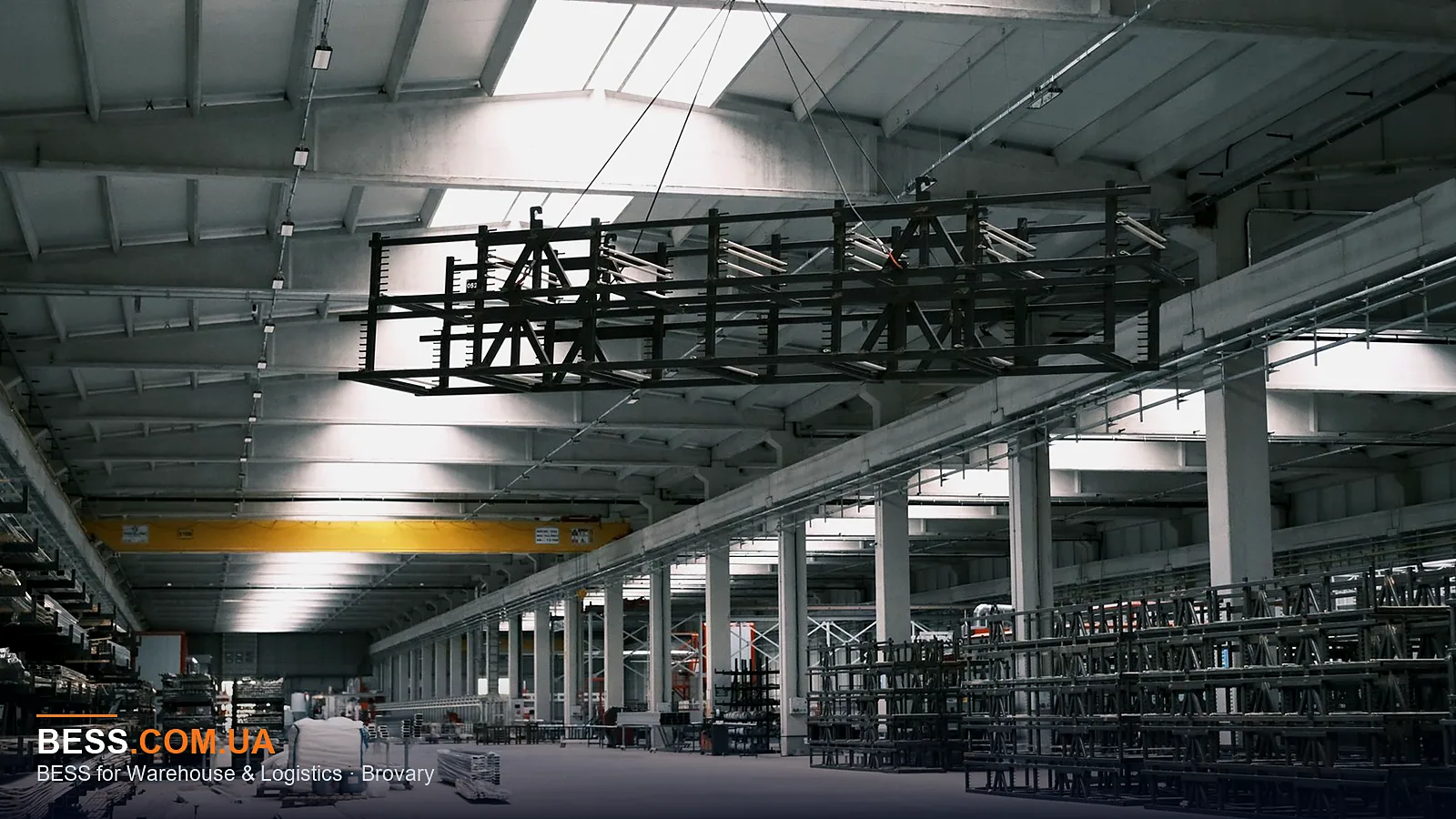
Brovary is a logistics hub for Kyiv Oblast, with dozens of warehouse complexes and food production sites. Your grid connection is via DTEK Kyiv Regional Grids, and the local 10 kV and 0.4 kV networks are not getting more stable during wartime. The first thing that hits your bottom line is not a full blackout – it is the repeated short dips and scheduled outages that make cold rooms cycle and conveyors stop.
Forklift charging is the biggest controllable load. Most facilities charge 20–30 forklifts during the day, when the tariff is highest. A 30 kW charger per forklift, running 4–6 hours, adds up to hundreds of kWh at peak price. Then, when the power goes out, your cold room compressors restart with a surge that can overload a small generator, and the doors lock – that is a safety and spoilage problem.
Without storage, you are exposed to every fluctuation. A generator covers only the essentials, not the full site, and fuel is expensive. You need a system that absorbs the dips, shifts the charging load, and gives you ride-through for the first minutes of an outage – that is where a BESS fits.
How BESS closes the gap: peak shaving and backup
A BESS with 100–500 kW power and 2–4 hours of capacity (200–2000 kWh) does two things. First, it charges at night when DTEK's tariff is 30–50% lower, and discharges during the day to power forklift chargers and other loads. That is time-of-use arbitrage – you pay less for the same energy. Second, it acts as an instant backup: in island mode, it takes over within milliseconds, giving you enough time to start a genset or shut down safely.
For cold rooms, the BESS must be sized to cover the starting current of compressors – typically 3–5 times the running current. If you have a 50 kW cold room, expect a 150–250 kW surge for a second. A BESS with a high discharge rate (C-rate) handles that, but only if the inverter is sized accordingly. At 0.4 kV, this works for most sites up to 500 kW; above that, you should consider a 10 kV connection.
The business case is simple: if you shift 500 kWh per day to night tariff, at a difference of 2–3 UAH/kWh, you save 1,000–1,500 UAH per day. That is 300–450 thousand UAH per year. Add the avoided spoilage and downtime – the payback is often 3–4 years.
Sizing for Brovary: specific considerations
Every warehouse is different, but there are common patterns. Start with your load profile – the most important data. Without it, any figure is rough. We need to know your forklift charging schedule, cold room duty cycles, and conveyor run times. For a typical 100–500 kW site, the BESS power should match your peak demand during the day – not the total connected load, but the average of the top hour.
In Brovary, consider the grid conditions. DTEK Kyiv Regional Grids uses 10 kV distribution with 0.4 kV step-downs. Most warehouses are on 0.4 kV, so the BESS connects at that voltage – no medium-voltage equipment needed, which keeps costs down. But if your site has a 10 kV connection, we can integrate the BESS on the LV side of your transformer, which is simpler and cheaper.
Also think about future expansion. Brovary is growing as a logistics hub – you may add more cold storage or EV charging. Oversize the inverter by 20–30%, and leave room for additional battery cabinets. Our modular systems allow you to start with, say, 200 kW/400 kWh and add another 100 kW later without changing the core.
Installation and grid connection with DTEK
Connecting a BESS to the grid in Brovary requires technical specifications from DTEK Kyiv Regional Grids. As an EPC contractor, we handle the audit, design, and approval process. The system must meet local grid codes, including anti-islanding protection and power quality requirements – our EMS/SCADA ensures compliance.
Installation is typically done in 2–4 weeks, depending on site conditions. We use LiFePO4 cells (CATL or other Tier-1) with liquid cooling, enclosed in IP55/C4 outdoor cabinets. For larger sites, we use 20/40 ft containers. The system is delivered with a full BMS, and our engineers commission it and train your staff.
We do not just sell boxes – we do the whole cycle: audit, design, supply, installation, commissioning, and service. Our Kyiv office is close enough for quick support. And we do not do residential – that goes to SolarProm.com.ua – so you are dealing with a purely industrial team.
Numbers that matter for your business case
Let's put concrete figures on a typical 300 kW/600 kWh system for a Brovary warehouse. The capital cost is around $120,000–150,000, depending on battery chemistry and enclosure type. With daily arbitrage savings of 1,000–1,500 UAH, the payback is 3–4 years, assuming a 30% night tariff discount and 250 working days.
Backup value is harder to quantify but real: a 2-hour outage during a cold chain can cost tens of thousands of UAH in spoiled goods. A BESS with a 2-hour runtime covers the critical loads until a genset is up. If you already have a genset, the BESS reduces fuel consumption by 50–70% during short outages.
Finally, consider the intangible: grid stability in Brovary is not guaranteed. Having a BESS gives you control over your energy, and it can also provide reactive power support, improving power factor and avoiding penalties from DTEK. These savings are not always in the initial business case, but they add up.
Frequently asked questions
How much does a BESS for a warehouse in Brovary cost?
Will a BESS work with my existing generator?
What is the payback period for a BESS in Brovary?
Do I need a 10 kV connection for a BESS?
Can you help with DTEK approval and grid connection?
Figures shown are indicative. Exact sizing follows a site survey and load-profile analysis.