Hospital Backup Power: Why a Battery Beats a Genset Alone
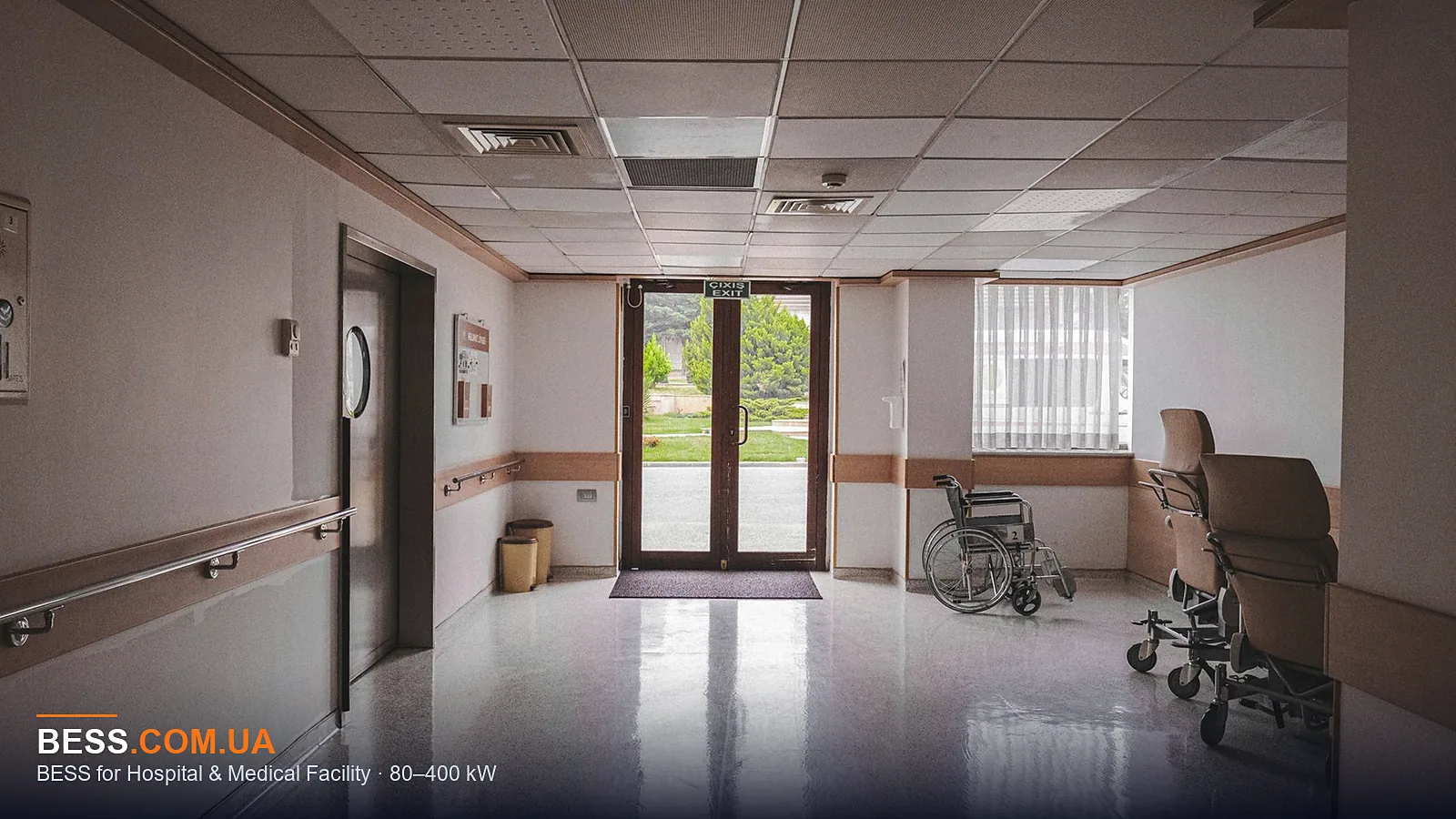
A ventilator does not wait for a diesel genset. In a hospital, every second between mains failure and backup power means risk to life. Here is how a battery energy storage system (BESS) closes that gap and why it is not just an option but a necessity for Category-I supply.
Key parameters
The Physics of the Problem: Why Gensets Fail Your Hospital
When the grid fails, a diesel genset takes 10–30 seconds to start and synchronise. In that window, operating theatres, ventilators, and vaccine fridges lose power. For a Category-I load, even a 0.5-second interruption can corrupt data or reset equipment. The national standard actually demands an automatic transfer switch (ATS) with a break of less than 1 second for Category-I, but a genset alone cannot achieve that.
The issue is not just the delay. A genset's voltage and frequency are unstable for the first few cycles after starting, especially under load. Sensitive electronics like MRI scanners or anaesthesia machines may see brownouts or spikes that cause resets or damage. The only way to bridge this is a source that reacts in milliseconds—a battery.
How BESS Closes the Gap: From Millisecond to Minutes
A BESS is always online, inverting DC to AC. When the grid fails, it switches to island mode in under 20 ms—faster than an ATS. It carries the load until the genset is ready, then synchronises with the genset and transfers seamlessly. This is not a theory; we have done this in hospitals and data centres.
But the battery is not just a bridge. It can also shave peak demand from the grid, reducing your electricity bill. In Ukraine, with time-of-day tariffs, a BESS can charge at night and discharge during the morning peak, cutting demand charges. For a hospital with 80–400 kW load, that can save tens of thousands of UAH per month.
Sizing Method: Power and Capacity for Your Facility
Power is easy: it is the maximum load you must carry during the genset start. That is typically the sum of all Category-I loads—theatres, ICU, vaccine fridges—plus the inrush current of motors and compressors. For a 200 kW average, you might need 250–300 kW of battery output for the first few seconds. A good rule of thumb: size the BESS for 1.2–1.5 times the critical load, and ensure the genset can handle the rest.
Capacity is trickier. It depends on how long the genset takes to start and how many times you have a mains failure per year. If your genset starts in 15 seconds, a 30-second battery is enough, but we often recommend 5–10 minutes to cover failures where the genset fails to start or needs a second attempt. For a 200 kW load, 10 minutes is about 33 kWh. We always run a load profile analysis before committing to a number.
What Happens If You Size It Wrong
Undersize the battery, and you are back to the original problem: equipment resets, data loss, or worse—a patient on a ventilator during a blackout. The battery will shut down when depleted, and the genset may not be ready. Oversizing is not a safety issue, but it costs money and floor space. You might end up with a battery that never discharges below 50%—a waste of capital.
Also, do not forget the grid side. At 0.4 kV, a 300 kW BESS is feasible, but you need a proper switchgear and protection coordination. If you have a 10 kV supply, you will need a transformer. Without a single-line diagram, any sizing is a guess. We have seen sites where the BESS was connected to the wrong bus and caused nuisance trips. Engineering matters.
What We Need From You to Start
If you want a feasibility study, we need three things: a one-year load profile (preferably 15-minute intervals), your electricity bills (to see tariff structure and demand charges), and a single-line diagram of your electrical distribution. That is enough to determine the right power, capacity, and control strategy. We will also look at your genset specs—some gensets have poor transient response, which means the battery must take more load for longer.
We are BESS Ukraine Engineering Group, a full-cycle EPC contractor. We design, supply, install, commission, and service industrial storage from 50 kW to 5 MW. We use LiFePO4 cells from CATL and other Tier-1 manufacturers, with liquid cooling, BMS, EMS/SCADA, and IP55/C4 outdoor cabinets. For residential systems, please contact SolarProm.com.ua—we do not do residential. Call us at +380 44 339-50-20 or email engineering@bess.com.ua.
Frequently asked questions
How fast does a BESS switch to backup power for a hospital?
What is the payback period for a hospital BESS?
Can a BESS replace a diesel genset entirely?
Do you provide maintenance for the BESS after installation?
What is the typical cost of a BESS for a 200 kW hospital?
Figures shown are indicative. Exact sizing follows a site survey and load-profile analysis.