Battery Energy Storage for Greenhouse Complexes: An Engineering View
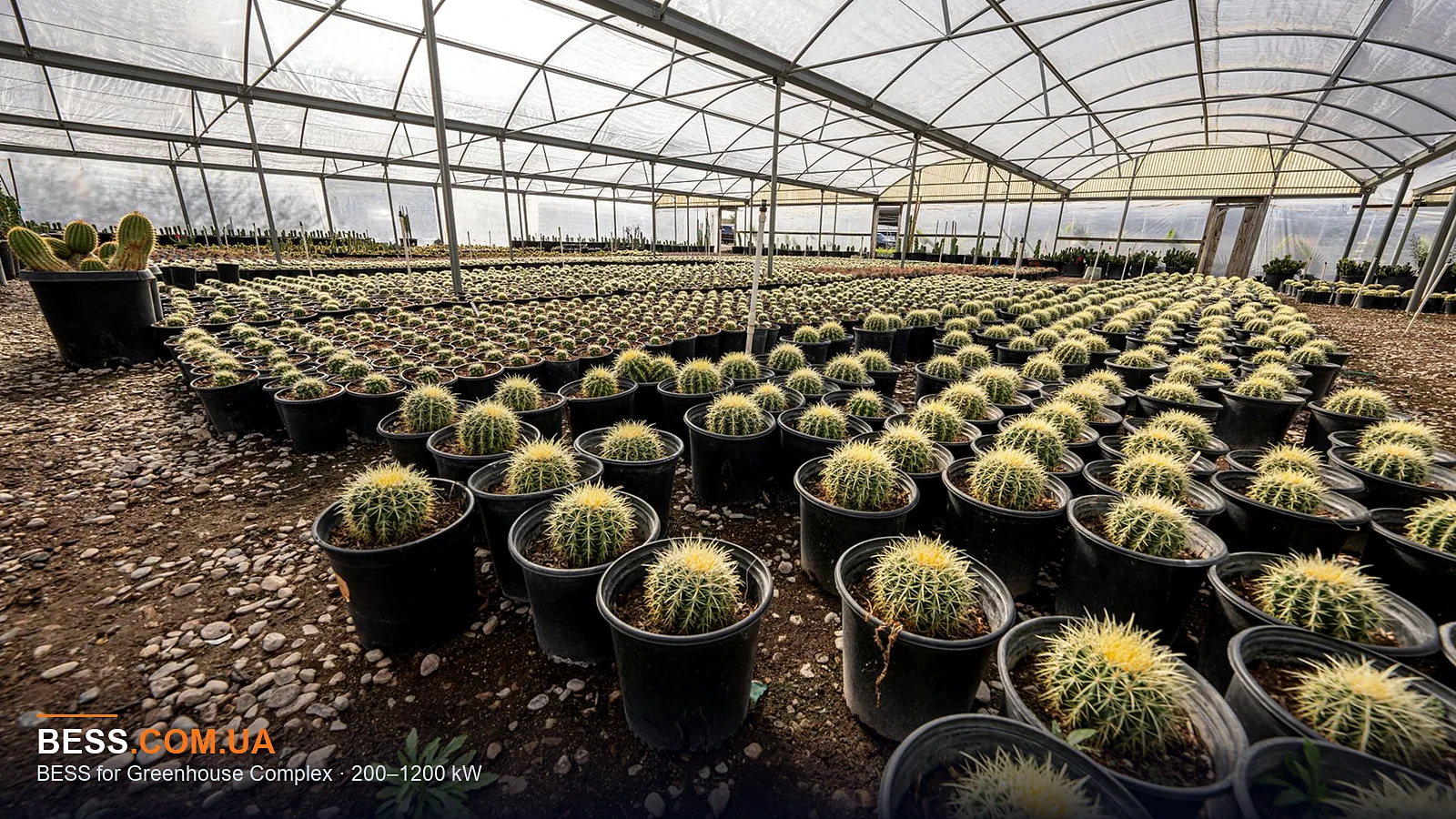
A greenhouse is not a data center. A 200 kW load that fails for three hours in February means crop loss measured in tens of thousands of euros. This page covers the physics, sizing, and pitfalls of BESS for greenhouse complexes, based on our work in the 200–1200 kW range.
Key parameters
The Physics of the Problem: Why Your Greenhouse Needs Storage
Greenhouse loads are dominated by three consumers: supplemental lighting (high-pressure sodium or LED), climate control (fans, heating, CO2 generation), and irrigation pumps. At night, lighting is the primary load, and it is not optional — tomatoes and cucumbers need a minimum daily light integral. If the grid fails, you have minutes to hours before the crop starts to stress.
But the bigger issue is not outages. It is the night tariff. In Ukraine, night electricity can be 2-3 times cheaper than peak. If you can shift your lighting load from peak to night, you slash your energy bill. The problem is that solar does not help at night. And a gas generator is noisy, expensive to run, and has a carbon footprint.
A BESS charges during cheap night hours (or during the day from solar if you have it) and discharges during peak hours to run the lighting and climate. The capacity must cover the full night lighting window, not just a few hours of backup.
Input Data: What We Need Before Sizing
No two greenhouses are identical. To size a BESS, we need three things: a 15-minute load profile for at least a year (ideally including seasonal variation), your electricity bills for the last 12 months (to see tariff structure and peaks), and a single-line diagram of your electrical system (to know where to connect).
If you do not have a load profile, we can install temporary loggers for a week or two. That is the minimum. Without a load profile, any capacity number we give is a guess, and that guess can cost you money.
Sizing Method: Power and Capacity for Night Lighting and Backup
Power sizing is straightforward: the BESS inverter must handle the peak load you want to cover. For a typical complex, that is the lighting load plus the starting current of the largest irrigation pump. If your lighting is 400 kW and the pump draws 50 kW inrush, you need at least 450 kW of inverter capacity. At 0.4 kV, this is feasible up to about 1 MW; beyond that, consider medium voltage connection.
Capacity is trickier. For tariff arbitrage, calculate the night hours when electricity is cheap — often 23:00 to 07:00. Your lighting runs for, say, 8 hours at 400 kW, so you need 3200 kWh. But you also need to account for round-trip efficiency (about 92% for LiFePO4), so you need roughly 3500 kWh of battery capacity. For backup, you need at least 2-4 hours at full load to prevent crop loss, which is usually less than the arbitrage requirement.
We size the battery to the larger of the two. In practice, for a 200-1200 kW complex, that means systems from 500 kWh to 4 MWh. We have done feasibility studies for several complexes in the Kyiv region; payback is typically 4-6 years with night tariff arbitrage alone.
Connection Topology: AC-Coupled vs. DC-Coupled, and Where to Connect
For existing greenhouses, we almost always use AC-coupled storage. That means the battery connects to the AC bus via a bidirectional inverter, alongside your existing transformers. This is simple, works with any generation source, and allows you to island the greenhouse during an outage.
If you have solar PV, you can go DC-coupled, but it adds complexity and is rarely worth it for greenhouses. The exception is new builds where the solar inverter is sized for storage.
At 0.4 kV, we can handle up to about 1 MW of storage in a single cabinet. For larger systems, we step up to 10 kV or 35 kV. This is a decision we make after seeing your single-line diagram. The connection point matters — it must be upstream of your critical loads but downstream of your main breaker.
What Goes Wrong If You Size It Wrong?
If you undersize the power, your lights dim or the inverter trips when the pump starts. That means crop stress and equipment damage. If you undersize the capacity, you discharge the battery before the night tariff ends, and you are back on peak prices — or worse, in an outage, you lose the crop.
If you oversize, you waste capital. A 1 MWh battery that you only discharge 50% every day has a payback that stretches to 8+ years. There is also a risk of thermal runaway if the battery is forced to cycle aggressively without proper cooling — we use liquid cooling to mitigate that.
And do not forget the grid connection. If your transformer is too small, you cannot charge the battery at full power. We have seen projects where the client had to upgrade the transformer, blowing the budget. That is why we always audit the site first.
Frequently asked questions
What is the typical cost of a BESS for a greenhouse complex?
How long does a BESS last?
Can a BESS replace a diesel generator?
Do you handle the permitting and grid connection?
What if my greenhouse is 200 kW, is it worth it?
Figures shown are indicative. Exact sizing follows a site survey and load-profile analysis.