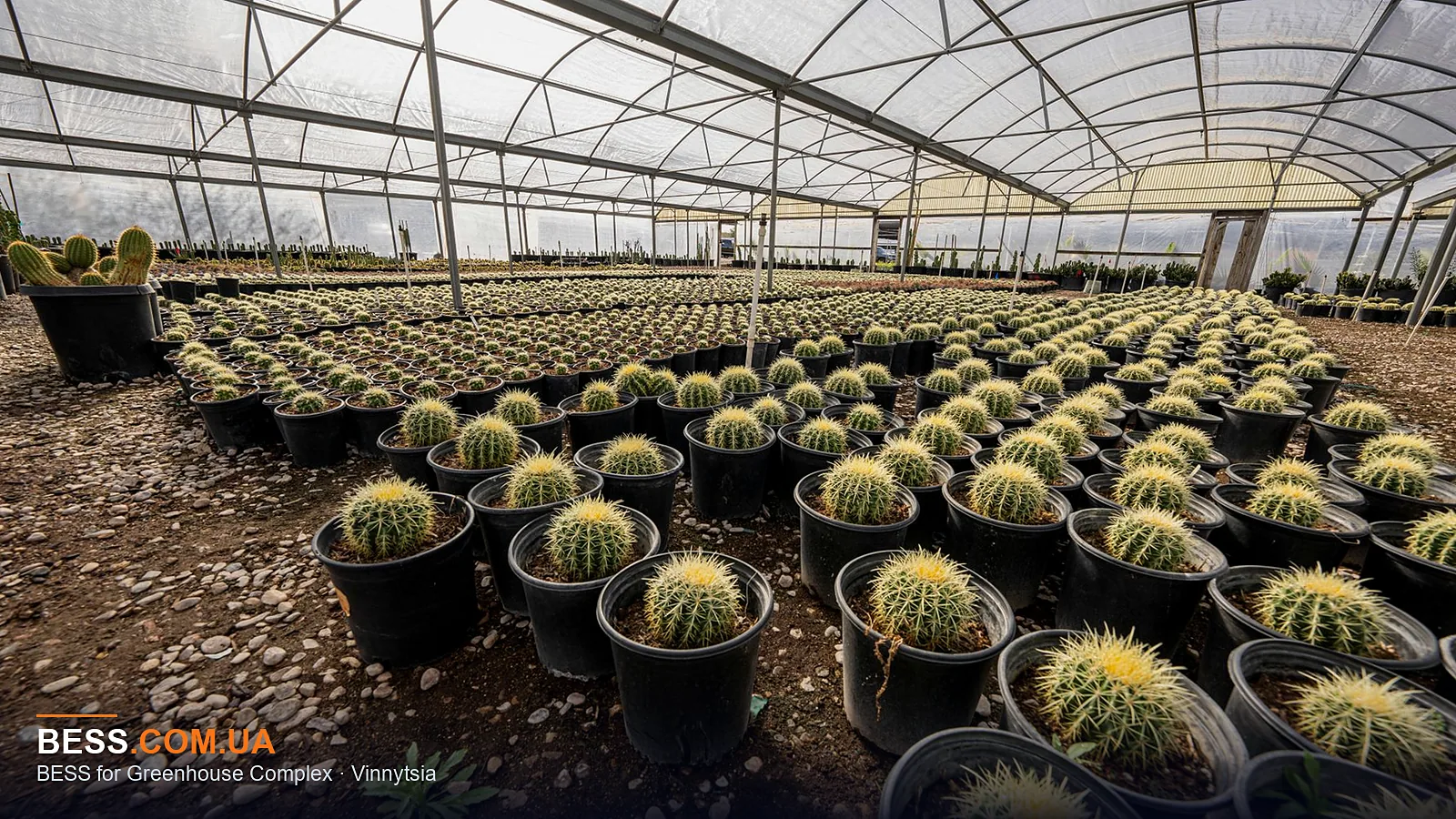
Energy storage for a greenhouse complex in Vinnytsia
A 4-hectare greenhouse in Vinnytsia can lose an entire tomato crop in three hours without supplemental lighting and climate control. We compare diesel, UPS, contracted capacity upgrades, and battery storage — with concrete numbers for 200–1200 kW loads, night tariffs, and Vinnytsiaoblenergo connection rules.
Key parameters
Why Vinnytsia greenhouses face a harder problem than elsewhere
Vinnytsia sits in a continental climate zone where winter photoperiods drop below 8 hours. Tomatoes, cucumbers, and lettuce need 16–18 hours of light daily. That means 8–10 hours of high‑pressure sodium or LED supplemental lighting at 50–100 W/m². A 4‑ha greenhouse easily draws 400–800 kW for lighting alone, plus another 100–300 kW for irrigation pumps, circulation fans, and boiler automation.
The local grid operator, Vinnytsiaoblenergo, enforces strict capacity limits in peri‑urban areas where most greenhouse complexes are built. Raising contracted capacity from, say, 250 kVA to 800 kVA often requires a new 10/0.4 kV transformer substation, a cable line upgrade, and 6–12 months of permitting — all before the first tomato is picked. Worse, the region’s overhead 10 kV lines are vulnerable to ice storms and wind; a single fault can knock out power for 4–6 hours. For a greenhouse, that means crop loss within 3 hours.
Industrial electricity prices in Vinnytsia oblast are split into three time‑of‑use zones. The night tariff (23:00–07:00) is roughly 2.10 UAH/kWh, while the peak tariff (08:00–11:00, 17:00–23:00) reaches 5.80 UAH/kWh. This spread is the economic engine behind a battery storage system.
Comparing four backup strategies with real numbers
Diesel generator. A 600 kW genset costs ~2.5 million UAH installed, plus a fuel tank and exhaust system. At 65% load, it burns about 110 L/h of diesel. Over a 6‑hour outage that is 660 L — roughly 33 000 UAH at 50 UAH/L. Maintenance adds 50–80 UAH per engine hour. Cold start takes 15–30 seconds; that gap can crash climate controllers. Gensets make sense only if outages are rare (under 50 hours/year) and the greenhouse already has a UPS for the control system.
Double‑conversion UPS. A 600 kVA UPS with VRLA batteries for 10‑minute autonomy costs around 4 million UAH, but extending runtime to 4 hours requires a battery bank that balloons to 9–10 million UAH. The battery room needs air conditioning, fire suppression, and floor reinforcement. At 0.4 kV, cabling losses alone reach 2–3%. UPS is justified only for the 10–30 second gap before a generator starts — not for full night‑lighting backup.
Raising contracted capacity. Upgrading from 250 kVA to 800 kVA with Vinnytsiaoblenergo involves a connection fee of roughly 1 200–1 500 UAH/kVA, plus the cost of a new transformer and switchgear — total 1.8–2.5 million UAH. The monthly capacity charge then rises by 550 kVA × 75 UAH/kVA = 41 250 UAH, or 495 000 UAH/year. You pay this even in summer when lighting hours are minimal. For seasonal operations, capacity upgrade is the most expensive option over 5 years.
Battery energy storage (BESS). A 600 kW / 2400 kWh LiFePO₄ system in a 40‑ft container, liquid‑cooled, with BMS and EMS/SCADA, costs 12–15 million UAH installed. It charges during the night tariff (2.10 UAH/kWh) and discharges during the morning and evening peaks (5.80 UAH/kWh). The daily arbitrage spread is 3.70 UAH/kWh. At 90% round‑trip efficiency and one full cycle per day, the system shifts about 2160 kWh/day, saving roughly 7 990 UAH/day. Over 250 operating days per year, that is ~2 million UAH/year in avoided peak charges, plus the value of avoided crop loss — which can exceed 5 million UAH per incident. Simple payback falls between 4 and 6 years, depending on the outage frequency and the exact tariff schedule.
Sizing a BESS for a Vinnytsia greenhouse: what we actually calculate
The starting point is a 15‑minute load profile from the site’s smart meter — not the nameplate rating. We look at the lighting ramp‑up (usually 19:00–21:00) and the irrigation pump starts. The battery inverter power must cover the maximum simultaneous load during the discharge window. For a 4‑ha tomato greenhouse, that peak often sits at 450–500 kW, so we specify a 600 kVA PCS with 110% overload for 10 minutes.
Energy capacity is set by the night‑to‑peak shift duration. In Vinnytsia, the morning peak is 3 hours (08:00–11:00) and the evening peak is 6 hours (17:00–23:00). A 2400 kWh battery covers the full evening peak at 400 kW average load. If the site also wants backup for a complete grid failure, we add a contingency reserve of 20–30%, bringing the total to 3000–3200 kWh.
Connection voltage matters. At 0.4 kV, currents exceed 900 A per phase for a 600 kW system; that mandates a dedicated 2500 A busbar and a transformer with Uk% ≤ 6% to keep voltage drop below 3%. Most greenhouse sites in Vinnytsia have a 10/0.4 kV transformer already, but it is rarely sized for reverse power flow. We often install a new 1250 kVA dry‑type transformer with a vector group Dyn11 and a separate 0.4 kV switchboard for the BESS. At 10 kV, the PCS connects directly to the customer’s RMU, but that pushes the inverter cost up by 15–20%.
Vinnytsiaoblenergo connection: what the TU actually says
Vinnytsiaoblenergo treats a BESS as a “consumer‑owned generating facility with the ability to feed into the grid.” The technical specifications (TU) will require a grid‑tied inverter certified to EN 50549‑1 or equivalent, a protection relay with ROCOF and vector shift, and a remote disconnect switch accessible to the DSO. We submit a single‑line diagram, protection coordination study, and power quality calculations (harmonics up to the 50th order, flicker Pst ≤ 1.0).
If the BESS never exports to the grid — only charges and discharges behind the meter — the process is simpler. We sign a “non‑export agreement” and install a reverse‑power relay. The metering point stays the same. Commissioning takes 2–3 weeks after the equipment is installed, assuming the TU were approved in advance. The whole cycle from audit to energization runs 4–6 months.
When each option actually works
- Diesel genset — justified if outages total less than 50 hours/year and the greenhouse already has a DC‑UPS for the automation cabinet. Not a substitute for night‑tariff arbitrage.
- UPS with generator — justified for the 10–30 second bridge to genset start. Do not size it for hours; the battery cost kills the business case.
- Contracted capacity increase — justified only if the greenhouse runs a single day‑night shift and has no backup need. The monthly capacity charge eats the savings.
- BESS — justified when the night‑peak tariff spread exceeds 3 UAH/kWh and the site has at least 8 hours of low‑tariff charging time. In Vinnytsia, that covers almost any greenhouse with supplemental lighting.
Frequently asked questions
How much does a BESS for a 600 kW greenhouse cost in Vinnytsia?
Can a battery storage system completely replace a diesel generator?
What does Vinnytsiaoblenergo require to connect a BESS?
How long does it take to install and commission a greenhouse BESS?
What is the payback period for a greenhouse battery system?
Figures shown are indicative. Exact sizing follows a site survey and load-profile analysis.