Battery Storage for Grain Elevators in Ternopil: Cut Seasonal Peaks, Kill Diesel Backup
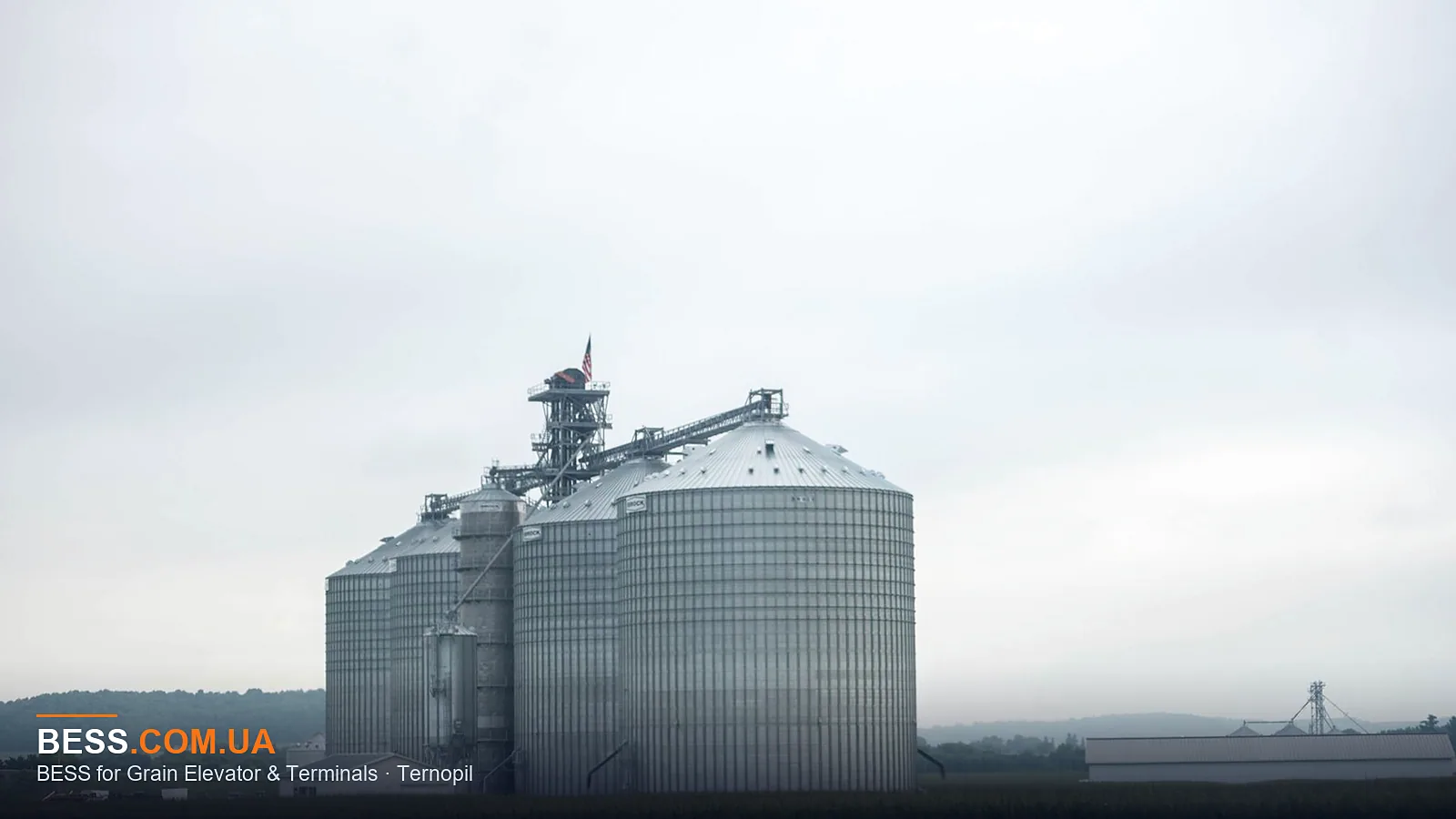
Your grain elevator in Ternopil runs hard during harvest, and the grid connection through Ternopiloblenergo punishes that with demand charges. A BESS sized to your dryer's 150–800 kW load shaves those peaks and replaces diesel backup, with a payback we can calculate from your actual load profile.
Key parameters
Where Your Electricity Bill Leaks in Ternopil
Your bill is built on three components: energy (UAH/kWh), capacity (UAH/kW of declared maximum), and distribution (UAH/kW of actually measured 30-minute peak). In Ternopil Oblast, the distribution tariff for businesses supplied by Ternopiloblenergo at 0.4 kV is about UAH 1,200/kW per month. If your dryer pulls 600 kW for two weeks, that peak stays on your bill for a full year.
The real leak is the seasonal peak. Grain dryers run at full power for a few weeks, then sit idle. You pay for that peak all year, even when the elevator is quiet. Diesel backup is worse: at UAH 52/litre, a 100-hour run costs UAH 1.5 million per season, not counting maintenance.
Storage removes the demand charge component. It charges during off-peak hours (23:00–07:00) and discharges exactly when the dryer kicks in, capping your measured peak. The energy component stays the same, but the capacity and distribution charges shrink.
Why This Problem Is Specific to Ternopil Grain Elevators
Ternopil Oblast grows more than 2 million tonnes of grain per year, and most of it moves through elevators like yours. The harvest window is short—August to October—and the dryers all run simultaneously, which is why Ternopiloblenergo's grid sees massive local peaks. They have no choice but to charge high demand rates to recover grid investment.
Your elevator sits on a 0.4 kV or 10 kV connection. At 0.4 kV, a 500 kW BESS is feasible, but you'll need a transformer upgrade if you want to export power—which you won't, because the business case is peak shaving, not arbitrage. Without a BESS, the transformer is sized for the dryer peak, but with storage, you can reduce the transformer capacity, saving money on the connection fee.
The local climate matters: Ternopil's winter temperatures drop to -15°C, and a BESS with liquid cooling maintains performance. The cabinets we install are IP55/C4, tested for this environment.
How a BESS Pays for Itself: Payback Math
Let's be concrete. A typical 500 kW dryer, running 300 hours per season, creates a measured peak of 500 kW. Under Ternopiloblenergo's tariff, that peak costs you UAH 1,200/kW/month × 12 = UAH 7.2 million per year. A BESS that shaves the peak to 200 kW saves UAH 4.3 million annually.
Add diesel replacement: if you run a 500 kW diesel generator for 100 hours per season, at UAH 52/litre and 0.3 l/kWh, that's UAH 780,000 per year. Combined savings: UAH 5.1 million per year.
For a 500 kW/1 MWh system, installed cost is around UAH 15–20 million (depending on container vs. cabinet). Payback: 3–4 years. Without a load profile, that figure is rough—we need your 15-minute interval data to nail it.
Sizing a BESS for Your Elevator: What We Account For
First, we pull your load profile from Ternopiloblenergo's meters. We look at the last 12 months to capture the seasonal pattern. The BESS power is set to the difference between your raw peak and the target peak (e.g., from 600 kW to 300 kW). The energy capacity is sized for the average daily peak duration—typically 2–4 hours.
For a 150–800 kW range, we match the inverter to the dryer's starting current. A 500 kW dryer may have a 2× inrush during startup; our BESS uses a 600 kVA inverter to handle that. We also check the transformer: at 0.4 kV, if the transformer is already near capacity, we can either oversize the BESS to cover the peak or suggest a transformer upgrade—but that adds cost and time.
Finally, we design for the grid code: Ternopiloblenergo requires a disconnect switch and anti-islanding protection. Our systems come with that built in.
What We Deliver and How We Work
We are BESS Ukraine Engineering Group, a full-cycle EPC contractor based in Kyiv. We do the audit, design, supply, installation, commissioning, and service—no subcontractors in between. For your elevator, we'd start with a site visit and load data analysis, then give you a firm quote.
Our systems use LiFePO4 cells from CATL or other Tier-1 manufacturers, liquid cooling, BMS, EMS/SCADA, and IP55/C4 cabinets or 20/40 ft containers. Power range is 50 kW to 5 MW—your 500 kW is well inside our comfort zone.
We do not do residential systems; for those, contact SolarProm.com.ua. Call us at +380 44 339-50-20 or email engineering@bess.com.ua to schedule a feasibility study.
Frequently asked questions
How much does a BESS for my grain elevator in Ternopil cost?
What is the payback period for battery storage at a grain elevator?
Will the BESS work during a power outage?
Can the BESS be connected to my existing 0.4 kV service?
What does maintenance involve?
Figures shown are indicative. Exact sizing follows a site survey and load-profile analysis.