Battery Energy Storage for Fuel & Gas Stations: Engineering Survey Before You Buy
A fuel station without power is a parking lot with a shop. Dispensers, till, and payment terminal stop, and you lose revenue for every minute of outage. This page is a pre-design survey checklist: what to measure, which documents to pull, and how to size a BESS so it actually keeps you selling.
Key parameters
Why a Fuel Station Is Not a Typical Backup Load
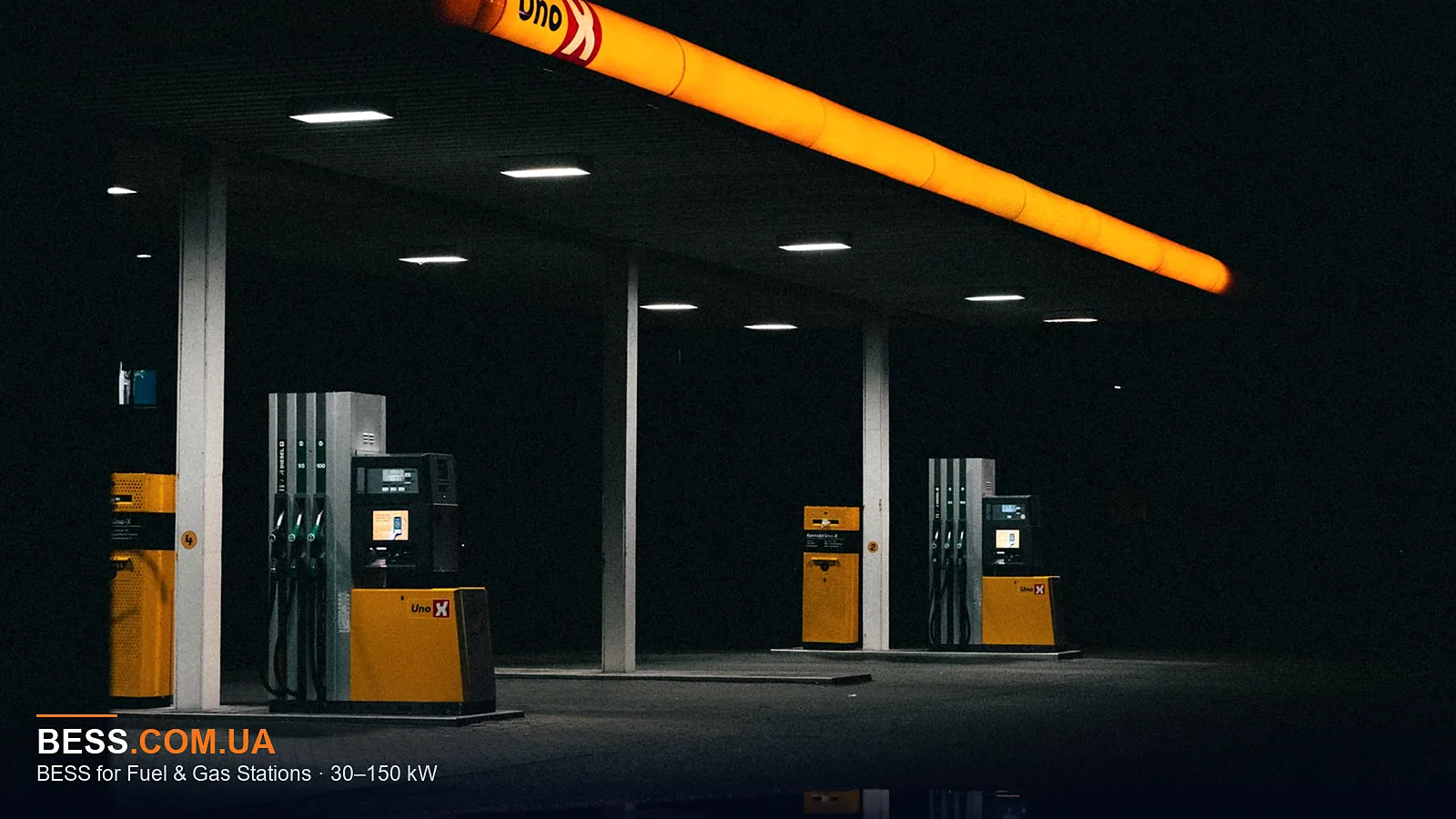
The physics of your site is different from a warehouse or office. The critical load is not just a few servers—it's the dispensers (each 2–5 kW with pumps and electronics), the till and card payment terminal (must stay online for transactions), and often canopy lighting, refrigeration, and security systems. A typical station draws 30–150 kW, but the peak is short: a sudden cluster of cars can spike demand by 20–30 kW for a few minutes.
Grid failure at a fuel station triggers an immediate safety and revenue crisis. The station cannot sell fuel, and worse, if the grid fault causes a phase imbalance or undervoltage, dispensers may reset, losing calibration and requiring a technician to re-verify metering. A BESS must therefore provide seamless, low-latency transition—ideally under 20 ms—to avoid any drop that resets electronics.
Autonomy is the key parameter. For a fuel station, you need 4–8 hours of full-site operation, not just a few minutes to save data. That means the battery capacity must cover the average load for that duration, plus a reserve for the inrush of cold-starting compressors and pumps.
Step 1: Measure the Actual Load Profile (Not the Nameplate)
Do not size from the transformer nameplate. Install a power quality analyser (e.g., Fluke 435 or similar) on the main LV switchboard for at least 7 days, ideally 2 weeks, to capture weekday and weekend cycles. Record kW, kVAr, voltage, and current at 1-minute intervals. You need the daily load curve: when the shop opens, when the fuel dispensers are busiest, and what the base load is at night.
Pull the utility bills for the last 12 months to identify the maximum demand (in kW) and the average monthly energy (kWh). Also note the contracted capacity—your BESS can reduce demand charges if you implement peak shaving, but for a fuel station, the primary driver is backup, not arbitrage.
You also need the single-line diagram of the site: incoming supply voltage (0.4 kV or 10 kV), transformer rating, and the distribution board list. That diagram tells us where to connect the BESS—on the LV side, between the main breaker and the critical loads—and what interlocking is required to avoid back-feeding the grid.
Step 2: Verify Grid Constraints and Connection Rules
At 0.4 kV, your station is likely connected to a public low-voltage network. Check the available fault level and the short-circuit current at the point of connection; the BESS inverter must be rated to withstand that. Also verify the utility's anti-islanding requirements: when the grid fails, you must disconnect from the grid within 0.5 s (per IEC 62116) and then re-synch when it returns. That is standard, but your local distribution operator may have specific settings.
If your station is on a 10 kV feed, you have more options—you can install a medium-voltage-rated BESS container or use a transformer—but that increases cost and complexity. For most stations, a low-voltage BESS with a static transfer switch (STS) is sufficient.
Another constraint is the available space and concrete foundation. A 100 kW / 400 kWh system in a 20-ft container weighs about 8–10 tonnes and needs a level pad. You also need clearance for ventilation and maintenance. Check the site for seismic and flood risks, and ensure the cabinet is IP55/C4 rated for outdoor installation.
Step 3: Sizing Method—Power and Capacity for 4–8 h Autonomy
Power sizing: take the maximum demand from your load profile. If that is 120 kW, you size the inverter for at least 120 kW, but add 20% headroom for future loads or inrush currents—so 150 kW. If you have three-phase equipment, the inverter must handle unbalanced loads; our cabinets use three-phase four-wire inverters.
Capacity sizing: multiply the average load by the desired autonomy. Example: average load is 60 kW, you want 6 hours, that is 360 kWh. Add a 10% safety factor for battery aging and system losses, so ~400 kWh. That is a typical block: 4 x 100 kWh battery racks, with a 150 kW inverter. For a smaller station with 30 kW average, 4 hours gives 120 kWh, so a 150 kW / 150 kWh system may suffice—but always verify with the load profile.
If you size wrong, the consequences are immediate: undersized power means the inverter will overload and drop the load—exactly what you are trying to avoid. Undersized capacity means the battery empties before the grid returns, and you are back in the dark. Oversizing wastes capital and reduces payback. That is why the survey is non-negotiable.
Step 4: What the Engineer Needs From You—Input Data Checklist
- Utility bills for 12 months (PDFs or scans).
- Single-line diagram (if you have it, otherwise we will create one from site survey).
- Load profile from a 7-day measurement (we can install a logger for you).
- Site layout with dimensions of the proposed BESS location.
- Details of any existing generator or UPS (size, fuel type, transfer switch).
- Grid connection details: voltage level, transformer rating, fuse size.
If you do not have a load profile, we can rent you a power analyser and interpret the data as part of the audit. Without it, any capacity figure is a guess—and we do not guess.
Frequently asked questions
How much does a BESS for a fuel station cost in Ukraine?
Can I use a BESS to sell electricity back to the grid?
What happens if the grid fails while the battery is charging?
Can I integrate a BESS with an existing diesel generator?
What is the lifespan of a LiFePO4 battery in a fuel station environment?
Figures shown are indicative. Exact sizing follows a site survey and load-profile analysis.