Battery Storage for Manufacturing Plants in Kremenchuk: Stop Paying for Power You Don't Use
Your factory pays for contracted capacity whether you use it or not, and every motor start drags the voltage down. A BESS from BESS Ukraine Engineering Group fixes both: it shaves the peaks that trigger penalties and holds the line during inrush. Here is how that works specifically in Kremenchuk, under Poltavaoblenergo, for a plant like yours.
Key parameters
What Actually Costs You Money in Kremenchuk
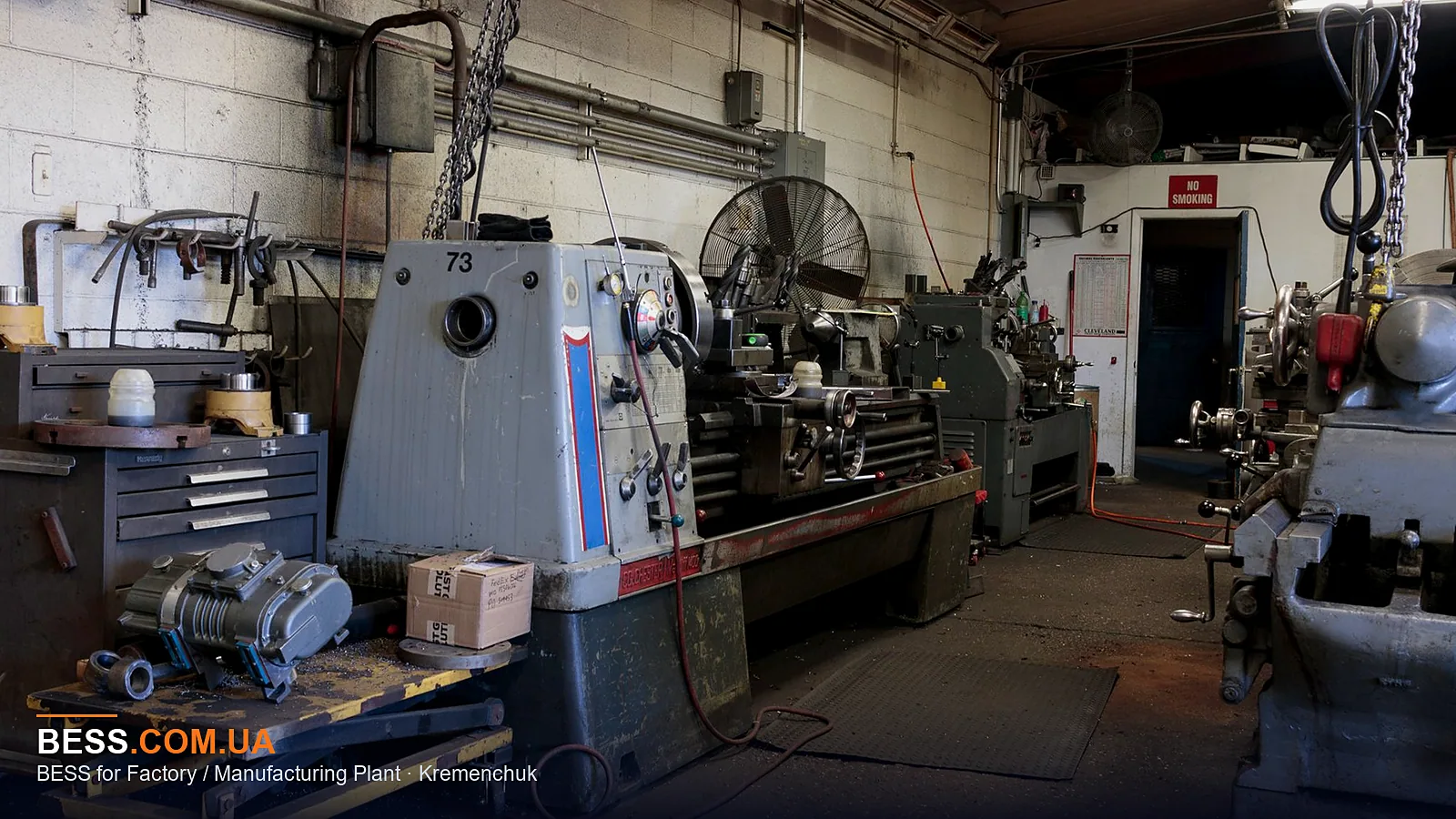
Kremenchuk is not a typical industrial city. The oil refinery, KrAZ, railcar plants, and ore processing create a dense grid with heavy inductive loads. When your line starts a 200 kW motor, the voltage on the 0.4 kV bus can dip by 10–15% for a second. That dip resets PLCs, drops contactors, and ruins a batch of product. Each event is scrap, rework, and often an emergency call to your electrician.
The second cost is the capacity tariff. Poltavaoblenergo bills you for the maximum 30-minute average power in the billing month, multiplied by the tariff. One 15-minute spike – a cold start, a compressor bank, a furnace cycling – sets your capacity charge for the whole month. In Kremenchuk, with its mix of continuous and batch processes, those spikes are common and expensive.
How Storage Fixes the Voltage and the Bill
A battery energy storage system (BESS) acts as a buffer. In normal operation, it charges during low load and discharges during peaks, cutting your 30-minute maximum. The EMS reads your meter and the plant PLC, so it knows when a motor is about to start. It can inject power for 1–2 seconds, holding the voltage above 90% and preventing the sag from propagating to sensitive equipment.
For motor inrush, the BESS must be sized not just in kWh but in kW and in short-term overload capability. A typical 500 kW load with a 250 kW motor start wants at least 300 kW of BESS output for 2 seconds. Our cabinets use LiFePO4 cells (CATL or other Tier-1) with liquid cooling, and the inverter can deliver 1.5x rated power for 10 seconds. That is enough to cover the inrush without tripping.
Sizing for a Kremenchuk Factory: Not a Guess
You cannot size a BESS for a Kremenchuk plant from a table. The refinery has continuous 24/7 loads; the railcar plant has welding robots that pulse; the ore crusher has huge starting currents. First, we log your load profile for 2–4 weeks at 1-minute intervals, including voltage events. Then we model the 30-minute maximum with and without storage, and simulate motor starts at your actual bus.
At 0.4 kV, a BESS can handle most plants up to 1 MW. If your transformer is 10/0.4 kV and the grid is weak, we may recommend a medium-voltage connection at 10 kV – that changes the transformer and protection design. Without a load profile, any kWh figure is rough. But for a typical 500 kW average plant, you are looking at 250–500 kW / 500–1000 kWh to cut the capacity charge by 30–40% and cover the worst sags.
Poltavaoblenergo and Grid Connection: What You Must Know
Poltavaoblenergo's tariffs and technical requirements are local. They will require a certified meter, a protection relay, and a grid-tie agreement. The BESS must be designed to island in case of a grid outage – that means a transfer switch and a separate backup panel. We handle the paperwork: application, technical conditions, metering scheme, and commissioning protocol.
One trap: if your plant has a standby diesel generator, the BESS must interlock with it to avoid parallel operation. Also, Poltavaoblenergo may impose a limit on export – most factories in Kremenchuk are not allowed to feed power back. We configure the BESS for zero export, so you do not need a feed-in tariff or additional permits.
Numbers That Matter: Payback and Reliability
A 500 kW / 1000 kWh system for a Kremenchuk factory costs roughly 12–18 million UAH installed, depending on container vs. cabinet and grid connection work. With capacity charge savings of 300,000–500,000 UAH per month, payback lands between 3 and 5 years. Add avoided scrap from voltage sags – a single event can cost more than a month of savings.
We are BESS Ukraine Engineering Group, a full-cycle EPC contractor. We audit, design, supply, install, commission, and service industrial storage from 50 kW to 5 MW. We have done feasibility studies for this region and know the grid specifics. Call us at +380 44 339-50-20 or email engineering@bess.com.ua – we will start with a no-cost load profile review.
Frequently asked questions
Will a BESS work for my factory in Kremenchuk if I have voltage sags from motor starts?
How long does it take to install a BESS at a manufacturing plant?
What is the payback period for a BESS in Kremenchuk?
Can the BESS provide backup power during grid outages?
Do I need permission from Poltavaoblenergo to install a BESS?
Figures shown are indicative. Exact sizing follows a site survey and load-profile analysis.