
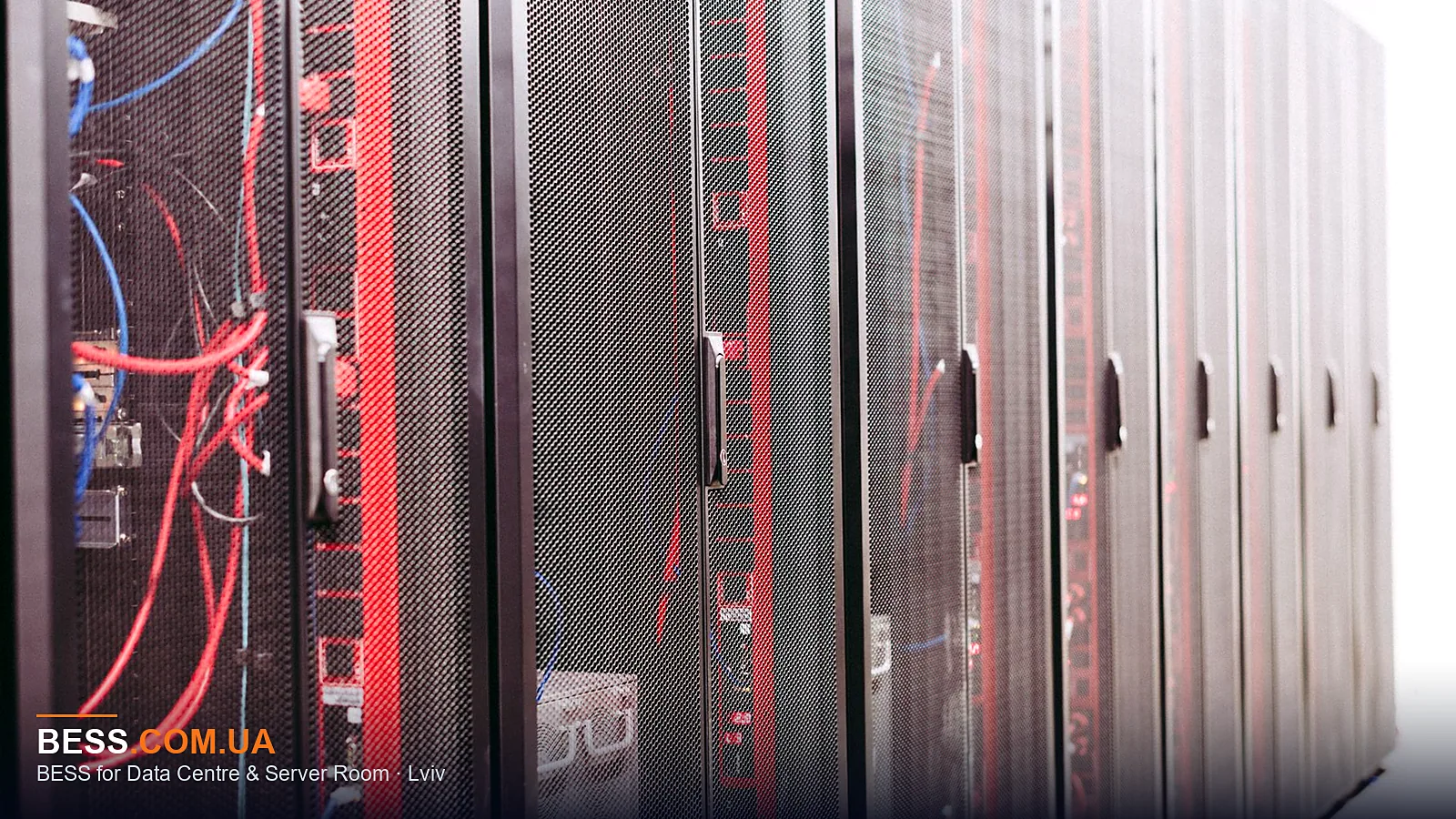
BESS for Data Centre & Server Room in Lviv: Pre-Design Survey Checklist
You run a data centre in Lviv. Power outages are not hypothetical. Before we talk kWh and payback, we need to measure and verify. Here is the checklist we use for a site in your city, under Lvivoblenergo.
Key parameters
Why Lviv Data Centres Have a Specific Pain
Lviv's grid, operated by Lvivoblenergo, is not Kyiv's. The 110 kV and 35 kV networks around the city are ageing, and the industrial parks on the eastern edge — where most IT and data centres sit — experience voltage dips and short interruptions more often than the central business district. Your server rooms cannot tolerate a single cycle of lost power.
Lead-acid UPS strings are the weakest link. They age faster in Lviv's climate — summer heat pushes battery room temperatures above 25°C, winter cold reduces capacity. You replace them every 4-5 years, and they still fail when you need them most.
Measurables: What to Record On-Site
First, log the actual load. Not nameplate. Use a power quality analyser for at least 7 days. Record kW, kVAr, and THD per phase. Note the peak demand (kW) and the energy (kWh) per day. Also log the UPS input and output voltage, and the battery string voltage and current.
Measure the UPS efficiency at typical load. Often it is 92-94%, not the brochure 96%. That loss is heat that your cooling system must remove. Also measure the temperature and humidity in the battery room, and the space available for cabinets — height, width, depth, and floor loading.
- Daily load profile: 24h, 1-min resolution
- Power factor and harmonics
- UPS efficiency at 25%, 50%, 75% load
- Battery room dimensions and ventilation
Documents to Pull Before We Do Anything
Get your latest electricity bill and the supply contract with Lvivoblenergo. We need the contracted capacity in kW (often 200-400 kW for a 2000 kW site, so check). Also get the one-line diagram of the LV switchgear and the UPS single-line. And the utility's technical conditions for connection — they state the permitted short-circuit power and the protection settings.
If you have an existing diesel generator, get its datasheet and transfer switch logic. We need to know if the BESS will sit upstream or downstream of the generator. Also pull the server redundancy scheme (2N, N+1) and the IT load profile from the DCIM if you have it. Without these, any sizing is a guess.
Grid Constraints: Lvivoblenergo Specifics
Lvivoblenergo enforces a maximum import capacity at the point of connection. If you exceed it, you pay penalties. A BESS can shave peaks, but we must verify the CTs and protection settings with the utility. At 0.4 kV, you cannot just connect a 500 kW BESS without a new connection agreement.
Check if your site has a dual feed or a single 0.4 kV bus. For a 200 kW to 2 MW load, we usually propose a low-voltage AC-coupled BESS. But if the site is fed at 10 kV, we need a transformer. Also verify the earthing system (TN-S or TN-C-S) and the available short-circuit current — it affects fuse selection and arc flash rating.
Sizing the BESS for Lviv: From Survey to Solution
Based on the load profile, we size the battery to cover the longest expected outage — often 30 minutes to 2 hours for server ride-through, but you may want 4 hours for a prolonged blackout. For a 500 kW average load, 1 MWh gives 2 hours. That is a 20 ft container with 280 Ah LiFePO4 cells, liquid cooling, and a 500 kVA PCS.
We replace your VRLA strings with a LiFePO4 BESS that has zero transfer time. It sits parallel to the UPS DC bus, or acts as a UPS itself, depending on your architecture. The business case is simple: VRLA replacement every 5 years costs about $200 per kWh installed. LiFePO4 lasts 10-15 years and cuts cooling load because it is more efficient. Payback is 3-5 years if you also do peak shaving.
We design, supply, install, and commission. We are BESS Ukraine Engineering Group, Kyiv. For residential, go to SolarProm.com.ua. For your data centre, call +380 44 339-50-20.
Frequently asked questions
What is the typical cost for a BESS for a 500 kW data centre in Lviv?
Can we keep our existing UPS and just add a battery?
How long will the installation take?
What maintenance does a LiFePO4 BESS require?
Do you provide a performance guarantee?
Figures shown are indicative. Exact sizing follows a site survey and load-profile analysis.