Battery Energy Storage for Beverage & Bottling Plants: Engineering the Continuity
Bottling lines are unforgiving. A voltage dip or a 2-second blackout means the line stops, the product in progress is scrapped, and a full sanitation wash follows. This page is a technical breakdown of how to size and connect a BESS so that your line never stops.
Key parameters
The Physics of the Problem: Why Bottling Lines Are Different
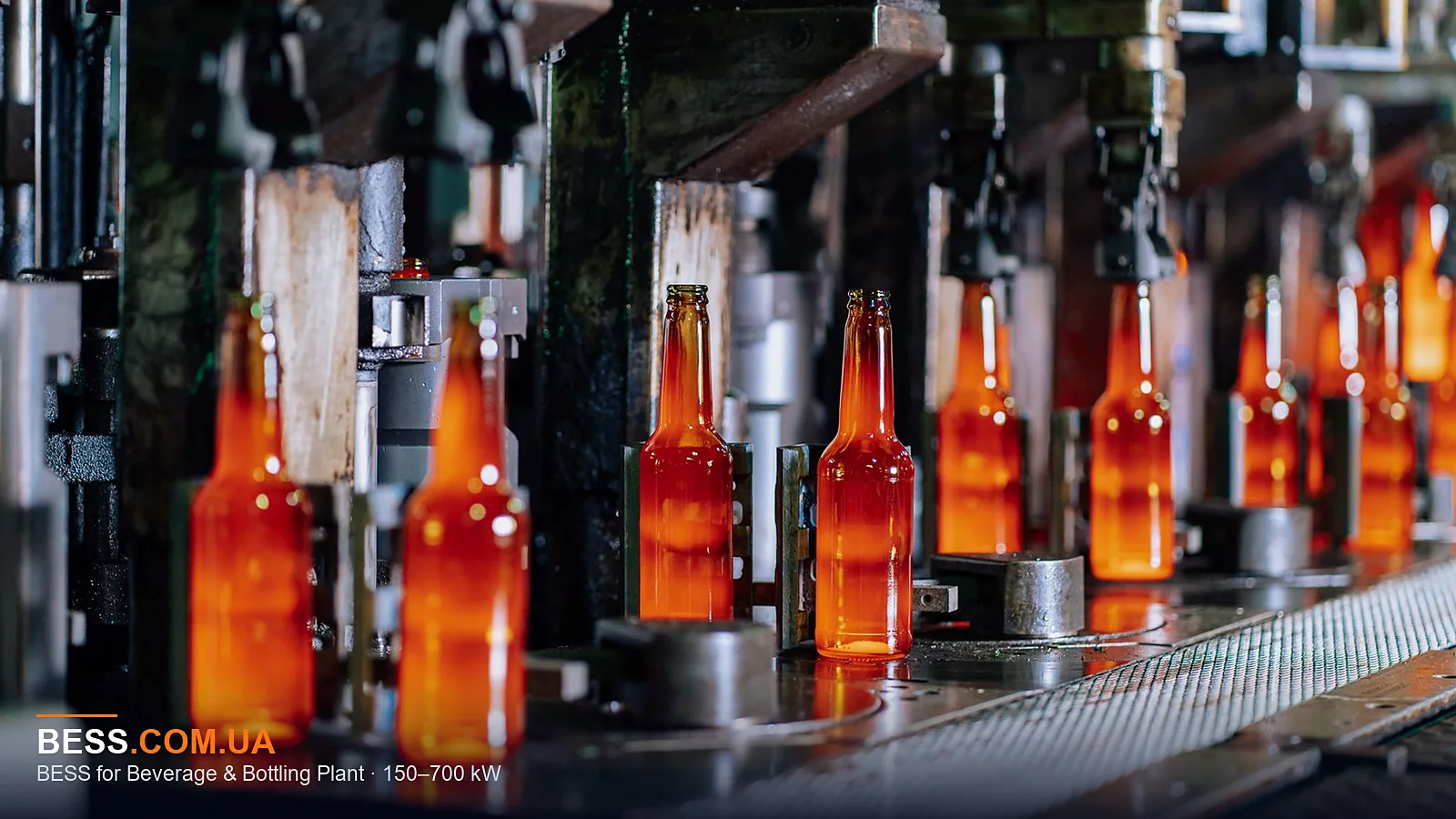
A bottling line is a synchronous process. Fillers, cappers, labelers, and conveyors are interlocked; a stop in any section cascades. The line's motors and servo drives have high inrush currents and sensitive control electronics. When grid voltage sags or drops, contactors drop out, drives fault, and the PLC initiates a stop sequence. Even if power returns in 500 ms, the line must be cleared, inspected, and sanitized. The cost is not just lost production – it is product waste, labor for cleaning, and a restart that can take 2-4 hours.
Unlike a warehouse or office, you cannot simply 'ride through' with a UPS on a few PLCs. The entire motor load – typically 150-700 kW – must be supported. The BESS must switch in within milliseconds (static transfer switch) and hold the frequency and voltage within tight tolerances. At 0.4 kV, large motors draw hundreds of amps; the BESS must have enough instantaneous current capability to start and run them.
Input Data: What the Engineer Needs from You
Before any sizing, we need three things. First, a load profile: at minimum, a week-long recording at 1-minute resolution from your main switchboard, showing active and reactive power. If you have a power quality analyzer, even better. Second, your electricity bills for the last 12 months – we need to see the demand charges and energy rates to calculate payback. Third, a single-line diagram of your LV network, including transformer rating, cable lengths, and the starting currents of your largest motors.
Without a load profile, any capacity number is a guess. I can give you a rough figure, but for a contract, we need data. The load profile tells us the base load, the peaks, and the worst-case transient when the largest motor starts. The single-line diagram tells us where to connect the BESS and whether we need a transformer or a direct LV connection.
Sizing Power and Capacity: A Method for 150–700 kW Lines
Power sizing is straightforward: the BESS inverter must cover the worst-case instantaneous load of the entire line. Take the maximum demand from your load profile, add the starting kVA of the largest motor (typically 6-8 times its rated kW), and apply a safety factor of 1.2. For a 500 kW line with a 90 kW filler motor, that might be 500 + (90*7) = 1130 kVA, but since the motor start is brief, the BESS can supply that from its battery via a large inverter – we size the inverter for that peak, not the battery.
Capacity (kWh) is about duration. For line continuity, you need to ride through outages that last from milliseconds to, say, 15-30 minutes – the time for a generator to start and synchronize. A typical rule of thumb: 1 hour at full load. So a 500 kW line needs a 500 kWh battery. That covers multiple short dips and one extended outage. If you want to also do peak shaving or arbitrage, capacity will be larger – but that is a separate business case.
Connection Topology: Where to Put the BESS
Most bottling plants are fed at 0.4 kV (LV). The BESS can be connected in two ways. The simplest is a passive standby: the BESS sits on a dedicated feeder, and a static transfer switch (STS) connects it when the grid fails. That works for outages but not for voltage sags – the STS reaction time (2-5 ms) is fast enough for most dips, but the line's contactors may already drop out if the sag lasts more than a cycle.
A better approach is an online UPS topology: the line is always powered by the BESS inverter, and the grid charges the battery. This provides seamless ride-through for any event, but the inverter must be rated for the full load continuously – that is more expensive. A third option is a hybrid: a fast STS plus a line-interactive inverter that can support voltage during sags. For most plants, the online topology is the safest, but we always simulate the transient response with your motor data.
At 0.4 kV, a 500 kW BESS is feasible, but cable and switchgear get large. If your plant is 10 kV, we can connect on the MV side with a transformer – that reduces losses and allows a smaller footprint. But that requires a custom design.
What Goes Wrong If You Size It Badly
Undersize the power, and the BESS will trip on overload during a motor start. The line stops anyway – you have spent money on a system that fails at the critical moment. Undersize the capacity, and the battery drains in 5 minutes, leaving you without backup for the next dip. Oversize, and you waste capital – the payback stretches from 5 to 10 years.
Another common mistake is ignoring the charging rate. If the battery takes 4 hours to recharge, and you have two outages an hour apart, the second outage will find the battery partially empty. We always size the charger (rectifier) to replenish the battery in 1-2 hours.
Finally, the BESS must have the correct fault current capability. A battery inverter cannot supply the same short-circuit current as the grid. If the BESS is the sole source during an outage, protective devices may not clear faults, and a downstream short could damage the inverter. That is why we always coordinate with your existing protection scheme.
Frequently asked questions
How much does a BESS for a bottling plant cost in Ukraine?
Will a BESS protect my bottling line from voltage sags and blackouts?
What is the payback period for a BESS in a bottling plant?
Can you integrate a BESS with my existing generator?
Do you provide maintenance and service for BESS systems?
Figures shown are indicative. Exact sizing follows a site survey and load-profile analysis.