
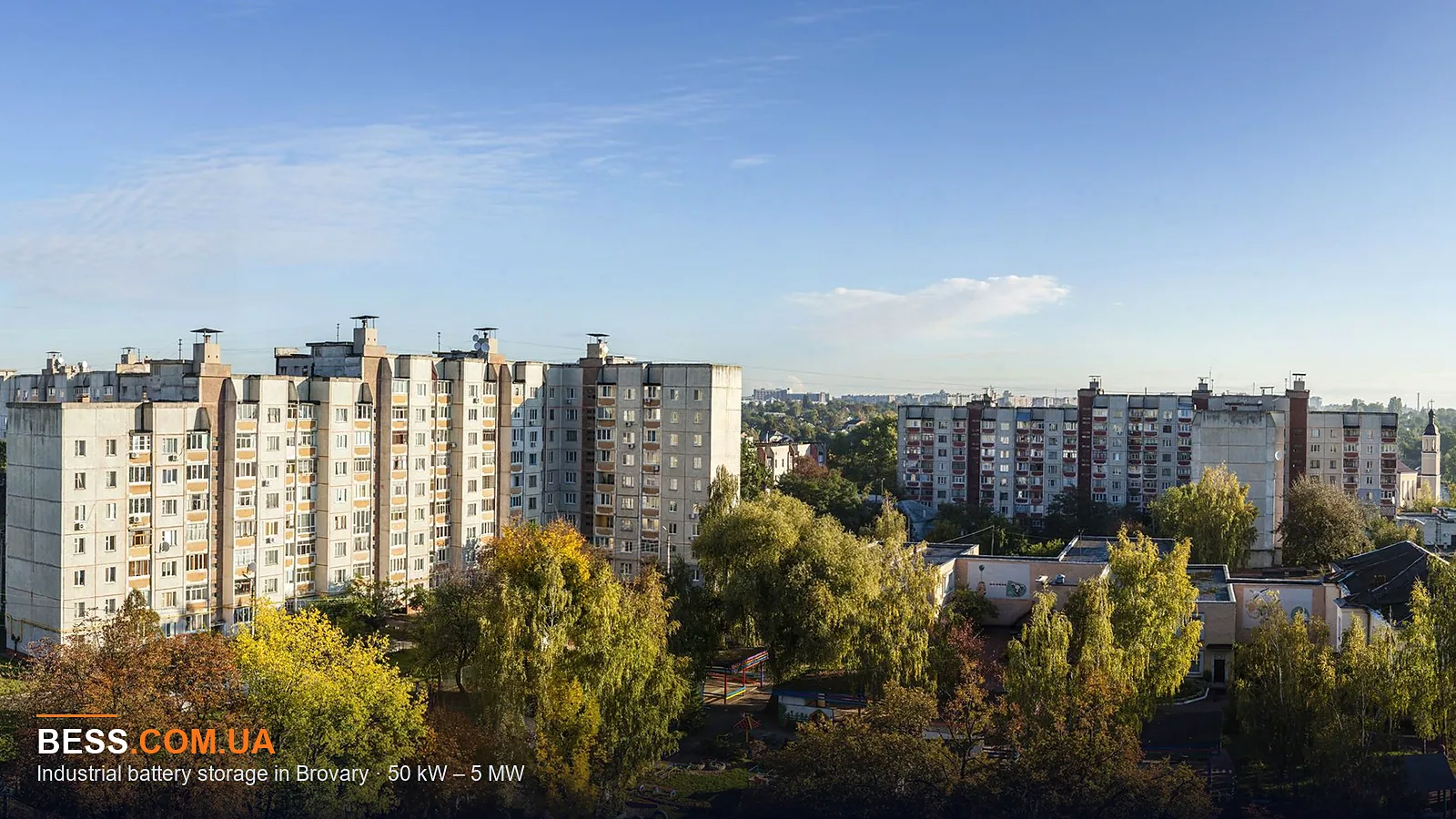
Industrial Battery Energy Storage for Brovary, Kyiv Oblast
Feasibility study for a battery energy storage system (BESS) in Brovary starts with numbers: your 0.4/10 kV load profile, your electricity tariff, and the grid constraints of DTEK Kyiv Regional Grids. Here's the pre-design checklist we run through before proposing a single battery.
Key parameters
1. What to measure on site
We record actual power demand at your transformer substation. For a warehouse complex, that means logging every 15 minutes for at least two weeks — ideally over a month — to catch peak events. Same for food production lines, where cooling and freezing cause sharp load steps.
For steel structures plants, we look at welding equipment and cranes: they create short, high-current spikes. Those peaks are what a BESS can shave, but the exact kW and duration matter. A 50 kW storage unit will not cover a 500 kW crane start.
2. Which documents to pull
Get your electricity supply contract, the latest invoice with the hourly tariff breakdown, and the technical conditions (TU) from DTEK Kyiv Regional Grids. The TU specify your permitted connection capacity and the voltage level — 0.4 kV or 10 kV. That determines the inverter topology and transformer needs.
Also request a single-line diagram of your internal network. If you operate a logistics hub with multiple buildings, we need to know where the storage can connect without overloading existing cables.
3. Grid constraints to verify with DTEK
DTEK Kyiv Regional Grids handles connection applications for industrial sites in Brovary. They will state whether your new storage can export to the grid or only operate behind the meter. Most industrial BESS in the region are installed behind the meter for peak shaving.
Ask DTEK about the allowed short-circuit power at your point of common coupling. At 0.4 kV, a large BESS may require a dedicated transformer; at 10 kV, the connection is simpler. We have seen both cases.
4. The solution: sizing, chemistry, and controls
Once we have the load profile and grid constraints, we size the BESS in kWh and kW. For a typical Brovary warehouse with a 200 kW peak and 20 minutes of duration, a 100 kW / 100 kWh system with LiFePO4 cells and liquid cooling fits. For food production with longer peaks, we step up to 500 kW / 1 MWh.
We use CATL or other Tier-1 LiFePO4 cells, IP55/C4 cabinets, and a BMS that talks to our EMS/SCADA. The control strategy is set to your tariff schedule: charge at night (if you have a two-zone tariff) and discharge during the morning and evening peaks. Payback is typically 5–7 years, but without an hourly load profile, that figure is rough.
5. What we deliver and what we do not
BESS Ukraine Engineering Group supplies industrial energy storage equipment: audit, design, supply, installation, commissioning, and service are organized through verified subcontractors. We handle industrial storage from 50 kW to 5 MW, in 20/40 ft containers if needed. We provide the TU approval process support and guarantee the system meets DTEK's requirements.
We do not install residential systems — that is SolarProm.com.ua. And we will not promise a payback under 4 years if your tariff does not support it. Call us at +380 44 339 50 10 or email engineering@bess.com.ua for a site survey.
Frequently asked questions
How much does a BESS for a warehouse in Brovary cost?
Do I need DTEK approval to install a battery storage?
Can I use a BESS as a backup during power cuts?
What is the typical payback period for an industrial BESS?
What maintenance does a BESS require?
Figures shown are indicative. We supply the equipment and size the system; design, installation and commissioning are arranged through contractors when needed and quoted separately. Exact sizing follows a load-profile analysis.